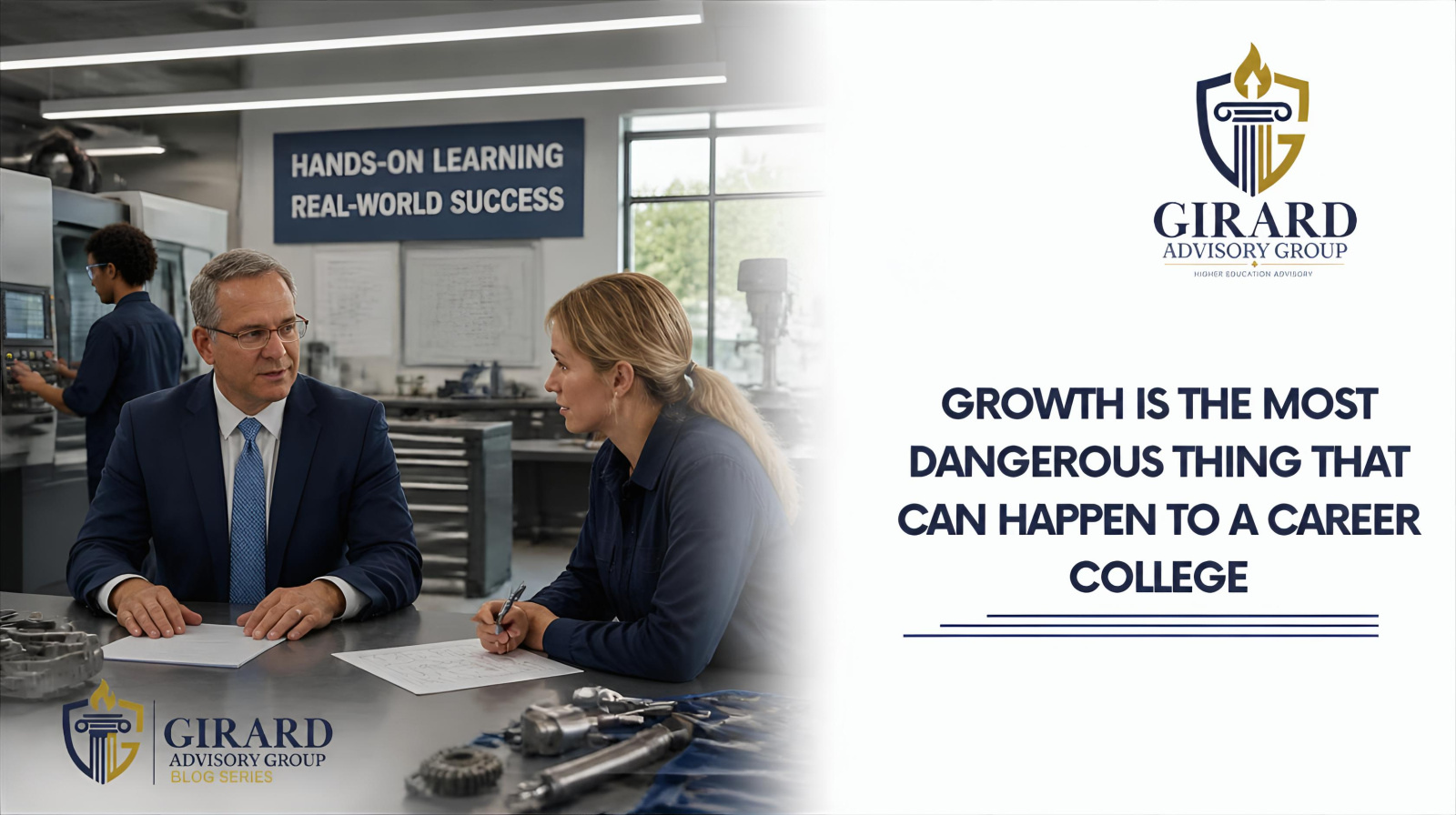
Growth Is the Most Dangerous Thing That Can Happen to a Career College

John P. Girard
Founder, Girard Advisory Group
Enrollment growth exposes every operational weakness an institution has been deferring. Here’s where career colleges break down when volume increases — and how to build operations that scale without losing compliance or quality.
She enrolls in April. She is exactly the student the institution says it exists to serve: working, motivated, first in her family to attempt anything past high school. She signs the enrollment agreement, shakes hands with her admissions rep, and goes home to tell her mother.
She shows up on day one without a complete financial aid package. She sits through an orientation that does not answer the question she actually came with, which is how she is going to pay for childcare on Tuesdays. Her schedule conflicts with the only shift her employer will give her. Nobody calls. By week three she has quietly stopped coming.
She does not appear in the admissions numbers. She appears in the persistence rate six months later, mixed in with forty others, and by then the connection to the thing that actually failed her — a handoff between two departments that nobody owned — is invisible.
That student is what enrollment growth costs when the operations underneath it have not been built to absorb it.
The most dangerous moment in a career college’s life is not when enrollment is declining. It is when enrollment is growing faster than the institution knows how to manage.
Declining enrollment is painful and visible. Everyone can see it, everyone agrees it is a problem, and the organization mobilizes around fixing it. Growing enrollment feels like success — and it is, until the operational infrastructure that was adequate at 400 students starts failing at 600, and the institution is too busy celebrating the growth to notice the cracks forming underneath it.
I have led three campus turnarounds through exactly this kind of growth. One went from 601 students to more than 1,300 in under three years. Another went from 227 to 402. A third went from 64 to 162, and a fourth campus in that same network grew from 50 students to 150, which forced a facility move I ended up designing and building out myself. Across that same period I sat inside more than fourteen re-accreditation cycles, eleven of which closed with no findings.
I want to be clear about why that last number matters here. It is not a credential I am offering for its own sake. It is the reason I know that growth and clean compliance are compatible — and the reason I know how much deliberate work it takes to keep them that way. Every one of those growth curves put pressure somewhere. The difference between the campuses that absorbed it and the ones that did not had almost nothing to do with how fast they grew, and almost everything to do with what was built before the growth arrived.
The specific failures vary. The underlying dynamic is almost always the same: the organization scales its marketing and admissions function without scaling the operations that have to absorb the students those functions produce. The result is a compliance exposure, a retention problem, or both — and by the time leadership recognizes it, the damage is already in the cohort.
One pattern is worth naming before we get into the specifics, because it governs everything else. The further downstream a function sits from admissions, the later the growth damage surfaces and the harder it is to trace back. Financial aid feels the surge in weeks. Student services feels it in a term. Career services does not feel it for a year and a half — which is why career services is where the most expensive version of this problem lives, and the last place anyone looks.
Where career college operations break down during enrollment growth
The enrollment-to-operations handoff
In most career colleges, admissions ends when the student signs the enrollment agreement. What happens next — the financial aid package, the orientation, the schedule, the first day of class — belongs to a different set of people operating under a different set of pressures. When enrollment volume is low, the gaps in that handoff are manageable. When volume spikes, they become a retention problem.
The student I described at the top of this piece is not a hypothetical. She is a composite of dozens of exit interviews, and the thing that consistently strikes me about those conversations is how rarely she blames the school. She assumes the failure was hers.
A better orientation script will not fix this. What fixes it is a documented, accountable handoff process with defined owners, defined timelines, and a mechanism for flagging students who have not completed each step before the start date. In my experience that process is rare, because it requires admissions, student services, and financial aid to agree on who owns what — and those functions have historically operated as separate silos with separate metrics.
Admissions and marketing integrity under volume pressure
This is the failure mode I am asked about least and worry about most, and I say that as someone who spent the back half of my career running marketing and lead generation for a seven-campus network.
When pipeline pressure rises, representation risk rises with it. Not because admissions people are dishonest — the overwhelming majority are not — but because a rep under quota pressure, fielding a question she has not been trained to answer, will improvise. She will round a placement figure up. She will describe a program length in terms of the fastest possible path rather than the typical one. She will say something encouraging about earnings that she believes to be true and cannot document.
Every one of those improvisations is a misrepresentation exposure, and they multiply precisely when volume is highest and supervision is thinnest. What makes this failure mode distinct from the others in this article is its origin: it does not happen downstream of growth, it happens inside the function producing the growth. The department generating the numbers everyone is celebrating is the same department creating the exposure.
The controls are not complicated. Call monitoring at a defined sample rate that scales with volume rather than staying fixed. A single approved source for every outcome, cost, and program-length claim, with a documented review date. Written scripts for the six or seven questions reps get asked that they have not been given an answer to. And a rule I have found useful: if a rep cannot point to where a number came from, the rep does not say the number.
Financial aid compliance under volume pressure
Financial aid is the operational function most likely to generate a regulatory finding when enrollment grows, and it is the one most likely to be understaffed relative to volume. The math is straightforward: an office sized for 400 students does not have the bandwidth to process 600 with the same accuracy and timeliness. Something gets deferred, something gets approximated, something gets done in a way that was fine at lower volume and creates a pattern finding at higher volume.
The specific failure modes I see most often are verification backlogs that push disbursement past the point where students can cover living expenses, satisfactory academic progress determinations that are not being made on the required schedule, and return-of-Title-IV calculations that are correct in individual cases but not tracked systematically enough to catch aggregate patterns before a program review does.
At one campus I led, enrollment climbed nearly eighty percent over four years and financial aid headcount did not move until year three. We caught up. We were fortunate to catch up before anyone else noticed we were behind. That gap between “we are behind” and “someone external has discovered we are behind” is the entire margin an institution is operating on, and it is a narrower margin than most leadership teams assume.
Every institution that has grown through a compliance finding has, in retrospect, a clear moment where volume exceeded capacity and the decision was made — explicitly or by default — not to add resources. That decision always looks cheaper than it is.
Instructor capacity and faculty qualifications
Career college programs run on a tight instructor-to-student ratio, and most programs have a small pool of qualified instructors for any given discipline. When enrollment grows, the scheduling problem compounds quickly: more sections require more instructors, qualified instructors are scarce, and the institution faces a choice between holding enrollment to what the current pool can support or filling sections with instructors who are less experienced, less credentialed, or carrying overloads that affect their effectiveness.
The accreditation dimension of this is underappreciated. Faculty qualifications are a standard at every major accreditor. An institution that grows by adding sections staffed with instructors who do not meet the credential requirements for the courses they teach has created a finding that will surface at the next visit, and “we were growing” does not satisfy the standard.
What this requires is a faculty capacity model updated every enrollment cycle rather than annually. For each program it should show the maximum enrollment the current credentialed pool can support at compliant ratios, the lead time to recruit and credential a new instructor, and the cost of that recruitment relative to the revenue the additional enrollment generates. I have rarely walked into an institution that had one. They tend to discover they needed it while already over-enrolled.
Career services and the delayed placement problem
Here is the one that costs the most and gets caught the latest.
Placement rate is a hard standard. It is reported, it is reviewed at the site visit, and at most accreditors it carries consequences that escalate quickly. It is also, structurally, the metric most exposed to enrollment growth — because the cohort that enrolled during the surge does not reach career services for twelve to eighteen months.
By the time it arrives, several things have happened. The career services team is sized for the cohort that graduated before the surge. The employer relationships that supported the old graduation volume have not been expanded, because nobody asked them to be. And the leadership attention that was focused on the growth eighteen months ago has moved on to something else. A team built to place eighty graduates a year receives a hundred and forty, works as hard as it has ever worked, and posts a lower rate than it did the year before.
Then the accreditor asks why placement declined in the same period enrollment grew, and the honest answer — that the institution grew the front of the funnel without growing the back of it — is not an answer anyone wants to give at a site visit.
The discipline here is to treat career services capacity as a function of projected graduates, not current graduates, and to expand employer relationships on the same eighteen-month lead time the cohort itself is running on. Employer development is slow work. It cannot be compressed into the term where you suddenly need it.
Space, equipment, and capital planning
Physical capacity is the most visible operational constraint, and the one institutions manage most proactively — though the management is often reactive rather than planned. A program adds a section, discovers the lab cannot support the additional students at the required equipment-to-student ratio, and improvises a solution that works for one term and creates a scheduling problem for the next three.
I lived the planned version of this. One campus I oversaw tripled from 50 students to 150, and it became clear well before we hit the ceiling that the existing space could not support the program at compliant ratios. We moved. I designed and built out the new facility. That was expensive and disruptive and far better than the alternative, which was discovering the constraint in the middle of a term.
The less visible version of this problem is equipment maintenance and replacement. Career education programs run equipment hard. When enrollment grows, utilization increases, maintenance intervals compress, and equipment scheduled for replacement in two years needs replacing in one. A capital plan built on steady-state enrollment does not survive growth enrollment, and equipment failures mid-term are both an operational problem and a student experience problem.
The compliance calendar under operational stress
Every career college operates under a compliance calendar that is largely invisible until something on it is missed. Accreditation reporting deadlines. State authorization renewals. Financial aid program reviews. Gainful employment disclosures. Satisfactory academic progress determinations. Clock-hour attendance reconciliations. Each has a deadline, a responsible owner, and a consequence for non-compliance ranging from corrective action to program suspension.
At steady state, the calendar gets managed. Under stress from enrollment growth, the calendar is the first thing to slip — because its consequences are deferred and the immediate pressure is on the problems that are visible right now. An institution that misses a reporting deadline because it was managing a financial aid backlog has traded a manageable operational problem for a compliance problem that is harder to resolve and more expensive in every dimension.
What scalable career college operations actually look like
Each failure mode above has a corresponding discipline. Here is the mapping in the form I would use if I were building the dashboard myself:
| Failure mode | Leading indicator to track | Suggested owner | Review cadence |
|---|---|---|---|
| Enrollment-to-operations handoff | % of starts with all pre-start steps complete 7 days out | Student services director | Weekly during surge |
| Admissions representation risk | % of calls monitored; # of claims without a documented source | Compliance coordinator | Weekly |
| Financial aid capacity | Verification backlog age; SAP determinations past due | Financial aid director | Weekly |
| Faculty qualifications | Enrollment vs. credentialed-instructor capacity, by program | Academic dean | Every enrollment cycle |
| Career services capacity | Projected graduates vs. active employer partners | Career services director | Monthly |
| Space and equipment | Equipment-to-student ratio by lab; open maintenance tickets | Campus operations | Monthly |
| Compliance calendar | Days to next deadline vs. required prep lead time | Single named owner | Monthly |
Four disciplines make that table possible.
Process documentation at the task level
The most reliable predictor I have found of whether an institution can scale without breaking is whether its core processes are documented at the task level — not the policy level. Every institution has policies. Task-level means: who does what, in what sequence, by what deadline, in what system, and what happens when a step is missed. Institutions with that documentation can onboard staff quickly and isolate where a process is breaking when volume rises. Institutions without it depend on institutional memory held by specific individuals, which makes every departure an operational risk and every growth surge a repeat of the last learning curve. It is unglamorous work and it is not optional for an institution that intends to grow.
Metrics that lead rather than lag
Retention rate, graduation rate, and placement rate matter, but they describe six months ago. By the time a retention problem appears in the retention rate, the students who generated it are gone. The leading indicators in the table above are not difficult to track. They require an owner and a cadence — weekly during enrollment surges, not monthly. Catching operational problems early enough to fix them is mostly a question of whether leadership has decided that operational metrics deserve the same standing meeting as enrollment metrics.
Staffing tied to projections, not actuals
The standard model is reactive: hire when the pain is acute, cut when enrollment declines. That is rational on a short-term cost basis and damaging operationally, because the lag between recognizing a need and having a trained, effective person in the seat runs 60 to 90 days. The institution is therefore understaffed through at least two months of every growth surge. Tying staffing triggers to pipeline projections instead requires a reliable projection, which requires admissions and operations to share data most institutions have never connected — and it requires leadership to authorize hiring before the revenue justifying it has been recognized. That is a harder organizational conversation than it sounds.
A compliance calendar with a single owner
Every deadline on a master calendar with a responsible owner, a preparation lead time, and a review checkpoint. This is not a sophisticated system; a well-maintained spreadsheet is sufficient. What makes it work is the discipline to treat compliance deadlines with the same urgency as enrollment deadlines, and to protect the time of the people responsible for meeting them when operational stress is highest. Where I have seen this managed well, one person — a compliance coordinator, a VP of operations, a COO — owns the calendar and escalates when preparation falls behind. Where it is managed poorly, responsibility is distributed across functions without a single owner, which makes every deadline someone’s second priority.
How to conduct a career college operational capacity diagnostic
Before investing in operational infrastructure, an institution needs to know where its current ceiling is. A capacity diagnostic answers that question systematically rather than waiting for the ceiling to become visible through a compliance finding or a retention collapse.
The diagnostic I use covers six areas, each evaluated against the institution’s current enrollment and its projected enrollment twelve months out.
Enrollment-to-start handoff. What percentage of enrolled students complete all pre-start steps — financial aid package, schedule, orientation — at least seven days before their start date? If the answer is below 85%, the handoff process has a gap that will show up in first-term attrition.
Financial aid processing capacity. What is the current verification backlog, and what is the oldest item in it? What is the current SAP determination schedule, and is it being met? At what enrollment level does the current staff headcount become unable to meet federal processing timelines?
Faculty credentialing headroom. For each program, what is the maximum enrollment the current credentialed instructor pool can support at compliant ratios? How many programs are within one instructor departure of being unable to staff a section?
Career services capacity. What is the current ratio of projected graduates to active employer partners? What was the placement rate in the most recent reporting period, and what would it be if the cohort were 20% larger with no change in employer relationships?
Compliance calendar coverage. Is there a master calendar with every deadline, a named owner for each, and a preparation lead time? When was it last reviewed? Are there any deadlines in the next six months where the responsible owner is also managing a significant operational workload?
Space and equipment utilization. What is the current equipment-to-student ratio in each lab, and what is the accreditor’s required minimum? What is the age and maintenance status of the highest-utilization equipment? At what enrollment level does the current facility become non-compliant?
The output of this diagnostic is not a report — it is a ranked list of the constraints that will become findings or retention losses first, with a sequenced remediation plan attached. That sequencing matters. An institution with limited resources cannot fix everything at once, and the order in which constraints are addressed determines whether the growth is absorbed or whether it produces a crisis.
The growth-quality tradeoff in career college operations is a choice
There is a version of this conversation that frames operational investment as a constraint on growth: building infrastructure before you need it costs money that could be spent on marketing, so grow first and fix operations later. I have heard that argument made sincerely by people who believed it, and I have seen where it leads.
It leads to a retention problem that erodes the enrollment gains. It leads to a compliance finding that consumes leadership attention and legal resources for eighteen months. It leads to a site visit where the accreditor asks why the graduation rate declined in the same year enrollment grew, and the institution does not have a clean answer.
The real tradeoff is not between growth and operational investment. It is between growth now and sustainable growth over time. Institutions that build the infrastructure before they need it grow more slowly in the short term and more durably over the long term. Institutions that defer it grow faster and then stop, usually at a moment not of their choosing.
Which brings me back to the student in April.
Nothing in this article would have been hard to build before she enrolled. A handoff checklist with an owner. A flag when her aid package was still incomplete at seven days out. Someone whose job it was to call her in week two. None of that is expensive. It is only expensive to build after you have already lost her, and after you have lost the forty students behind her, and after someone external has started asking why.
Where to start
If your institution is growing and you are not certain your operations can absorb the volume, a capacity diagnostic is the place to begin. What that involves: a structured review of your enrollment-to-start handoff, financial aid processing capacity against projected volume, faculty credentialing headroom by program, career services capacity against projected graduates, and your compliance calendar and its ownership. It typically runs two to three weeks. What you get is a written assessment of where your current infrastructure tops out, ranked by how quickly each constraint becomes a finding or a retention loss, with a sequenced remediation plan attached.
If you would rather start on your own, I have put together a ten-question self-assessment — the questions a campus president should be able to answer about their own capacity before the next start date. If you cannot answer three or more of them, you already know what the diagnostic would tell you. Let’s talk.
Frequently Asked Questions: Career College Operations and Enrollment Growth
Why do career college operations break down when enrollment grows?
Institutions typically scale marketing and admissions without proportionally scaling the operations that absorb the students those functions produce. Financial aid, student services, scheduling, and compliance functions adequate at steady state become bottlenecks at higher volume, and the failures surface months later in retention rates, compliance findings, and accreditation reviews.
What is the most common operational failure when career college enrollment increases?
The enrollment-to-operations handoff. When a student signs an enrollment agreement she moves from admissions to financial aid, student services, and scheduling — functions operating under different pressures, often without a documented handoff. Students who fall through it do not complain; they stop attending by week three, and the cause is invisible by the time it appears in the persistence rate.
How does enrollment growth create financial aid compliance risk?
An office sized for 400 students cannot process 600 with the same accuracy and timeliness. The recurring failure modes are verification backlogs that delay disbursement, satisfactory academic progress determinations that fall behind schedule, and return-of-Title-IV calculations that are correct individually but not tracked systematically enough to reveal aggregate patterns before a program review does.
Does enrollment growth increase misrepresentation risk in admissions?
Yes, and this exposure is distinct because it originates inside the function producing the growth rather than downstream of it. Under pipeline pressure, reps improvise on outcomes, program length, and cost — usually in good faith. The controls are call monitoring at a sample rate that scales with volume, a single documented source for every outcome and cost claim, and scripted answers to the questions reps are otherwise left to invent.
Why does enrollment growth hurt placement rates?
Because the surge cohort does not reach career services for twelve to eighteen months, by which point the team is still sized for the previous graduating class and employer relationships have not been expanded. A team built to place eighty graduates receives a hundred and forty and posts a lower rate despite working harder. Career services capacity has to be planned against projected graduates, and employer development started on the same lead time.
What operational metrics should career colleges track during enrollment growth?
Leading indicators rather than lagging ones. Percentage of students with a complete financial aid package before the start date, orientation attendance, week-two attendance completion, verification backlog age, credentialed-instructor capacity by program, projected graduates against active employer partners, and open equipment maintenance tickets. Each needs a named owner and a weekly review cadence during surges.
How should career colleges staff for enrollment growth without over-hiring?
Tie staffing triggers to enrollment projections rather than actuals. Reactive hiring creates a 60-to-90-day lag between recognizing the need and having an effective employee in the seat, which guarantees understaffing through every surge. Projection-based triggers require admissions and operations to share pipeline data, and require leadership to authorize hiring before the revenue justifying it is recognized.
What is the relationship between operational infrastructure and accreditation risk?
Accreditors evaluate operations through standards they already have: faculty qualifications, timely financial aid determinations, program outcomes assessment, placement, and genuine employer engagement in advisory committees. Growth without proportional operational investment produces findings against those standards. An institution with task-level documentation, a managed compliance calendar, and leading-indicator metrics has a clean story regardless of enrollment trajectory.
How do I know if my institution is already over-extended?
Three signals show up first: a financial aid verification backlog whose oldest item is aging rather than holding steady, at least one program where the next section cannot be staffed by a currently credentialed instructor, and a compliance deadline in the last twelve months that was met late or met by heroics. Any one of those means the infrastructure is at its ceiling. All three mean it has been exceeded and the consequences are already in the cohort.
Is it possible to grow enrollment quickly without sacrificing operational quality?
Yes — it requires investing in infrastructure before the growth rather than after. I have taken campuses through enrollment increases of more than 100 percent while maintaining clean accreditation outcomes, and in every case the difference was work done before the growth arrived, not remediation after. The institutions that defer that investment grow faster in the short term and then stop, usually because a compliance finding or a retention collapse has made the operational debt visible.
Explore Topics
Written by
John P. Girard
John P. Girard is the founder of Girard Advisory Group and a thirty-year veteran of career and proprietary higher education, with hands-on leadership across enrollment growth, campus operations, accreditation and compliance, curriculum development, brand and marketing, and P&L management. Over three decades he has held roles spanning Campus Director, Campus President, Regional Campus Director, and National Director of Marketing & Digital Media Brand Management, leading multi-campus organizations through growth, accreditation, and operational turnarounds. That range — from the admissions floor to the boardroom — is what shapes his advisory approach: strategy that has to hold up in daily campus operations, not just on a slide. John holds a Master's degree in Teacher Education from the University at Albany, SUNY, and has served on the Board of the Ohio-Michigan Association of Career Colleges and Schools.