

The CARING+ Framework
CARING+ is a student engagement framework for career colleges built on five observable conditions that determine whether a student persists to graduation. Each condition is a belief a student either holds or does not hold about their relationship with the campus. None of the five is sufficient alone. Together, they are predictive.
Developed collaboratively at the Albany campus of Bryant & Stratton College by John P. Girard, Mike Gutierrez, and Gina Cassidy.
What CARING+ is — and what it is not
CARING+ is not a satisfaction survey. It is not a set of service standards. It is not a checklist of programs to add. It is a diagnostic model: a way of identifying which of five specific conditions is absent on a given campus, and therefore which intervention is most likely to move persistence.
The five conditions — I Matter, I Belong, I Trust, I Grow, I Can Do — are stated in the student's voice deliberately. Each one is a belief the student either holds or does not hold. The campus cannot manufacture the belief directly; it can only create the conditions under which the belief becomes possible. That distinction matters for implementation: the question is never "did we run the program?" It is "does the student hold the belief?"
The "+" in CARING+ represents the reciprocal obligation. The model works in both directions: the campus creates conditions for students, and the firm applies the same five conditions to its client relationships. A campus that experiences what it feels like to matter, to belong, to trust, to grow, and to believe it can succeed — in a consulting engagement — is better positioned to create those conditions for its own students.
I Matter.
The student believes the campus sees them as an individual, not a number.
Mattering is the foundational condition. A student who does not believe they are seen as a person — by their instructor, their advisor, the front desk — will not invest in the institution. Mattering is not warmth for its own sake; it is the precondition for every other condition in the model. When a campus creates it, students bring problems forward early. When it is absent, students disappear quietly.
Read: I Matter — Being Seen Is Not Enough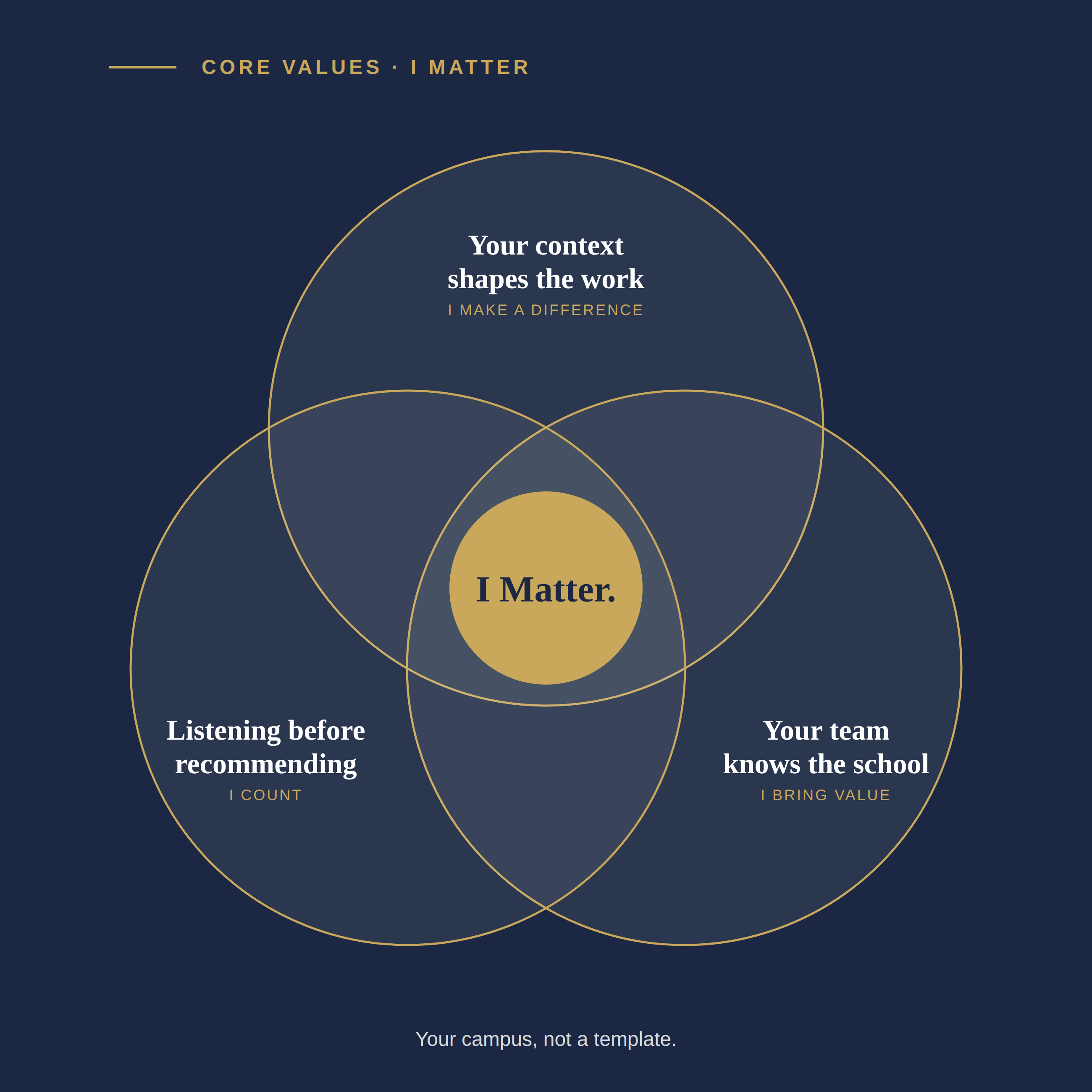
What you can observe when this condition is present
Staff know students by name and program. Advisors reference prior conversations. Problems surface before they become withdrawals.
I Belong.
The student feels connected to peers, staff, and the institution itself.
Belonging is relational. It is built through repeated, low-stakes interactions — a peer who remembers your name, a staff member who notices your absence, a classroom culture where asking a question is safe. Career college students often carry significant life complexity outside the building. Belonging is what makes the campus feel worth returning to when that complexity gets heavy.
Read: I Belong — Who Notices When a Student Is Gone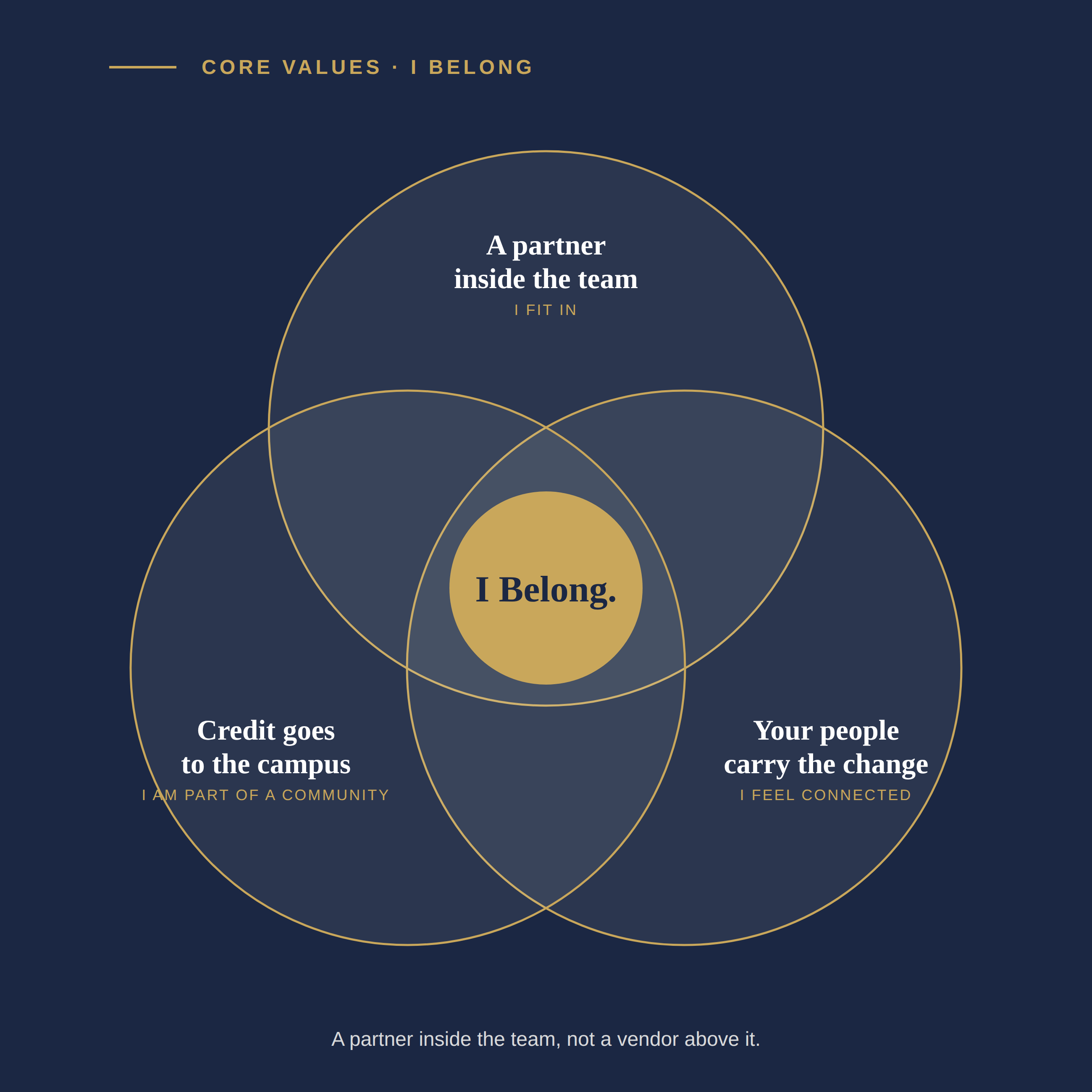
What you can observe when this condition is present
Absence is noticed and followed up within 24 hours. Peer cohorts are deliberately built. Students describe the campus as "their place."
I Trust.
The student trusts the institution to be honest, consistent, and competent.
Trust is earned through alignment between what the campus says and what it does. It is damaged faster than it is built. A student who discovers that the job placement rate on the website does not match what graduates actually experience loses trust in everything else the campus has told them. Conversely, a campus that delivers hard news early — about program difficulty, about financial aid limits, about realistic outcomes — builds the kind of trust that survives setbacks.
Read: I Trust — Students Are Watching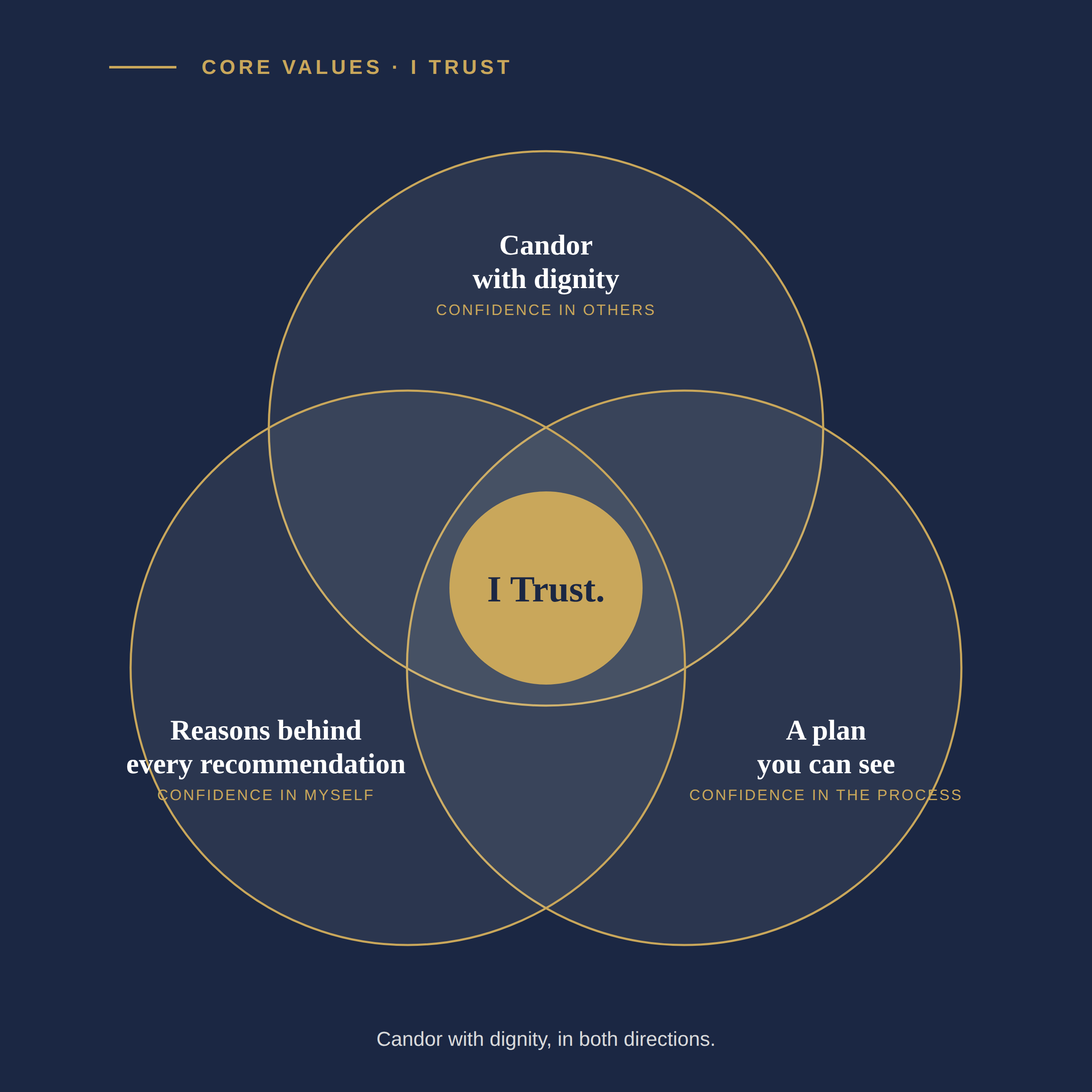
What you can observe when this condition is present
Program pages match public records. Hard news is delivered early and directly. Policies are applied consistently across students.
I Grow.
The student can see their own progress and believes the trajectory continues.
Growth is visible progress. Students who cannot see themselves improving — in skill, in knowledge, in professional identity — lose the motivation to continue. Career college students often enter with significant self-doubt about their academic capability. The campus's job is to make growth legible: through feedback that is specific and timely, through milestones that are celebrated, through instructors who name what a student has learned, not just what they still need to do.
Read: I Grow — Why Students Have to See It to Believe It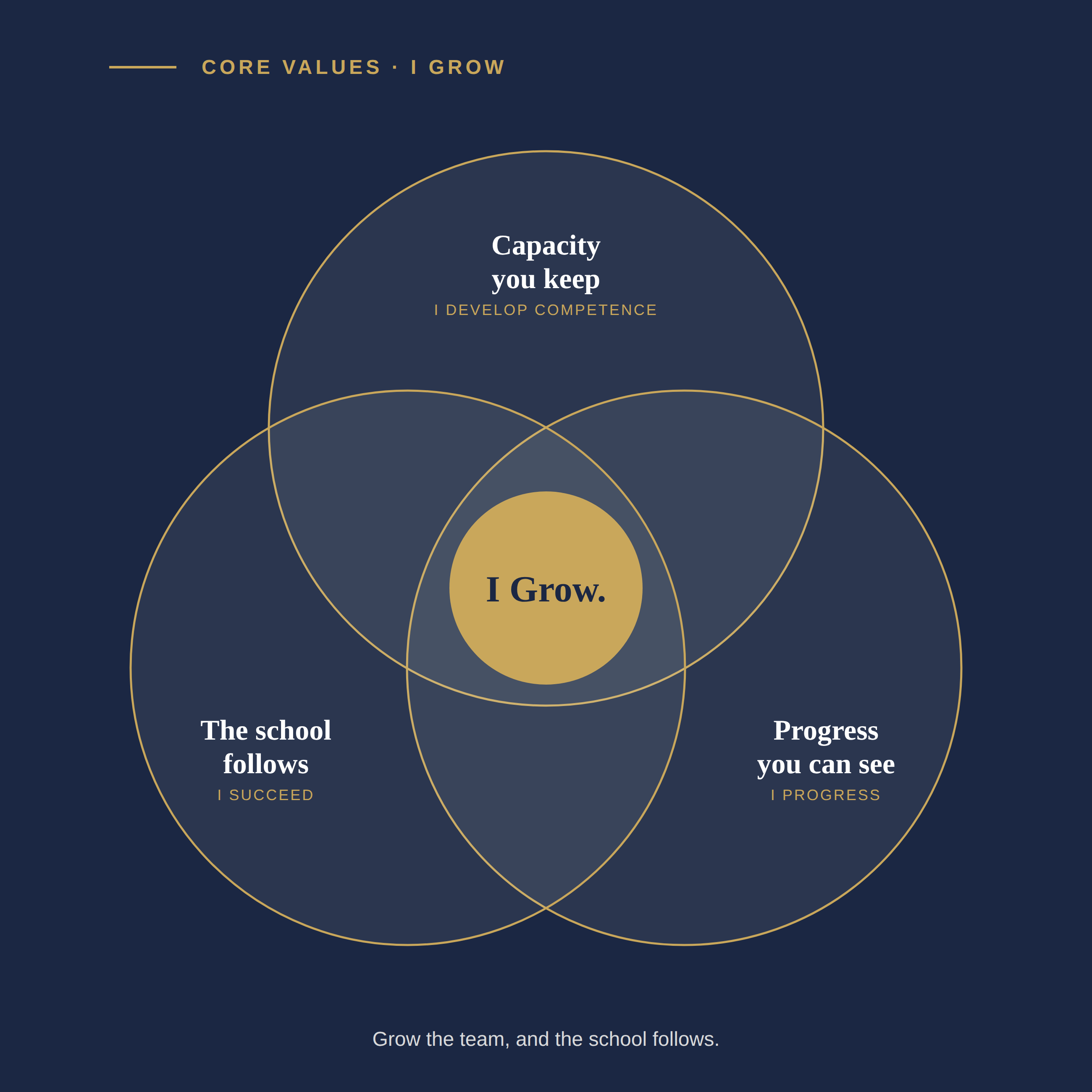
What you can observe when this condition is present
Feedback is specific and tied to observable skill. Milestones are marked. Students can articulate what they have learned since they started.
I Can Do.
The student believes they are capable of completing the program and succeeding in the career.
Self-efficacy — the belief that one can do the work — is the condition that converts all the others into persistence. A student can matter, belong, trust, and see growth, and still withdraw if they do not believe they are capable of finishing. Self-efficacy is built through mastery experiences: small, real wins that the student earned themselves. It is not built through encouragement alone. The campus's job is to sequence early work so that students experience success before they encounter the hardest material.
Read: I Can Do — Students Decide They Can Finish Before They Finish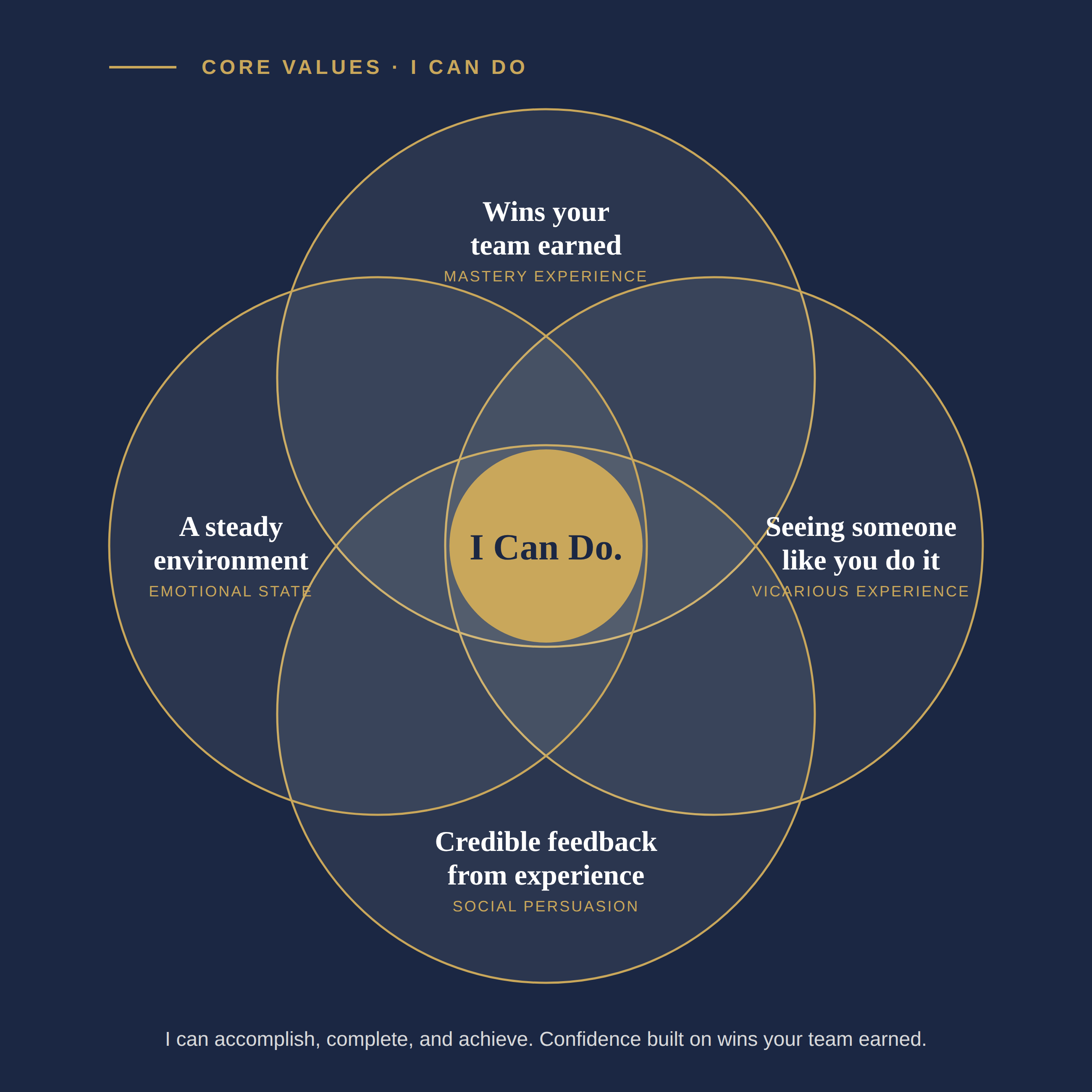
What you can observe when this condition is present
Early coursework is sequenced to produce completed wins. Students describe themselves as capable. Withdrawal conversations reveal academic confidence, not just life circumstances.
The "+" is not decoration
The plus sign in CARING+ represents a commitment that runs in both directions. The five conditions are not only what a campus owes its students — they are what Girard Advisory Group owes its clients. Every engagement is designed so that the campus team experiences what it means to matter, to belong, to trust the process, to see their own growth, and to believe they can do the work.
A campus that has experienced those conditions firsthand is not just implementing a framework. It is extending something it has already lived.
Five questions, in the student's voice
The CARING+ diagnostic instrument asks one question per condition, stated in the student's own voice. Asked every term, these five questions tell a campus exactly where it stands on each condition — and which one to address first.
None of them requires new budget. All of them require the campus to decide that a student's belief about their own capability is an outcome the institution is responsible for.
Download the diagnostic instrument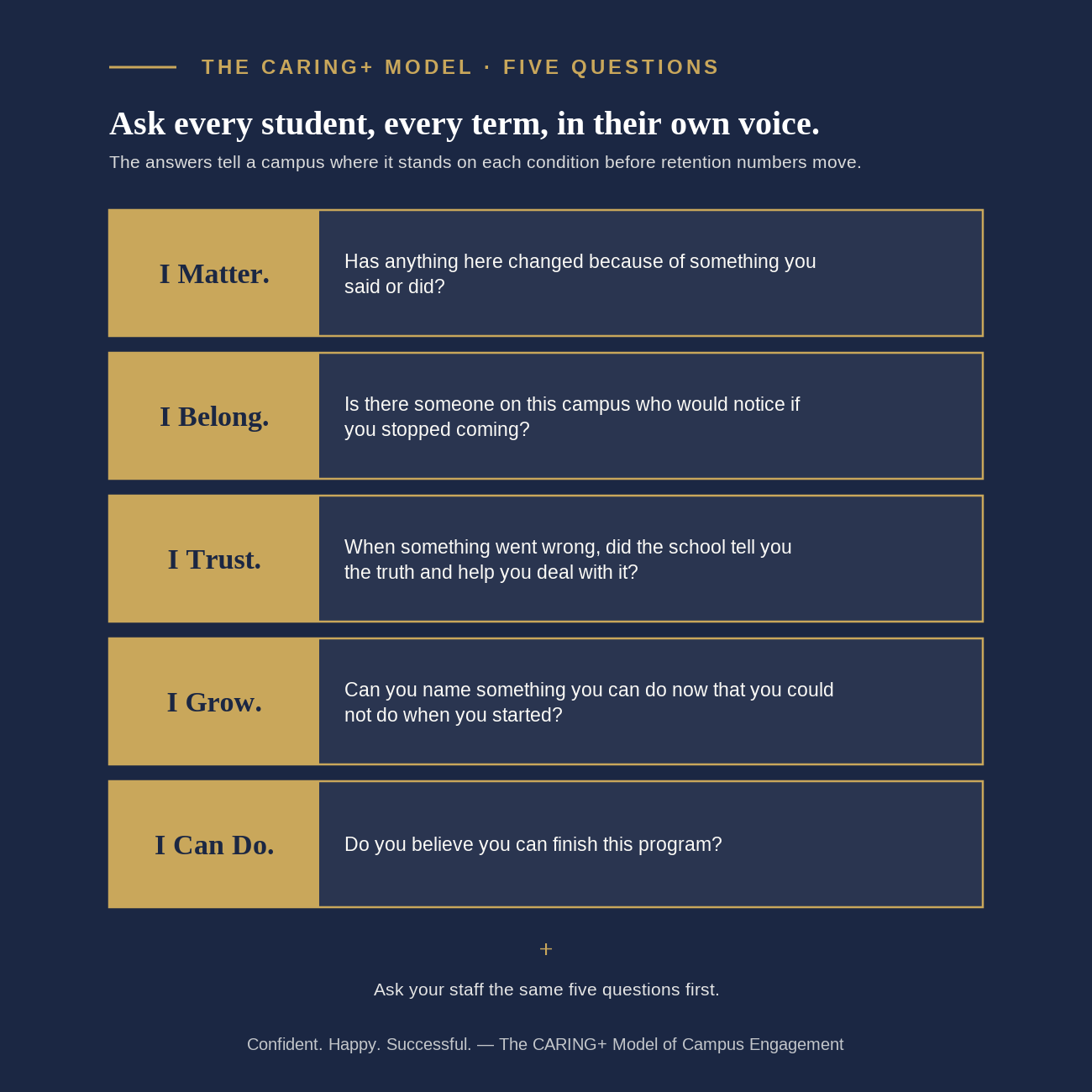
Where this came from
CARING+ was developed at the Albany campus of Bryant & Stratton College, where John P. Girard served as Campus President. The framework emerged from a practical problem: the campus had strong staff who cared about students, but no shared language for what "caring" actually looked like in observable behavior — and no way to diagnose which specific condition was missing when a student withdrew.
The model was built collaboratively with Mike Gutierrez and Gina Cassidy. It was tested against real withdrawal patterns, refined through staff development, and eventually embedded in the campus's operating rhythm. The campus that developed it became one of the highest-performing in the Bryant & Stratton network on persistence and graduation metrics.
The CARING+ Pulse
The CARING+ Pulse is a four-page printable instrument that measures a campus against all six CARING+ statements — once from students and once from staff, so you can see the gap between what staff believe is happening and what students actually experience.
The student form asks six questions on a four-point scale with optional follow-ups and one open question. The staff form asks the same six questions translated for staff and is read first. The scoring guide calculates each condition as the percentage answering Yes or Mostly, with 85% and 70% thresholds and a staff-versus-student comparison. The term report gives one page per program with six bars against the 70% line, plus what you heard, what changed, what didn't, and next term's three practices with owners.
Recommended cadence: before term, week 3, midterm, and end of term.
Download the CARING+ Pulse (PDF)
Student pulse, staff pulse, scoring guide, and term report — four pages, print-ready.
Download the CARING+ PulseExplore the full CARING+ series
Each of the five conditions is explored in depth in the Insights series — with the research behind it, the observable behaviors that signal its presence or absence, and the specific interventions that build it.