Students Decide They Can Finish Before They Finish

John P. Girard
Founder, Girard Advisory Group
A student’s lasting experience of a school is a belief about their own capability. This is the first in a series on the five conditions of the CARING+ Model — starting with the one the other four exist to serve.
A student’s lasting experience of a school is a belief about their own capability. That is the premise of the CARING+ Model, and its five statements — I matter, I belong, I trust, I grow, I can do — describe the conditions a campus creates, or fails to create, in every transaction.
This series takes the statements one at a time and asks a practical question of each: what does a campus actually do to produce this condition, inside the classroom and outside it? I am starting with the last statement, because it is the one the other four exist to serve.
“I can do” means I can accomplish, complete, and achieve. Notice the middle word. It is not “I can start.” Career and technical colleges enroll many students whose history with education is a history of things begun and not finished, and for those students the belief that they can complete something is not a given. It has to be built. The good news is that we know how it gets built, and most of the levers are already in the hands of the people on campus.
Belief Comes Before Results
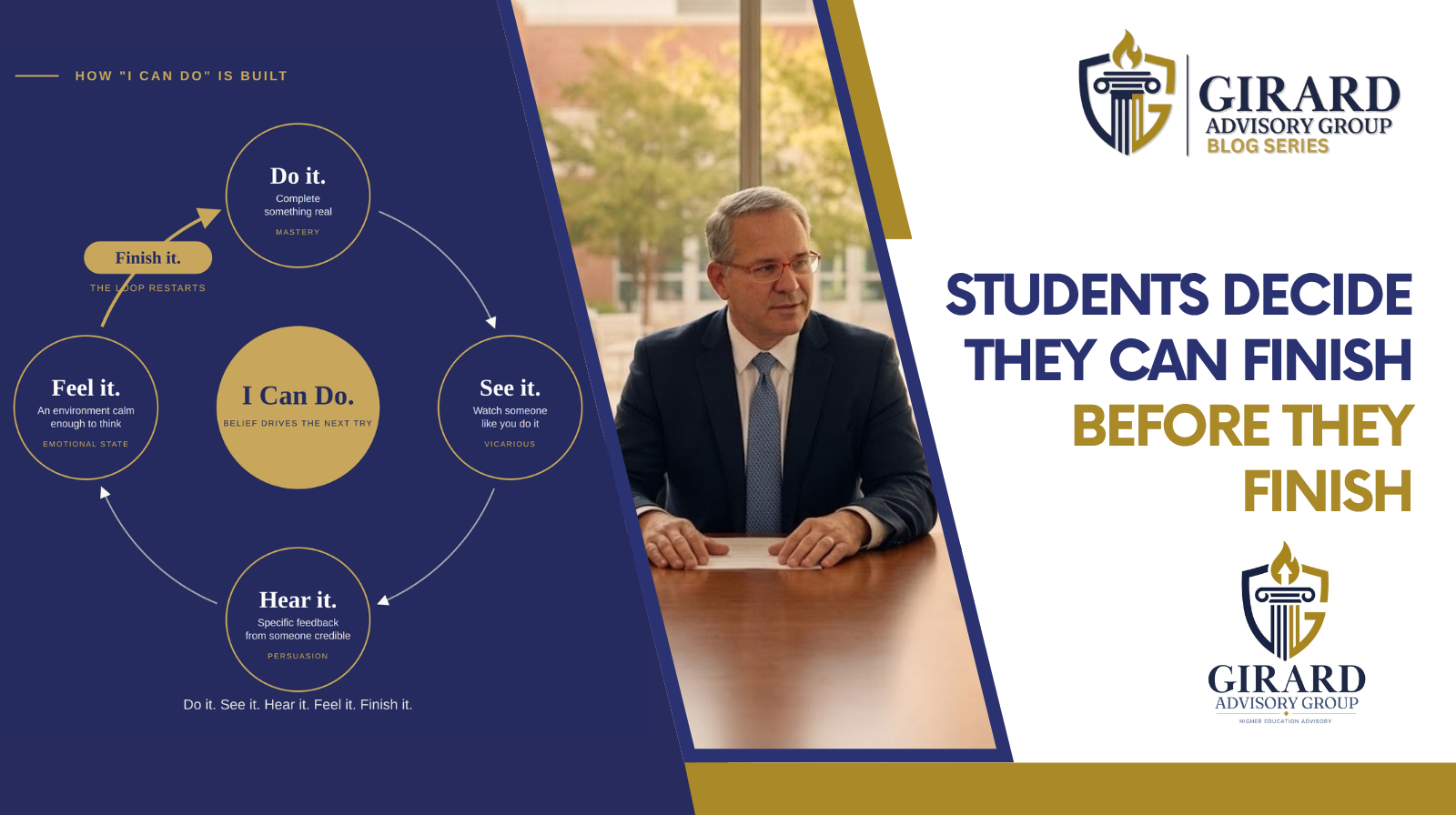
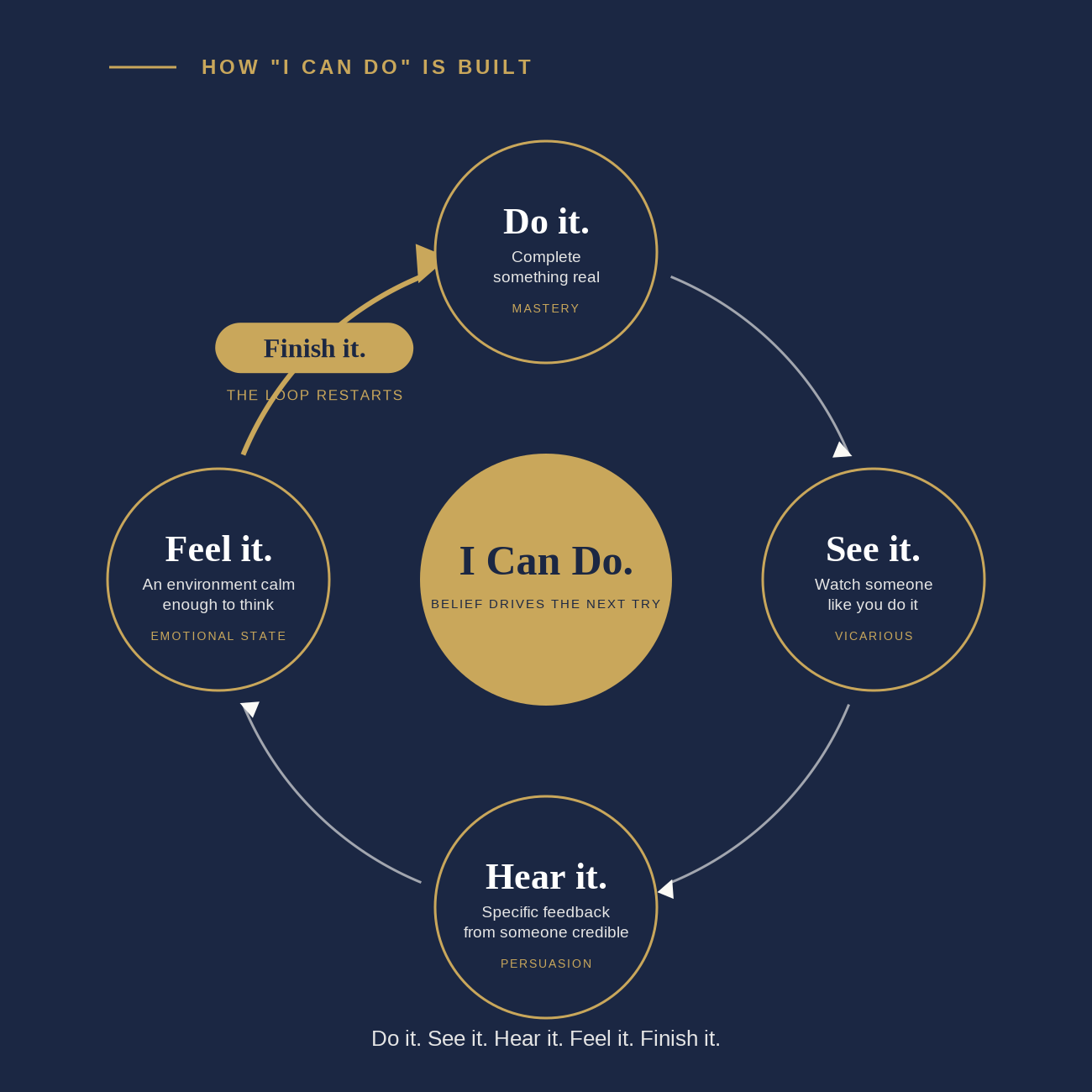
Psychologists call the belief in one’s own capability to carry out a task self-efficacy, and the research on it is among the most durable in education. Albert Bandura, who defined the concept, identified four sources from which it grows:
Mastery experiences. Successfully doing the thing. This is the strongest source by a wide margin. Nothing persuades a person that they can do something like having done it.
Vicarious experience. Watching someone like you do it. The more the model resembles the observer — same background, same starting point, same doubts — the stronger the effect.
Verbal persuasion. Being told, credibly, that you can. The word that matters is credibly. Encouragement from someone who has not done the work carries little weight; specific feedback from someone who has carries a great deal.
Physiological and emotional state. How the body and mind feel while attempting the task. Anxiety, exhaustion, and threat all read as evidence of incapability. A calm, predictable environment reads as the opposite.
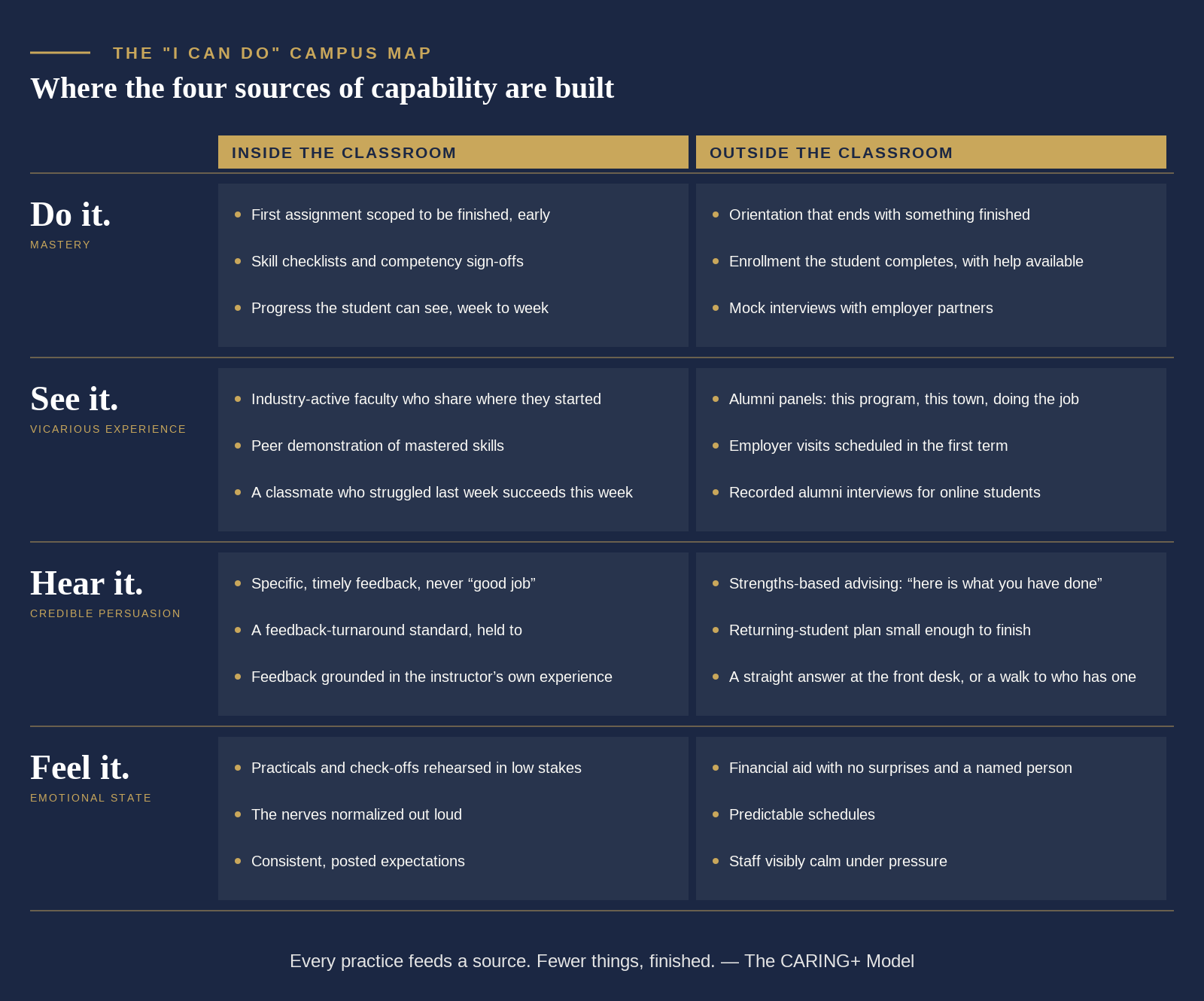
Every practice that follows maps onto one of these four. That is deliberate. If a campus wants to produce the condition of “I can do,” it should be able to say which source each of its practices feeds.
Inside the Classroom
Faculty are the highest-leverage point in the model, and the classroom is where the four sources can be engineered most directly.
Sequence the first weeks for completion. The first assignment a student turns in, graded and returned, is the first mastery experience of the term. Design it to be finished. That does not mean easy; it means scoped so that a student who does the work completes it, and completes it early enough to feel the completion before the harder material arrives. A course front-loaded with its most demanding content asks students to believe in themselves before giving them any reason to.
Make progress visible. Students cannot draw confidence from progress they cannot see. Skill checklists, competency sign-offs, and lab logs that show what has been mastered do more for self-efficacy than a single grade at midterm. In technical programs, this is easy to make concrete: the student who could not run a procedure in week two and can run it in week five has evidence, and the instructor’s job is to make sure they notice it.
Put industry-active faculty in front of students. This is the vicarious source. A student learning from someone who does the work for a living, and who came from a similar place, is watching proof that the path is real. “Learn from a pro to be a pro” is a marketing line, but it is also a self-efficacy mechanism. Faculty who share their own starting point — the first job, the first failure, what they did not know at the beginning — are doing more for belief than any motivational speech.
Give feedback that is specific and timely. “Good job” does nothing. “Your intubation technique was correct; your sequencing was off, and here is the order” does a great deal, especially when it comes from someone whose judgment the student has reason to trust. Feedback returned two weeks after the work is too late to shape the next attempt. The CARING+ standard is purposeful action at the moment it matters, and feedback is where that standard is tested daily.
Rehearse the hard moment before it happens. Practical exams, clinical rotations, and portfolio reviews are where anxiety converts into failure. Students who have run through the format in low-stakes conditions arrive with a lower threat response and perform closer to their actual ability. Instructors who normalize the nerves — “everyone feels this on the first check-off” — are managing the fourth source directly.
Structure peer work so students see each other succeed. Student-to-student interaction is one of the six lenses of the model for a reason. When a student watches a classmate who struggled last week demonstrate a skill this week, that is vicarious experience from the closest possible model. Pairing, peer teaching, and public demonstration of mastered skills all feed it.
Outside the Classroom
Most of a student’s week happens outside instruction, and most of the transactions that shape “I can do” happen there too. Every department owns a piece of it.
Admissions and orientation. The first mastery experience is not academic. It is completing enrollment: the paperwork, the financial aid steps, the schedule, the first day navigated without getting lost. Students who experience enrollment as confusing and rescued-by-staff learn that they need rescuing. Students who experience it as a sequence of things they completed, with help available but not required, arrive on day one with a small deposit of evidence. Orientation should end with something finished, not something explained.
Financial aid. No office generates more anxiety, and anxiety is the enemy of the fourth source. A student who does not understand their funding, or who receives a surprise, is in a threat state that follows them into every classroom. Predictability is the intervention: clear timelines, no surprises, and a named person to call. This is not a service function; it is a self-efficacy function.
Advising and the returning student. The student who comes back after weeks away is the hardest case in the model, and it is the purest “I can do” case there is. They are asking, without saying it, whether completion is still possible for someone like them. The advisor’s job is to answer with a plan small enough to finish: not “here is everything you owe,” but “here is the first thing, and here is when we check in.” Deficit-based advising (“you are behind”) feeds the belief the student already has. Strengths-based advising (“here is what you have already completed”) feeds the other one.
Career services. Mock interviews, résumé reviews, and employer visits are mastery experiences dressed as preparation. A student who has done a practice interview with an employer partner and received specific feedback walks into the real one with evidence. Alumni panels are vicarious experience at its strongest: graduates from this program, from this town, doing the job. Career services should be scheduling these from the first term, not the last.
The front desk and every transaction. The CARING+ model holds that every campus transaction shapes the five conditions, and “I can do” is no exception. A student who cannot get a straight answer about a schedule change, or who is bounced between offices, is accumulating evidence that the institution is harder to navigate than they are capable of managing. Staff who resolve the issue, or who walk the student to the person who can, are doing the opposite.
The environment itself. Physical and emotional predictability lowers the threat response. Consistent schedules, posted expectations, quiet places to work, and staff who are visibly calm under pressure all contribute. Campuses in turnaround often underestimate how much staff anxiety is visible to students, and how much it transfers.
Fewer Things, Finished
One principle runs through all of this. Self-efficacy is built by completing, and campuses often undermine it by starting too much. Programs with more assignments than a working adult can finish, initiatives that launch and vanish, advising plans with fifteen action items: each of these teaches the student that beginning things is normal and finishing them is not.
The corrective is discipline about volume. Three assignments completed well beat ten submitted late. One advising commitment kept beats a plan that was never realistic. When a campus finds itself asking why students do not persist, it is worth asking whether the institution itself models completion.
What Undermines the Condition
It is worth naming the practices that erode “I can do,” because most of them are done with good intentions.
Rescuing. Staff who complete tasks for students, rather than alongside them, remove the mastery experience. Help should reduce the barrier, not the work.
Empty praise. Encouragement without specificity or credibility reads as pity. Students know the difference.
Late feedback. Assessment returned after the next attempt has already happened is information without use.
Surprises. Any unexpected consequence — a hold, a fee, a schedule change, a failed course discovered at term’s end — spikes the threat response and confirms the belief that the system is beyond the student’s control.
Front-loaded difficulty. Courses, programs, or orientations that demand the most before offering any evidence of capability.
Making It Observable
“I can do” cannot be produced by an attitude, and it cannot be measured by an activity log. Following the model’s six lenses, a campus can ask of any staff member or instructor:
- Does this person create early, completable tasks and make sure the student notices the completion?
- Do they share their own path and put students in front of people who have walked it?
- Is their feedback specific, timely, and grounded in experience?
- Do they lower the threat level, or raise it?
In a hiring interview, the behavioral question is simple: Tell me about a time you helped someone complete something they did not believe they could finish. Candidates who have done it will have a story with specifics. Candidates who value the idea in the abstract will not.
In student feedback, the question is equally simple, and it is in the student’s own voice: Do you believe you can finish this program? Trend that answer by term and by instructor, and a campus will learn more about its culture than any satisfaction survey can tell it.
Where to Begin
- Audit the first three weeks of every program for a completable mastery experience. If there is not one, build one.
- Redesign orientation so it ends with something finished.
- Set a feedback-turnaround standard and hold to it.
- Schedule alumni and employer contact in the first term, not the last.
- Add the behavioral question to interviews and the belief question to student feedback.
None of these requires new budget. All of them require the campus to decide that a student’s belief in their own capability is an outcome the institution is responsible for.
Frequently Asked Questions
Isn’t this just lowering standards so students feel successful?
No. Mastery experiences must be real to work; students know when a win was handed to them. The discipline is in sequencing and scope — making the first tasks completable — not in reducing what completion requires.
Does this apply to online and hybrid students?
Yes, and the sources are the same. Visible progress tracking, faculty who share their path on video, timely feedback, and predictable structure all translate. The vicarious source is the hardest to replicate at a distance and needs deliberate design: recorded alumni interviews, peer showcases, and live check-offs.
What if faculty resist the idea that belief is their responsibility?
Start with development, not evaluation. Most instructors already do several of these things; the model gives them language for it and shows them the rest. Rehearse the hard cases together before anyone is assessed on them.
How quickly does this show up in retention?
The belief moves before the numbers do. Ask the “can you finish” question early and track it; that is the leading indicator. Retention and completion follow, typically within a term or two, once the condition is consistently present.
Explore Topics
Written by
John P. Girard
John P. Girard is the founder of Girard Advisory Group and a thirty-year veteran of career and proprietary higher education, with hands-on leadership across enrollment growth, campus operations, accreditation and compliance, curriculum development, brand and marketing, and P&L management. Over three decades he has held roles spanning Campus Director, Campus President, Regional Campus Director, and National Director of Marketing & Digital Media Brand Management, leading multi-campus organizations through growth, accreditation, and operational turnarounds. That range — from the admissions floor to the boardroom — is what shapes his advisory approach: strategy that has to hold up in daily campus operations, not just on a slide. John holds a Master's degree in Teacher Education from the University at Albany, SUNY, and has served on the Board of the Ohio-Michigan Association of Career Colleges and Schools.