I Trust: Students Are Watching Whether You Mean It

John P. Girard
Founder, Girard Advisory Group
Trust is not a feeling students arrive with. It is a conclusion they reach by watching what a campus does when things are hard. The third in a series on the five conditions of the CARING+ Model — how a campus builds “I Trust” inside and outside the classroom.
The first two posts in this series argued that a campus builds “I can do” by engineering early completion and credible feedback, and builds “I grow” by making competence visible in a form the student can inspect. Both conditions depend on a third one that is harder to engineer and easier to destroy: “I trust.”
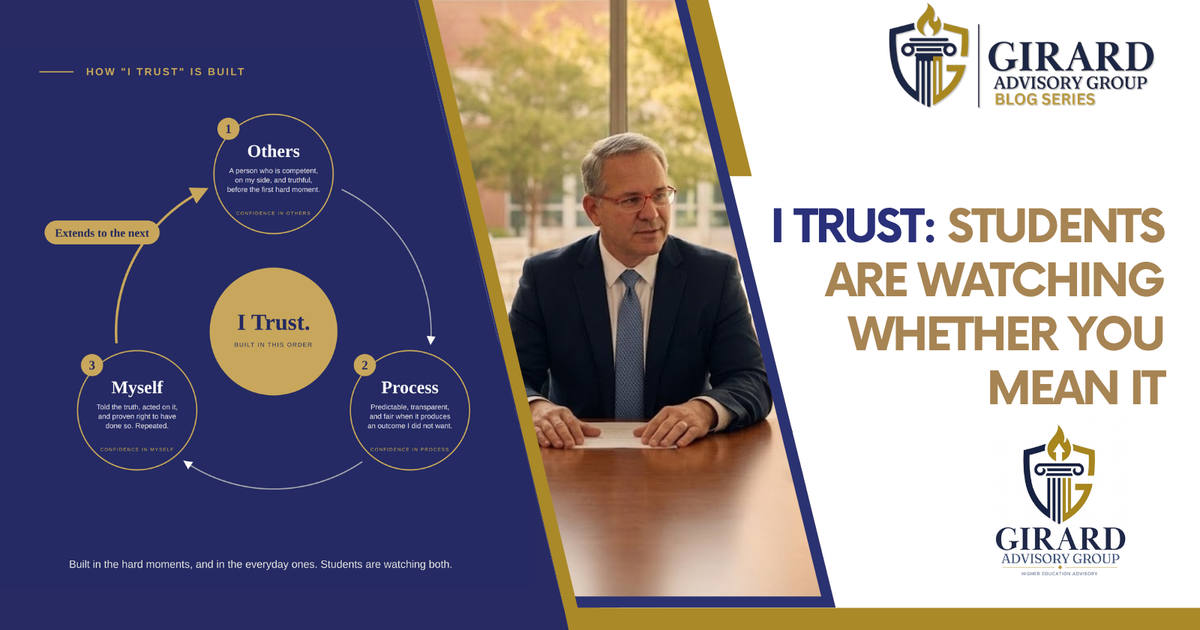
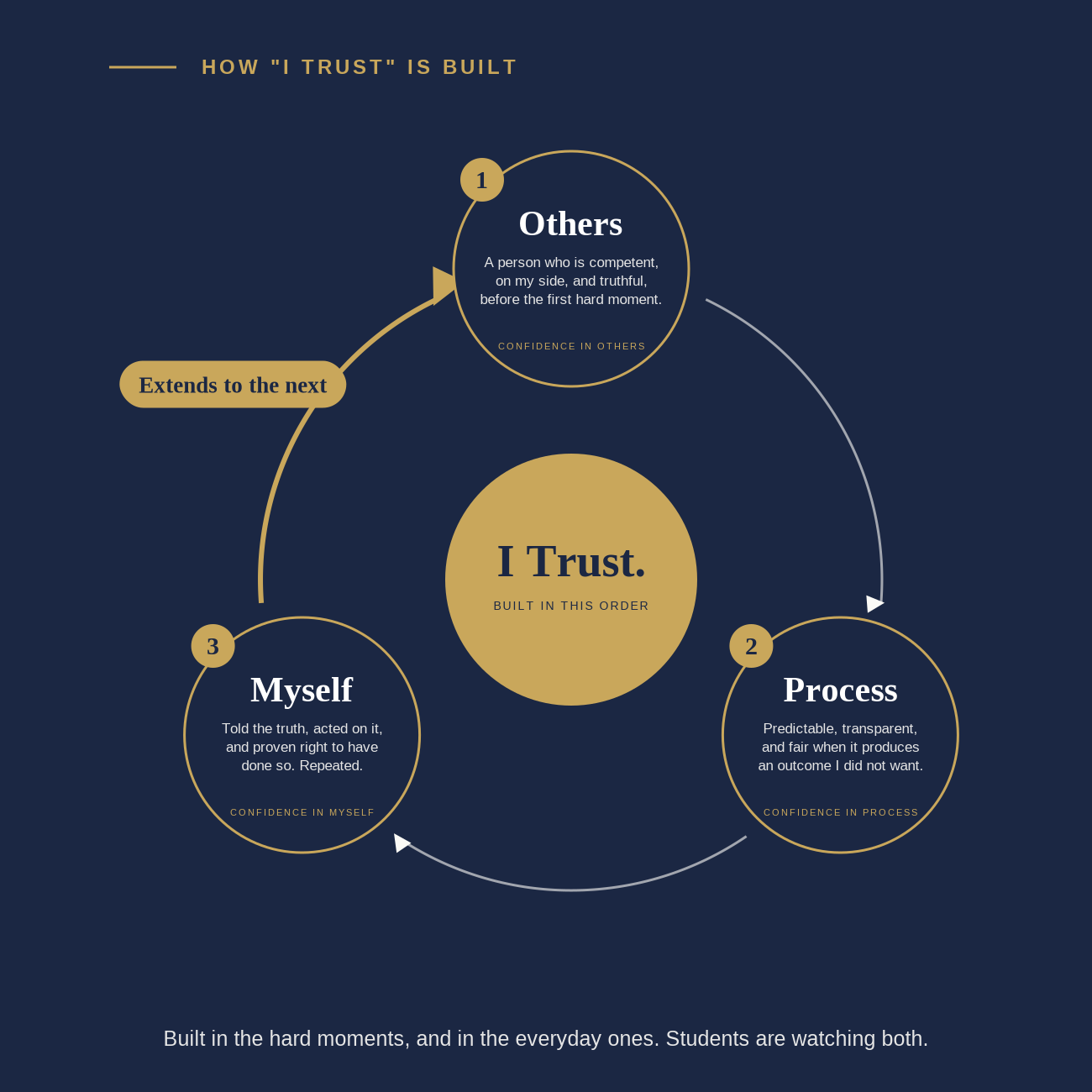
“I trust” means I have confidence in myself, in others, and in the process. Three objects, in that order. A student who trusts themselves believes their effort will produce a result. A student who trusts others believes the people around them are honest, competent, and on their side. A student who trusts the process believes the institution’s rules and procedures are fair and will be applied consistently. Remove any one of the three and the other two become fragile.
Most campuses think about trust as a starting condition — something students either arrive with or do not. The CARING+ Model treats it as a conclusion students reach by watching what the campus does, especially when things are hard. That distinction changes everything about how you build it.
Why Trust Is Built in the Hard Moments
Research on institutional trust is consistent across settings: trust is not formed primarily in smooth transactions. It is formed — or broken — in moments of difficulty, uncertainty, and disappointment (Bryk and Schneider, 2002; Tschannen-Moran, 2004). A student who navigates enrollment without friction has no particular reason to trust the institution; they simply have no reason not to. A student who hits a problem — a failed course, a financial hold, a schedule conflict, a difficult instructor — and finds the institution responds honestly, quickly, and fairly, has a reason to trust it. The hard moment is the test, and the test is the opportunity.
This is why the CARING+ Model frames trust in the student’s voice rather than the institution’s. An institution can claim to be trustworthy. A student decides whether it is, based on what they observed when something went wrong. The campus that handles difficulty well earns trust. The campus that handles it badly — or avoids it — loses trust it may never have known it had.
There is a second finding that matters for career and technical education specifically. Students who have been failed by institutions before — schools that promised outcomes they did not deliver, employers who did not keep commitments, systems that did not work as described — arrive with a lower prior for institutional trust. They are watching more carefully, and they are quicker to conclude that the current institution will follow the pattern. The campus that wants to build “I trust” with these students has to earn it faster and hold it more consistently than it would with a student who arrived with no history of institutional disappointment.
The Three Objects of Trust
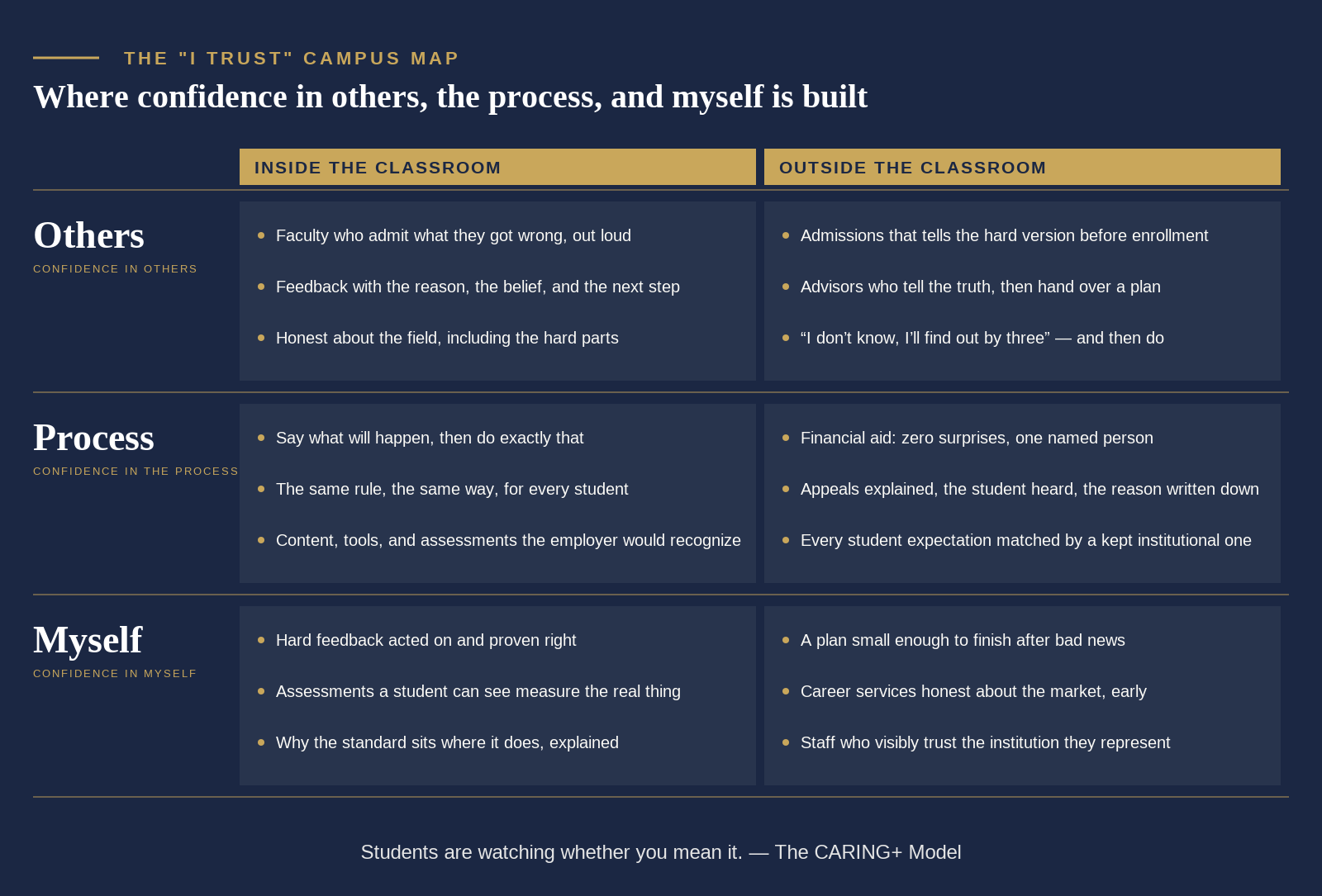
The three objects — self, others, process — are built by different practices and broken by different failures. It helps to take them separately.
Trust in self. This is the closest of the three to “I can do.” A student who trusts themselves believes their own judgment, their own effort, and their own capacity to navigate difficulty. It is built by the same mechanisms as self-efficacy: early completion, specific feedback, visible progress, and the experience of having handled something hard. It is broken by the same failures: rescuing, empty praise, surprises, and front-loaded difficulty. The difference is that “I can do” is about capability — can I finish this? — and trust in self is about reliability — can I count on myself when it matters? The campus builds both, but the second requires the student to have been tested and to have found themselves adequate.
Trust in others. This is the relational object, and it is the one most directly in the hands of faculty and staff. A student who trusts others believes the people around them are honest about what they know and do not know, competent to do what they say they will do, and genuinely interested in the student’s success rather than their own convenience. It is built through consistency: the instructor who returns work when they said they would, the advisor who follows through on the referral, the financial aid officer who calls back. It is broken through inconsistency: the promise not kept, the answer that turns out to be wrong, the staff member who is warm in the hallway and unavailable when the student needs something.
The research on relational trust in educational settings identifies five components: benevolence (the belief that the other person cares about your welfare), honesty (the belief that they tell the truth), openness (the belief that they share relevant information), reliability (the belief that they do what they say), and competence (the belief that they can actually do the job) (Tschannen-Moran and Hoy, 2000). A campus that wants to build trust in others has to be able to say, of each faculty and staff member, which of those components they are demonstrating and which they are not.
Trust in the process. This is the institutional object, and it is the hardest to build because it is the most abstract. A student who trusts the process believes the institution’s rules are fair, applied consistently, and designed with the student’s interests in mind rather than the institution’s convenience. It is built through transparency: published policies that are actually followed, decisions that are explained rather than announced, appeals processes that work. It is broken through opacity: rules that seem to change, decisions that seem arbitrary, processes that exist on paper but not in practice.
Process trust is also the object most vulnerable to a single bad experience. A student who has seen the institution apply a rule inconsistently — one student gets an exception, another does not, with no visible reason — will distrust the process for the rest of their enrollment, regardless of how fairly they are treated afterward. Consistency is not just a fairness value; it is a trust-building mechanism.
Inside the Classroom
Be honest about what you know and do not know. Faculty who admit uncertainty — “I am not sure; let me find out and get back to you” — build more trust than faculty who answer confidently and incorrectly. Students in career and technical programs are often training for fields where the instructor has direct industry experience, and they can tell the difference between a practitioner who knows the limits of their knowledge and an instructor who is performing expertise. The honest admission of uncertainty, followed by a correct answer, is one of the most effective trust-building moves available to a faculty member.
Do what you say you will do. Return work when you said you would. Hold office hours when they are posted. Follow through on the referral you promised. These are small commitments, and breaking them is small in the moment. But trust is built from small commitments kept, and broken from small commitments missed. A faculty member who is consistently reliable on small things is trusted on large ones. A faculty member who is inconsistently reliable on small things is not trusted on anything.
Explain the why. Students who understand why a rule exists are more likely to trust it than students who are simply told to follow it. This is especially true in technical programs, where the rules often have direct safety or professional implications: the sequencing requirement exists because the industry does it in that order, the documentation standard exists because regulators require it. Faculty who explain the professional context of their requirements are building trust in the process at the same time as they are teaching the content.
Handle failure honestly. The way a faculty member responds to a student’s failure is one of the highest-stakes trust moments in the classroom. A response that is honest about what went wrong, specific about what to do differently, and clear about what happens next builds trust in the instructor and in the process. A response that is vague, punitive, or inconsistent with how other students are treated breaks all three objects of trust at once. The CARING+ standard — purposeful action at the moment it matters most — is tested here as directly as anywhere in the model.
Develop before you evaluate. A student who first encounters a standard as a test has no basis for trusting the evaluation. A student who has practiced the standard, received feedback, and been told what the evaluation will look like has a basis for trusting both the standard and the evaluator. The develop-before-evaluate principle is a trust-building mechanism as much as a pedagogical one: it tells the student that the institution is interested in their development, not just their performance.
Keep the feedback loop closed. A student who submits work and receives no response has no evidence that the institution is paying attention. Feedback that is specific, timely, and actionable tells the student that their effort was noticed and that the instructor is invested in what happens next. Silence tells the student the opposite, and silence is one of the fastest ways to break trust in others.
Outside the Classroom
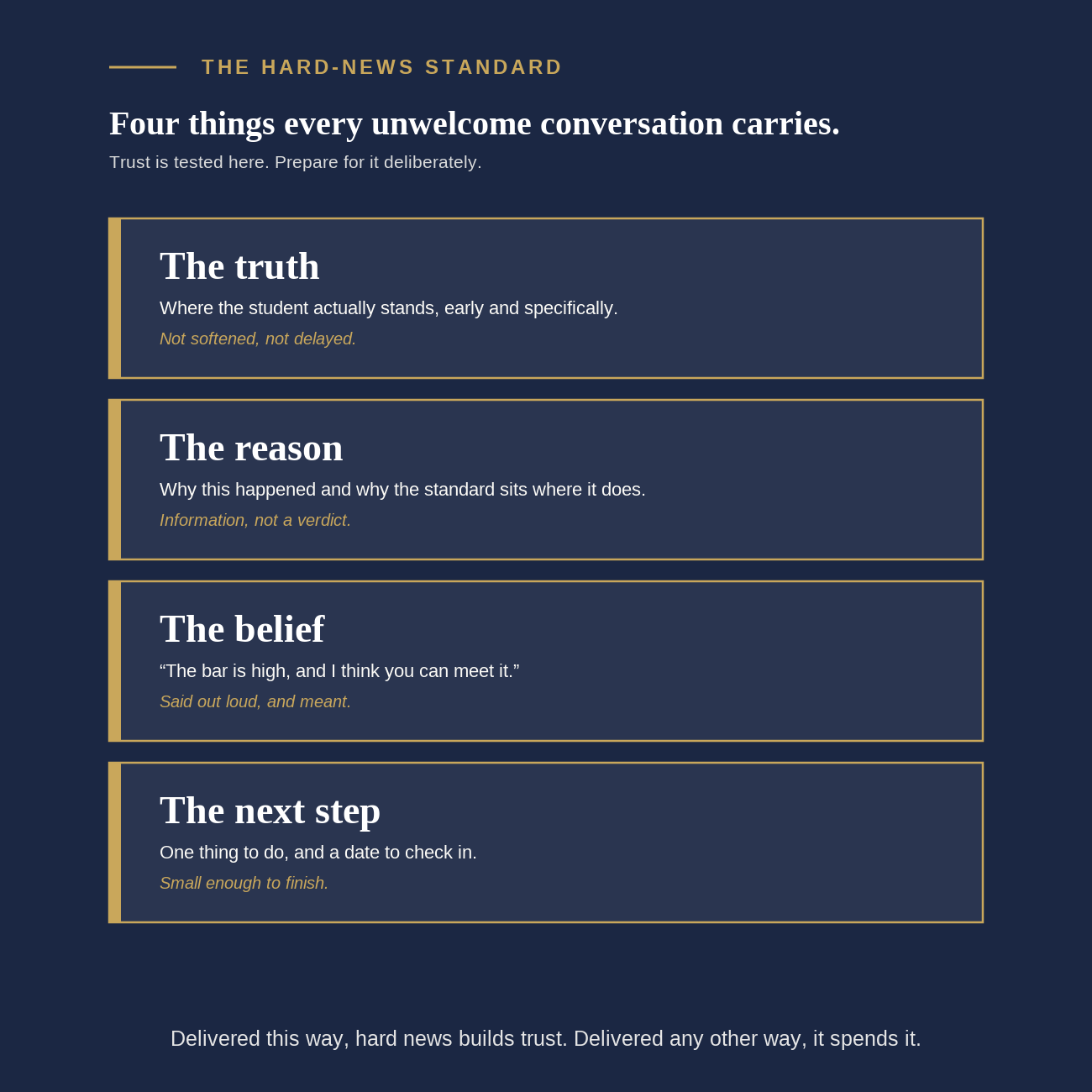
Advising: honest about the hard news. The advising conversation is where trust in others and trust in the process are most directly tested. A student who is failing, behind on credits, or at risk of not completing needs honest information about their situation, delivered in a way that preserves their dignity and their connection to the institution. Advisors who soften the news to the point of inaccuracy — who tell a student they are “a little behind” when they are in serious jeopardy — are protecting themselves from a difficult conversation at the cost of the student’s ability to make an informed decision. That is a trust violation, even when it is done with good intentions.
The honest advising conversation has a structure. It names the situation accurately. It explains what the options are, including the difficult ones. It gives the student time to respond. And it ends with a plan the student chose, not one that was handed to them. A student who leaves an advising conversation with an accurate picture of their situation and a plan they understand is more likely to trust the institution than a student who leaves with a vague reassurance and no plan at all.
Financial aid and the business office: no surprises. Financial surprises are among the most common trust-breaking events in career education. A student who discovers a hold they did not know about, a balance they did not expect, or a disbursement that did not arrive when promised is in a threat state that follows them into every classroom. The intervention is not warmth; it is predictability. Clear timelines, proactive communication about anything that might change, and a named person to call when something goes wrong. A student who knows what to expect and finds the expectation met has a basis for trusting the process. A student who is surprised has evidence that the process is not reliable.
The front desk and every transaction. Every campus transaction is a data point in the student’s ongoing assessment of whether the institution can be trusted. A student who gets a consistent answer from two different staff members trusts the institution more than a student who gets two different answers. A student who is told “I don’t know, but I will find out” and then receives the answer trusts the institution more than a student who is told “I don’t know” and hears nothing further. The front desk is not a low-stakes position in the trust model; it is one of the highest-stakes ones, because it is often the first point of contact when something has gone wrong.
Policies applied consistently. Nothing breaks trust in the process faster than visible inconsistency in how rules are applied. A student who sees another student receive an exception they were denied — without explanation — will distrust the process for the rest of their enrollment. This does not mean exceptions are never appropriate; it means exceptions require explanation. “We made an exception in that case because of these specific circumstances” is a trust-building statement. An unexplained exception is a trust-breaking one.
Complaints handled seriously. A student who raises a concern and finds it taken seriously — acknowledged, investigated, and responded to — trusts the institution more than before they raised it. A student who raises a concern and finds it minimized, deflected, or ignored trusts the institution less than before, and is likely to tell others. The complaint process is not a liability management function; it is a trust-building one, and it should be designed accordingly.
The staff. The CARING+ Model holds that staff who do not trust the institution cannot reliably build trust for students, and the same reciprocal standard applies here as in the previous posts. Staff who are told one thing and find another, who are given policies that are not followed, who raise concerns that are not addressed, will communicate their distrust to students whether they intend to or not. A campus that wants students to say “I trust” has to be trustworthy to its staff first, and visibly so.
What Undermines the Condition
Promises not kept. The commitment made and not followed through on. Small ones matter as much as large ones, because trust is built from the pattern, not the individual instance.
Inconsistent application of rules. Exceptions without explanation. Different answers from different staff members. Policies that exist on paper but not in practice.
Softened honesty. Telling a student what they want to hear rather than what they need to know. The short-term comfort is not worth the long-term cost to the student’s ability to make informed decisions.
Surprises. Any unexpected consequence — a hold, a balance, a policy change, a failed course discovered at term’s end — is evidence that the process is not reliable. Predictability is not a bureaucratic value; it is a trust-building one.
Silence after a problem. A student who raises a concern and hears nothing has evidence that the institution is not paying attention. Silence is not neutral; it is a trust-breaking signal.
Competence gaps that are not acknowledged. A staff member who does not know the answer and does not say so, or who gives a wrong answer confidently, breaks trust in others more durably than a staff member who admits uncertainty and follows up.
Institutional self-protection over student welfare. Decisions that are clearly made to protect the institution rather than to serve the student — and that are presented as the opposite — are among the most corrosive trust-breaking events in the model. Students recognize them, and they remember them.
Making It Observable
Following the six lenses of the model, a campus can ask of any faculty or staff member:
- Does this person do what they say they will do, on the timeline they said?
- Are they honest about what they know and do not know?
- Do they explain the why behind the rules and decisions they communicate?
- Do they handle difficult news in a way that is honest, specific, and preserves the student’s dignity?
- Do they apply policies consistently, and explain exceptions when they make them?
The behavioral interview question: Tell me about a time you had to deliver difficult news to a student or colleague. How did you handle it, and what happened next? Candidates who have done this well will describe a conversation that was honest, specific, and followed up. Candidates who have not will describe a conversation that was softened, deflected, or avoided.
The student feedback question, in the student’s voice: When something went wrong, did the people here handle it honestly? Ask it every term. A student who answers no is at risk regardless of their grades, because they have concluded the institution is not trustworthy, and that conclusion is very hard to reverse.
Where to Begin
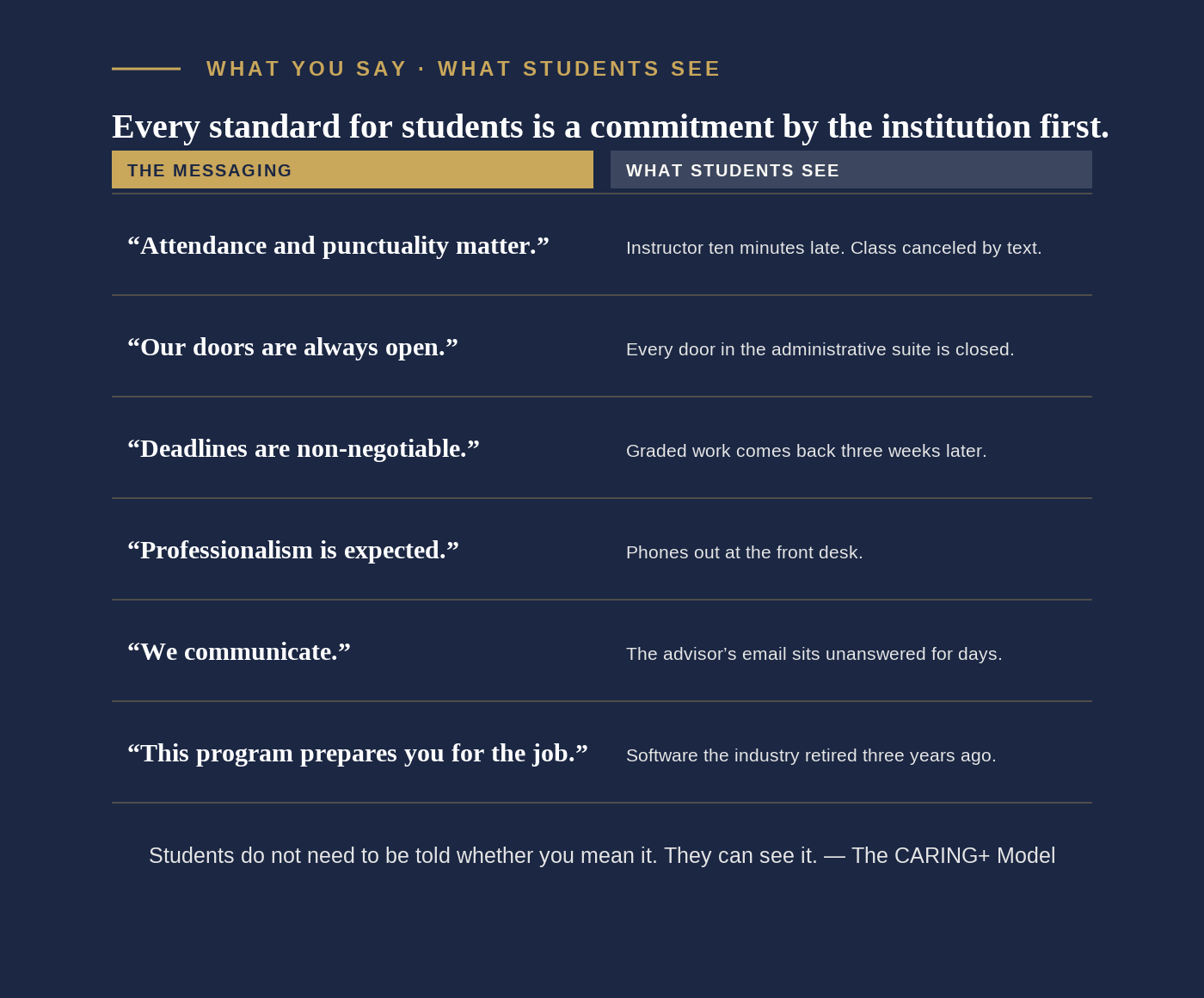
- Take every expectation the campus places on students — attendance, punctuality, deadlines, communication, professionalism — and write down the institution’s matching commitment. Then walk the building and check whether students can see it being kept.
- List the five situations in each department that most often produce hard news for students, and write down what a student should be told in advance about each.
- Adopt a standard for hard-news conversations: the truth, the reason, the belief, the next step. Rehearse it in staff development using real cases.
- Set the financial aid standard at zero surprises and audit against it each term.
- Review the appeals and disciplinary process for what a student sees: is the process explained, is the student heard, is the reason written down?
- Tell staff the truth about the institution first, before they are asked to tell it to students.
None of these requires new budget. All of them require the campus to decide that trust is built in the hard moments and in the everyday ones, to prepare for the first deliberately, and to be seen keeping its word in the second.
Frequently Asked Questions
Isn’t telling students the hard truth going to hurt retention?
The opposite, over any horizon longer than a term. Students who are told the truth early can act on it; students who are told late cannot. And a student who learns the institution softened the truth stops believing anything it says, including the encouragement. Retention built on withheld information is borrowed, not earned.
How is “I trust” different from “I matter” and “I belong”?
“I matter” is about being seen; “I belong” is about being connected. “I trust” is about whether the student believes the people, the process, and the education itself will deliver what was promised when it counts. A student can feel seen and connected and still not trust the institution to tell them the truth, and that student leaves at the first hard moment.
What about students who arrive already distrustful of institutions?
Many do, often for good reasons from prior schooling. The research on wise feedback was developed specifically for students with reason to doubt whether an institution is on their side, and it found that explicit statements of high standards plus belief, backed by consistent behavior, close the gap. Distrust that arrives with the student is overcome by the same practices, applied more consistently and for longer.
Aren’t student satisfaction scores a good measure of trust?
Only partly, and they mislead in a specific way. Satisfaction measures whether a student liked the experience; trust is whether they believe the institution will act in their interest when it counts. The two diverge exactly where trust is built. A student who was softened instead of told the truth may report high satisfaction right up until the term they find out. An advisor who tells a student the hard thing early may take a satisfaction hit while building the trust that keeps that student enrolled. Satisfaction is also lagging and averaged, so it hides the students who already left, and if staff know it is the metric, the rational move is to avoid hard conversations. Better measures are behavioral: whether students bring problems to staff early or hide them until they are unrecoverable, whether students who receive bad news persist afterward, whether students who were told no still recommend the school, and the direct question above, asked by department. Keep satisfaction as one input, and treat a sudden drop as a real signal. Do not treat a steady score as evidence that trust is fine.
Does this apply to how leadership treats staff?
Directly, and first. The model’s reciprocal standard holds that staff cannot create for students a condition they do not experience themselves. A campus that wants students to trust it has to be an institution its staff trust, which means the same rules: no unstated rules, no softened truths, no surprises, fairness they can see.
Sources
- Bryk, A. S., and Schneider, B. (2002). Trust in Schools: A Core Resource for Improvement. Russell Sage Foundation.
- Mayer, R. C., Davis, J. H., and Schoorman, F. D. (1995). “An Integrative Model of Organizational Trust.” Academy of Management Review, 20(3), 709–734.
- Tyler, T. R. (2006). Why People Obey the Law. Princeton University Press.
- Yeager, D. S., Purdie-Vaughns, V., Garcia, J., Apfel, N., Brzustoski, P., Master, A., Hessert, W. T., Williams, M. E., and Cohen, G. L. (2014). “Breaking the Cycle of Mistrust: Wise Interventions to Provide Critical Feedback Across the Racial Divide.” Journal of Experimental Psychology: General, 143(2), 804–824.
- Bandura, A. (1997). Self-Efficacy: The Exercise of Control. W. H. Freeman.
Explore Topics
Written by
John P. Girard
John P. Girard is the founder of Girard Advisory Group and a thirty-year veteran of career and proprietary higher education, with hands-on leadership across enrollment growth, campus operations, accreditation and compliance, curriculum development, brand and marketing, and P&L management. Over three decades he has held roles spanning Campus Director, Campus President, Regional Campus Director, and National Director of Marketing & Digital Media Brand Management, leading multi-campus organizations through growth, accreditation, and operational turnarounds. That range — from the admissions floor to the boardroom — is what shapes his advisory approach: strategy that has to hold up in daily campus operations, not just on a slide. John holds a Master's degree in Teacher Education from the University at Albany, SUNY, and has served on the Board of the Ohio-Michigan Association of Career Colleges and Schools.