I Grow: Why Students Have to See It to Believe It

John P. Girard
Founder, Girard Advisory Group
Belief gets a student to attempt the work. Growth is what turns the attempt into something real. The second in a series on the five conditions of the CARING+ Model — how a campus builds “I Grow” inside and outside the classroom.
The first post in this series, on “I Can Do,” argued that a student’s belief that they can finish is built before the results arrive, and that every part of a campus either feeds that belief or starves it. This post is about what happens next. Belief gets a student to attempt the work. Growth is what turns the attempt into something real.
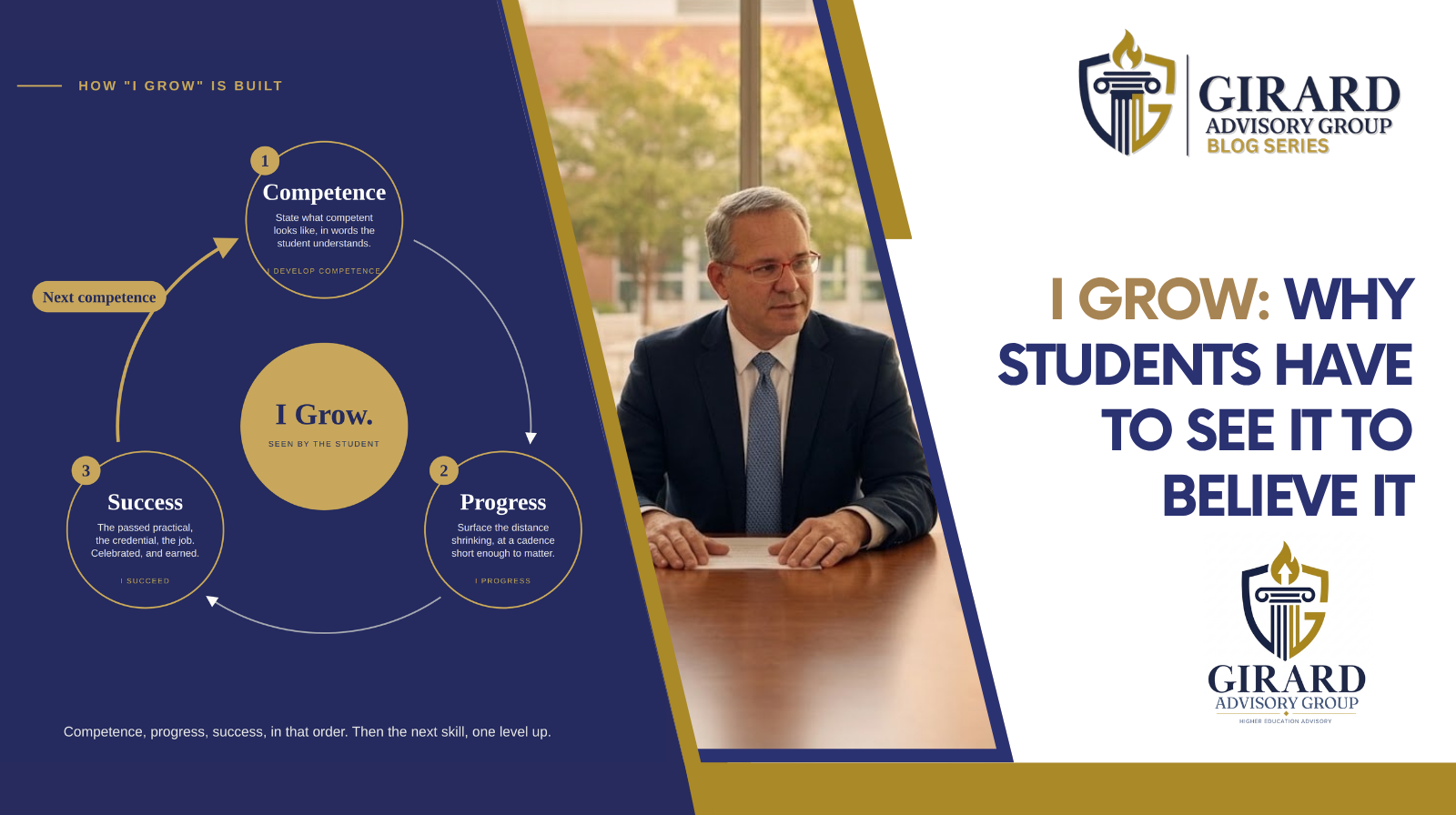
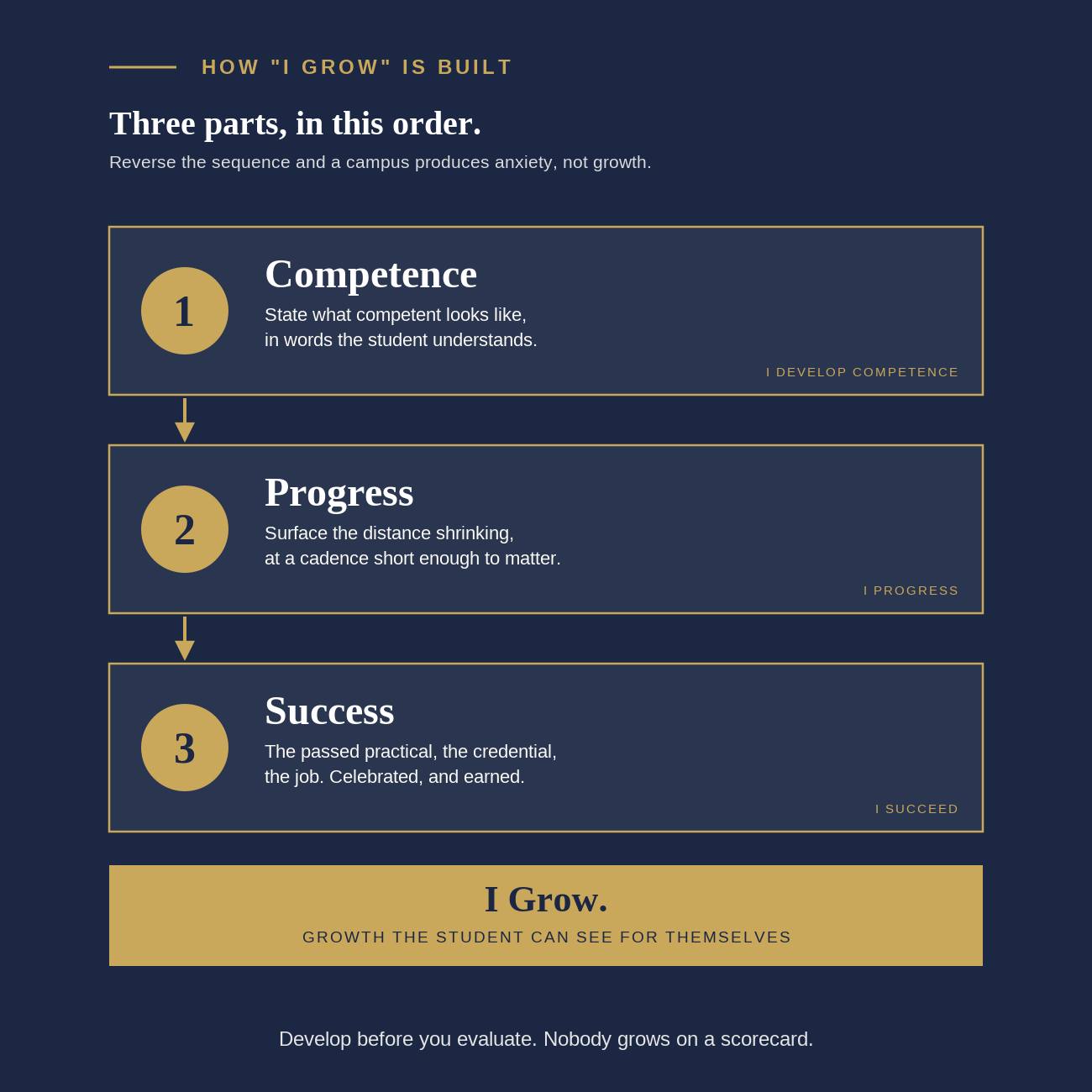
“I grow” means I develop competence, progress, and succeed. Three parts, in order: the skill itself, the visible movement toward mastery, and the result that movement produces. A campus that wants students to say “I grow” has to deliver all three, and it has to deliver them in a way the student can see for themselves. Growth a student cannot perceive does not change what they believe about themselves, and belief is what keeps them enrolled long enough for the growth to compound.
Most institutions are organized around the third part. They measure completion, placement, and licensure pass rates, which is right and necessary. Far fewer are organized around the first two. This post is about those.
Why Growth Has to Be Visible
There is a reason the CARING+ Model puts “I grow” in the student’s voice rather than the institution’s. A transcript can show growth. A competency log can show growth. But a student who does not experience growth — who cannot point to something they can do this month that they could not do last month — is not saying “I grow.” They are saying “I am getting through this,” which is a different sentence and leads to a different outcome.
The research here is consistent across settings. Goal-setting theory, built on several decades of studies, finds that specific, challenging goals paired with feedback on progress produce more effort and persistence than vague goals or goals without feedback (Locke and Latham, 2002). The feedback research points the same way: feedback that tells a learner where they are relative to a clear target, and what to do next, is among the strongest influences on achievement, while praise and grades alone are among the weakest (Hattie and Timperley, 2007). Put the two together and the practical rule is this: students perceive improvement when the goal is specific, the feedback is frequent, and the progress is made visible in a form they can inspect. Remove any one of the three and the growth may still be happening, but the student will not know it, and a student who does not know they are growing behaves like a student who is not.
There is a second finding that leaders in career and technical education should take seriously. Growth is learnable. Students who understand that competence is built rather than possessed respond differently to difficulty: they treat a failed check-off as information rather than as a verdict (Dweck, 2006; Yeager and Dweck, 2012). That understanding is not a personality trait. It is taught, mostly by how the institution responds to the failed check-off.
So the response has to be designed, not left to temperament. Faculty and staff have to make it clear, in words and in what happens next, that failure is often the passage to growth rather than the end of it. In practice that means four things happen every time a student falls short:
Name it as expected. “Most students miss this the first time” is not consolation; it is calibration. It tells the student the failure is a normal point on the path, not evidence about who they are. Faculty who say this out loud, before the attempt as well as after it, change how the attempt is interpreted.
Locate the gap precisely. A verdict is global: you failed. Information is specific: your hand position was right, your sequence was wrong at step three. The narrower the diagnosis, the more the failure reads as a solvable problem, and the more the student believes the next attempt will go differently.
Put the next attempt on the calendar. Failure becomes a passage only if there is somewhere to pass to. “You can retest Thursday” turns a check-off into a checkpoint. A failure with no scheduled next attempt is a verdict whatever the instructor intended.
Tell the story of the second attempt. When the student passes, say what changed. “Three weeks ago you couldn’t sequence this; today you did it without prompting.” That sentence is the student’s growth made audible, and it teaches every student within earshot how to interpret their own next failure.
Staff outside the classroom have the same job in a different setting. The financial aid counselor whose student missed a deadline, the advisor whose student failed a course, the front desk that fields the frustrated call: each is a moment where the institution either tells the student that the setback is a passage or that it is proof. The words are different; the four moves are the same.
The Sequence Matters
The three parts of “I grow” come in an order, and the order is the point.
Competence comes first. Before a student can see progress, there has to be something to be progressing in. That means a clear picture of what competent looks like — a skill, a standard, a demonstration — stated in terms the student can understand on the first day. “You will be able to run this procedure without prompting” is a competence statement. “You will earn a B or better” is not; it is a grade, and grades hide what was actually learned.
Progress comes second. Once the target is clear, the student needs to see their distance from it shrinking. This is where most campuses lose the thread. They assess at midterm and at the end, and the student spends the weeks in between without evidence. Progress has to be surfaced at a cadence short enough to matter — weekly in most technical programs, and after every hands-on attempt in labs and clinicals.
Success comes third. The result — the passed practical, the completed externship, the credential, the job — is what the first two parts were for. It should be celebrated. But a campus that celebrates success without having made competence and progress visible along the way will find that many students never reach it, because they left in the stretch where they could not see themselves growing.
Reverse the sequence and the model breaks. A campus that leads with the outcome and works backward produces anxiety, not growth.
Inside the Classroom
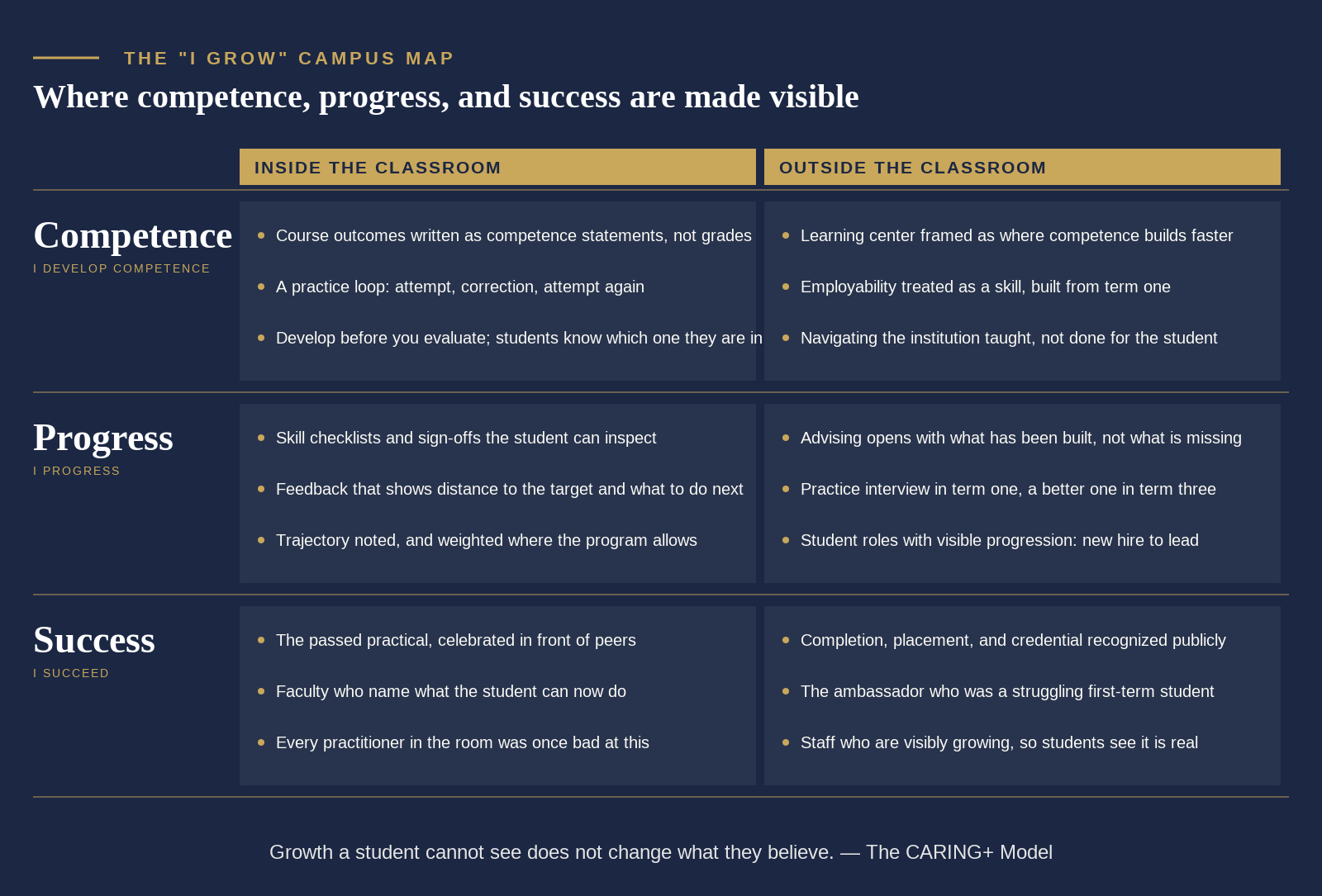
State the competence, not the grade. Every course should be able to answer, in plain language, what a student will be able to do at the end that they could not do at the start. Post it. Refer to it. Let students track themselves against it. Faculty who teach to a competence statement grade differently, give feedback differently, and get different persistence than faculty who teach to a syllabus.
Build the practice loop. Competence is built through repeated attempts with feedback in between, and the loop is only as good as its shortest cycle. A lab where students attempt, get corrected, and attempt again within the same session builds more competence than a lecture followed by a graded assignment a week later. Instructors should be able to say how many attempts a student gets at a skill before it is assessed, and the answer should not be one.
Make the progress inspectable. Skill checklists, competency sign-offs, portfolio pages, and lab logs are not administrative overhead. They are the student’s evidence. A student who can open a log and see fourteen signed-off skills is saying “I grow” whether or not anyone tells them to. This is also where educational technology earns its place: not by automating instruction, but by making progress visible in real time.
Develop before you evaluate. This principle is at the center of the CARING+ Model, and it applies to students as directly as it applies to staff. If a student first meets a skill as a test, they perform for the test. If they first meet it as something to be practiced together, with correction and without penalty, they build the skill. The evaluation should come after the development, and the student should know which one they are in.
Teach that competence is built. Faculty who share their own learning history — the first attempt that went badly, what they did not know at the start — are teaching students how to interpret difficulty from a position of credibility. This is where “learn from a pro” becomes a growth mechanism rather than a tagline: the pro knows, from experience, what it felt like not to be one yet.
Grade the growth, not just the level. A student who moved from a failing attempt to a passing one has demonstrated something a student who passed on the first try has not: they have demonstrated that they grow. Assessment that captures only the final level erases that. Instructors should at minimum note the trajectory, and where the program allows, weight it.
Outside the Classroom
Advising: from deficit to strengths. The single most important shift a campus can make for “I grow” happens in the advising office, and it is a shift in the first question. Deficit-based advising opens with what the student lacks: the missing credits, the failed course, the attendance problem. Strengths-based advising opens with what the student has built: the courses completed, the skills signed off, the distance already traveled. Both conversations end with a plan. Only one of them leaves the student believing they are growing. The advising literature has made the same case: strengths-based advising, which begins from what a student already does well, is associated with higher engagement and persistence than approaches that begin from deficits (Schreiner and Anderson, 2005). At the campus where this model was developed, moving advising from the deficit frame to the strengths frame was the change that made the rest of the model possible.
The learning center: growth, not remediation. Tutoring and academic support are too often positioned as the place students go when they are failing, which means students avoid them until it is too late and arrive feeling like a problem. Reposition the learning center as where competence gets built faster — where strong students go too — and it becomes a growth engine rather than a triage unit. The shift is partly physical (where it is, what it looks like) and mostly cultural (how faculty refer students to it).
Career services: professional growth from day one. Employability is a competence like any other, and it is built through the same loop of attempt, feedback, and attempt. A student who did a practice interview in the first term, got specific feedback, and did a better one in the third term has a growth story they can tell an employer. Career services that engage only in the final term have no story to tell, because there was no progress to see.
Financial aid and the business office: predictable process as growth. It is easy to overlook that a student’s ability to navigate the institution is itself a competence, and that growing it builds confidence. A student who understands their funding, their account, and their responsibilities, and who handles them without being rescued, is growing in a capability they will need for the rest of their life. Offices that keep processes predictable and teach students to manage them are building competence. Offices that surprise students, or that handle everything for them, are not.
Student employment and leadership. Campus jobs, peer tutoring, orientation leader roles, and student ambassadorships are among the most underused growth mechanisms in career education. They give students a competence to build outside the curriculum, a visible progression (new hire to lead), and a success that is recognized publicly. They also produce the vicarious models the first post described: the ambassador who was a struggling first-term student two years ago.
The staff. The CARING+ Model holds that staff who do not feel they matter cannot reliably create that feeling for students, and the same is true of growth. Staff who are not developing — who meet the model only as a scorecard, who get evaluated without being coached — cannot reliably produce “I grow” for anyone else. A campus that wants students to grow has to invest in staff growth first, visibly, and let students see it. This is the reciprocal standard, and it is why the model’s biggest surprise at its first campus was what it did to the associates.
What Undermines the Condition
Assessment without development. The skill is tested before it has been practiced. Students learn to perform, not to build.
Failure treated as a verdict. The check-off is failed, the grade is recorded, and nothing else happens. No diagnosis, no scheduled retry, no story afterward.
Invisible progress. Learning is happening, but the only evidence is a midterm grade. Students in the gap between assessments have no reason to believe they are growing.
Deficit framing. Every conversation opens with what is missing. The student’s own picture of themselves is confirmed rather than changed.
Grades that hide competence. A “C” tells a student nothing about what they can now do. A signed-off skill does.
Growth for students only. Staff are evaluated but not developed, and the model becomes something done to people rather than with them.
Remediation as punishment. Support services positioned as the place failing students are sent, so students avoid them.
Making It Observable
Following the six lenses of the model, a campus can ask of any instructor or staff member:
- Can this person state, in plain language, what competence looks like for the student in front of them?
- How short is their feedback loop? How many attempts does a student get before being assessed?
- Can a student in their course or caseload show evidence of their own progress without being told?
- Does their first question in a difficult conversation start with what the student has built, or what the student lacks?
- Is this person themselves growing, and do students know it?
The behavioral interview question: Tell me about a time you helped someone develop a skill they were struggling with. How did they know they were getting better? The second half of the question is the test. Candidates who have done this will describe how the progress was made visible. Candidates who have not will describe encouragement.
The student feedback question, in the student’s voice: Can you name something you can do now that you could not do when you started? Ask it every term. A student who cannot answer it is at risk regardless of their grades.
Where to Begin
- Rewrite every course outcome as a competence statement a student can understand on day one.
- Put a progress-tracking instrument — checklist, log, sign-off sheet — in every hands-on course, and make sure students can see it.
- Change the first question in advising from what is missing to what has been built.
- Move the learning center out of the remediation frame, in position and in language.
- Put staff development on the calendar before staff evaluation, and make it visible.
As with the first post, none of these requires new budget. All of them require the campus to decide that students should be able to see themselves growing, and to build the instruments that make it possible.
Frequently Asked Questions
How is “I grow” different from “I can do”?
“I can do” is the belief; “I grow” is the evidence. The belief gets a student to attempt the work, and the visible growth confirms the belief and sustains it. The two feed each other, but they are built by different practices: “I can do” by early completion and credible feedback, “I grow” by clear competence targets, short practice loops, and inspectable progress.
Doesn’t competency tracking add administrative burden for faculty?
It adds instrumentation, which is different. A sign-off sheet that lives in the lab and is completed during the session takes less time than a grading rubric applied afterward, and it does something the rubric does not: it shows the student their own progress. Most technical programs already track competencies for accreditation. The change is making that tracking visible to the student.
What about students who are not growing?
The instruments make that visible earlier, which is the point. A student whose sign-off sheet has not moved in three weeks is identifiable in week three, not at midterm. That is when the strengths-based advising conversation should happen, and it should open with what has been signed off so far.
Does this apply to staff evaluation?
Directly. The model’s rule — develop before you evaluate — was written for staff first. A campus that assesses staff on the model before training them on it will get compliance, not growth, and the students will feel the difference.
Sources
- Bandura, A. (1997). Self-Efficacy: The Exercise of Control. W. H. Freeman.
- Dweck, C. S. (2006). Mindset: The New Psychology of Success. Random House.
- Hattie, J., and Timperley, H. (2007). “The Power of Feedback.” Review of Educational Research, 77(1), 81–112.
- Locke, E. A., and Latham, G. P. (2002). “Building a Practically Useful Theory of Goal Setting and Task Motivation: A 35-Year Odyssey.” American Psychologist, 57(9), 705–717.
- Schreiner, L. A., and Anderson, E. (2005). “Strengths-Based Advising: A New Lens for Higher Education.” NACADA Journal, 25(2), 20–29.
- Yeager, D. S., and Dweck, C. S. (2012). “Mindsets That Promote Resilience: When Students Believe That Personal Characteristics Can Be Developed.” Educational Psychologist, 47(4), 302–314.
Explore Topics
Written by
John P. Girard
John P. Girard is the founder of Girard Advisory Group and a thirty-year veteran of career and proprietary higher education, with hands-on leadership across enrollment growth, campus operations, accreditation and compliance, curriculum development, brand and marketing, and P&L management. Over three decades he has held roles spanning Campus Director, Campus President, Regional Campus Director, and National Director of Marketing & Digital Media Brand Management, leading multi-campus organizations through growth, accreditation, and operational turnarounds. That range — from the admissions floor to the boardroom — is what shapes his advisory approach: strategy that has to hold up in daily campus operations, not just on a slide. John holds a Master's degree in Teacher Education from the University at Albany, SUNY, and has served on the Board of the Ohio-Michigan Association of Career Colleges and Schools.