The First Job Used to Finish the Training. Now We Have to.

John P. Girard
Founder, Girard Advisory Group
The task table in this post maps what AI is absorbing by program area — and what still needs a person on day one. If the first rung of the ladder is disappearing, our graduates have to arrive standing on the second one.
For most of my career, the first job after graduation did something no program could fully do. It finished the training. A new medical assistant learned the rhythm of a real front desk. A new audio tech logged hours on someone else’s sessions before running their own. A new office hire spent a year on data entry, scheduling, and first-draft reports, and absorbed the business while doing it. We built our programs on an unspoken assumption: get them employable, and the first employer will make them good.
That assumption is breaking. The routine, repeatable work that filled a new hire’s first year is exactly the work AI now does fastest and cheapest. Employers are not just cutting entry-level roles. They are quietly redesigning them so that the first job expects what used to be learned in it.
For career colleges, vocational schools, and anyone who writes curriculum for them, that changes the job. If the first rung of the ladder is disappearing, our graduates have to arrive standing on the second one.
What the data actually shows
The honest read is not “AI is taking all the jobs.” It is narrower, and for our sector more useful: AI is closing the front door, not emptying the building.
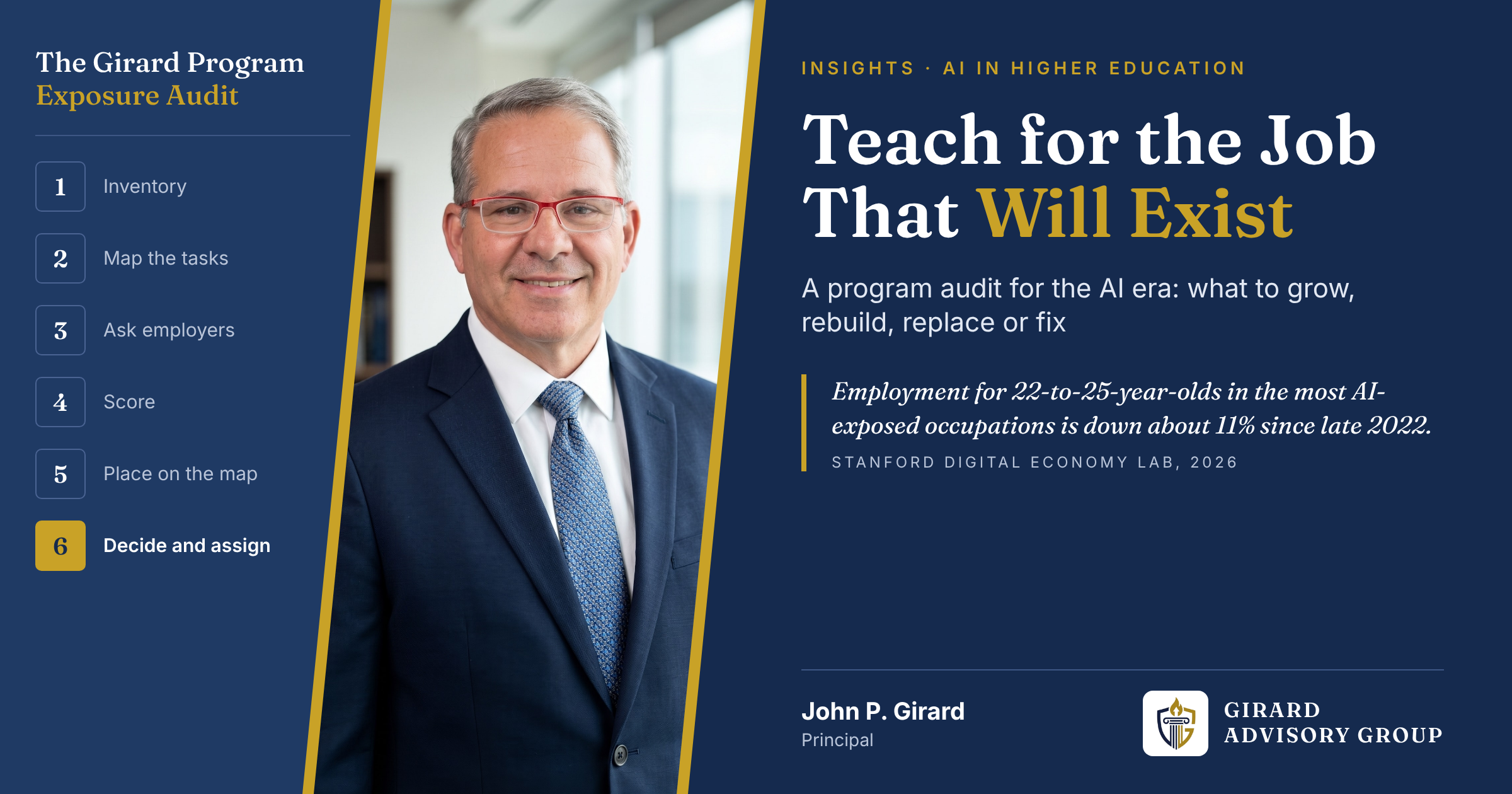
The best evidence comes from Stanford’s Digital Economy Lab, which tracks ADP payroll data for millions of U.S. workers. Their August 2026 revision found no sign of economy-wide job loss. But employment of workers aged 22 to 25 in AI-exposed occupations now sits about 19% below where it would be if it had kept pace with less-exposed peers. Experienced workers show no comparable gap, and the gap has widened every quarter since it was first reported in 2025.
Three details from that work matter for anyone designing programs:
- It is a hiring problem, not a layoff problem. The decline shows up as fewer young people being hired, not more being let go. The door is narrowing at the entrance.
- Substitution hurts; complementing helps. Declines concentrate where AI does the task instead of the worker. Where AI assists the worker, employment is flat or rising.
- Experience is the shield. The same occupations that are shutting out 23-year-olds are holding steady for people who already know the work.
Employer surveys point the same direction, with all the caveats surveys carry. In a February 2026 Resume.org survey of more than 900 U.S. business leaders, about one in five said they had already frozen entry-level hiring because of AI. A July 2026 ResumeTemplates.com report found that 45% of hiring managers said their company now has one senior worker plus AI doing work that used to take several new grads.
There is a counter-story, and it is fair to tell it. Some large employers say they are expanding early-career hiring, and some analysts trace the slump to post-pandemic tightening as much as to AI. Researchers themselves call these early indicators, not settled causes. But for a curriculum committee, the exact cause matters less than the direction: the expectations placed on a new hire on day one are rising.
Why this is a curriculum problem, not a placement problem
When placement numbers soften, the instinct in most schools is to push harder on career services. More employer calls, more job fairs, more resume workshops. Those matter. But they cannot fix a graduate who shows up ready for a job that no longer exists in that form.
If employers now expect a new hire to perform like someone with a year on the job, then that year has to move somewhere. It is moving into our programs, whether we plan for it or not.
This is good news for career education, if we take it seriously. Hands-on, applied, instructor-led training is exactly the model that can compress experience. Universities built around lectures will struggle with this shift. Schools built around labs, externships, and faculty who still work in their field are already halfway there. Faculty who still practice what they teach matter more now, not less.
The interest is already moving our way. Federal data show trade school enrollment grew about 5% from 2020 to 2023 while undergraduate enrollment slipped, and a Zety survey reported in February 2026 found 53% of Gen Z workers seriously considering skilled trades. Students are choosing us partly because they think our programs are safer from AI. We owe it to them to make sure that is true.
What AI takes and what it leaves
The useful unit of analysis is the task, not the job title. Every program prepares students for a bundle of tasks. AI is pulling some of those tasks out of the bundle. What is left is what your graduates must be great at.
| Program area | First-year tasks AI is absorbing | What still needs a person on day one |
|---|---|---|
| Medical assisting / allied health | Scheduling, intake forms, coding suggestions, routine patient messages | Hands-on clinical skills, reading a patient’s fear, judgment when something looks wrong |
| Media, audio, and video production | Rough edits, transcription, clean-up passes, basic graphics | Running a live session, directing talent, client taste, troubleshooting gear under pressure |
| Business and office administration | Data entry, first-draft reports, meeting notes, basic spreadsheets | Checking AI output, handling exceptions, owning a process end to end |
| IT support and networking | Ticket triage, password resets, scripted first-line answers | Physical installs, diagnosing the weird problem, calming a frustrated user |
| Skilled trades (HVAC, electrical, welding) | Estimates, parts lookups, code references, scheduling | Nearly all of the physical work, plus diagnosis and customer trust |
| Digital marketing | Ad copy variations, keyword lists, reporting summaries | Strategy, brand judgment, knowing when the AI version sounds fake |
Read across the right-hand column and a pattern appears. What remains is physical skill, judgment, exceptions, and people. Those are also the things that used to be learned slowly on the job. Our programs now have to teach them on purpose.
Five curriculum moves for program directors
I have written curriculum for both classroom and online delivery, and I have sat through enough advisory board meetings to know that most programs change slowly. These five moves do not require rebuilding a program. They require changing what gets practiced and what gets graded.
1. Teach students to supervise the machine. Stop treating AI as a cheating problem or a separate elective. In every program, students should use the AI tools of their field and then be graded on catching what the tool got wrong. A medical assisting student reviews an AI-drafted patient message for errors. An audio student fixes an AI rough mix. Verification is the new entry-level skill.
2. Build the first year into the program. Move externships, live client projects, and portfolio work earlier, not just into the final term. If employers want a year of experience, give students as many real reps as the schedule allows. A portfolio of real work beats a transcript.
3. Teach the exceptions on purpose. AI handles the routine case. Graduates earn their pay on the case that is not routine. Build hard-case scenarios into labs: the equipment that fails mid-session, the patient who will not cooperate, the customer who is angry before you say a word. Practice them until they are not scary.
4. Grade the human skills. Communication, judgment, and composure are now core job skills, not soft extras. Put them on rubrics, assess them in labs, and report them to your advisory board like any other competency.
5. Embed AI fluency inside each course. A standalone “Intro to AI” course ages in six months. Instead, update the tools inside each course every term. Have faculty who still work in the field bring in what their employers are actually using.
None of this replaces the fundamentals. A student who cannot do the work cannot check the AI doing the work. The fundamentals come first. What changes is how fast we get students past them and into judgment.
The accreditation and advisory board angle
Accreditors care about one thing above all: are graduates getting jobs in the field they trained for? If AI quietly raises the bar for those jobs, placement rates are where you will feel it first. By then you are a year or two behind.
Your program advisory committee is the early-warning system. Use it on purpose:
- Ask employers a new question. Not just “what skills do you need,” but “what did a new hire do in their first year three years ago, and who does that work now?”
- Document the answer. Minutes that show you asked about AI and changed curriculum in response are exactly the kind of evidence of continuous improvement site teams look for.
- Watch the leading indicators. Externship evaluations and employer feedback on recent grads will move before placement rates do. Treat a soft score on “needs less supervision” as a warning.
After more than a dozen re-accreditation cycles, I can tell you the schools that do well are not the ones that predict the future. They are the ones that can show they were listening and acted on what they heard.
Where to start this term
You do not need a strategic plan to begin. Pick one program and do three things before the next start:
- Ask two or three employers on your advisory board the “three years ago” question above
- Choose one lab or assignment and add an AI-check step that gets graded
- Add one hard-case scenario to a skills lab and run it with every cohort
Then look at what you learned and decide what to change next.
Career education has always promised one thing: we get people ready to work. The work is changing faster than it has in my 30 years in this sector. The schools that win the next decade will be the ones that stop counting on the first employer to finish the training, and start finishing it themselves.
If your team is working through what this means for your programs, I am glad to talk it through. You can reach me at girardadvisorygroup.com.
Frequently asked questions
Is AI eliminating entry-level jobs?
Not across the board. Current payroll research finds no economy-wide displacement, but a widening hiring gap for workers aged 22 to 25 in occupations where AI substitutes for human tasks.
Are skilled trades programs safe from AI?
Safer than most, because the core work is physical. But the paperwork, estimating, and scheduling around the trade are changing, and employers will expect graduates to use AI tools for those parts.
Should career colleges add a standalone AI course?
Usually not as the main answer. AI tools change too quickly. Embedding current, field-specific tools in each program course, taught by faculty who still work in the field, holds up better.
How do we show accreditors we are responding?
Use your program advisory committees. Ask employers how first-year work has changed, document the discussion in minutes, and record the curriculum changes you made in response.
What is the single most important skill to add?
Verification. Graduates who can check, correct, and take responsibility for AI output are more valuable than those who can only produce the first draft.
Sources
- Brynjolfsson, Chandar, and Chen, Canaries in the Coal Mine? Six Facts about the Recent Employment Effects of Artificial Intelligence, Stanford Digital Economy Lab, revised August 12, 2026
- HR Reporter, Trouble looms as nearly half of employers will soon stop hiring for entry-level jobs (Resume.org survey, February 2026)
- ResumeTemplates.com, Class of 2026 College Graduate Hiring Report, July 17, 2026
- WTVR / Scripps News, Gen Z trades tech for tools: Rise of the ‘toolbelt generation’, February 2026
Explore Topics
Written by
John P. Girard
John P. Girard is the founder of Girard Advisory Group and a thirty-year veteran of career and proprietary higher education, with hands-on leadership across enrollment growth, campus operations, accreditation and compliance, curriculum development, brand and marketing, and P&L management. Over three decades he has held roles spanning Campus Director, Campus President, Regional Campus Director, and National Director of Marketing & Digital Media Brand Management, leading multi-campus organizations through growth, accreditation, and operational turnarounds. That range — from the admissions floor to the boardroom — is what shapes his advisory approach: strategy that has to hold up in daily campus operations, not just on a slide. John holds a Master's degree in Teacher Education from the University at Albany, SUNY, and has served on the Board of the Ohio-Michigan Association of Career Colleges and Schools.