Teach for the Job That Will Exist: A Program Audit for the AI Era

John Girard
Founder, Girard Advisory Group
AI is not eliminating the careers career colleges train for. It is eliminating the first rung of some of them, and the first rung is the one our graduates stand on. This post gives campus leaders a way to find out which programs are exposed, and what to do with each.
AI is not eliminating the careers career colleges train for. It is eliminating the first rung of some of them, and the first rung is the one our graduates stand on. This post gives campus leaders a way to find out which programs are exposed, and what to do with each.
Key takeaways
- Hiring for entry-level roles is slowing in the occupations most exposed to AI, and the entry-level role is what career colleges train for.
- The Girard Program Exposure Audit scores every program on AI exposure and local employer demand, then assigns one of four decisions: Grow, Rebuild, Replace or Fix.
- A campus can go from a program inventory to an approved plan in about 90 days, with employers and the accreditor involved from the start.
The rung is disappearing, not the ladder
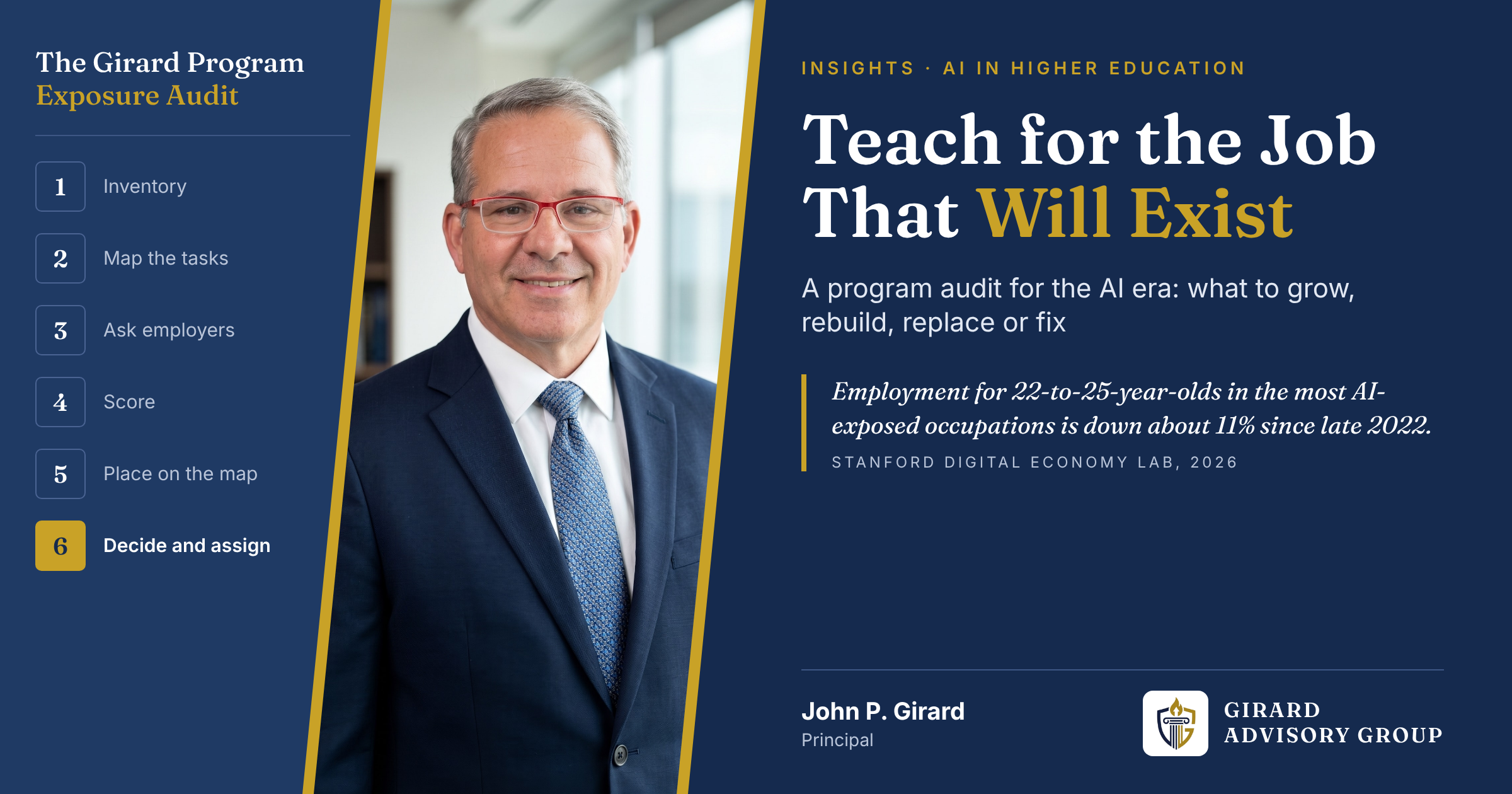
The clearest evidence so far comes from payroll records, not predictions. Economists at Stanford’s Digital Economy Lab tracked millions of workers through June 2026 and found that employment for 22-to-25-year-olds in the most AI-exposed occupations fell about 11% from late 2022. For young workers in the least exposed occupations, it grew. The gap came mostly from weaker hiring, not layoffs. Employers did not fire their experienced people. They stopped opening the entry-level seat.
That seat is our product. A career college does not graduate senior coders or office managers. It graduates people for their first job in the field.
The exposure is not confined to tech. When Anthropic measured which occupations its AI model is actually used for, medical records specialists ranked fourth, behind computer programmers, customer service representatives and data entry keyers. That is medical billing and coding, a diploma on almost every allied-health campus in the country. The Bureau of Labor Statistics still projects the wider category to grow, but now adds that AI-powered coding tools may affect demand.
Two cautions keep this honest. The same Anthropic research found limited evidence that AI has moved overall employment yet. And exposure is not elimination: a job whose tasks AI can do often becomes a job that checks the AI’s work. The point for campus leaders is not that programs are dying. It is that the first job is changing faster than most catalogs.
Students have noticed. In a recent survey by Jobber, 77% of Gen Z respondents said it matters that their future job is hard to automate. They will ask your admissions team about it, and they will ask an AI assistant about your programs before they ever call. I covered that shift in AI Is Now Your Prospective Student’s First Advisor.
Why this is a president’s decision
Most schools will treat AI as a curriculum question and hand it to a committee. The committee will add an “AI in the workplace” module to a few courses and report back. That is the wrong altitude. Which programs a campus offers is a portfolio decision, and it belongs to the person accountable for enrollment, outcomes and the budget at the same time.
Three things make waiting expensive.
Outcomes lag. Placement rates are reported on cohorts that started one to two years ago. By the time a program’s employment rate drops below your accreditor’s benchmark, you have already enrolled two more years of students into it. The accreditor sees the problem after the labor market does, and you carry the reporting.
Marketing amplifies whatever you point it at. A campus that keeps spending to fill an exposed program is buying future placement problems at today’s cost per start. Growth should be aimed at programs that can carry more students.
New programs take longer than the market does. A new program needs evidence of employer demand, an advisory committee, faculty, equipment, and approval from your accreditor and state before the first start. That is months in the best case. The school that starts its review this quarter launches a year ahead of the one that waits for the data to be undeniable.
None of this calls for panic. It calls for an audit: a structured look at every program you offer, on the same measures, ending in a decision for each one.
The Girard Program Exposure Audit
The Girard Program Exposure Audit is a six-step review that takes a campus from a list of programs to a decision for each one.
The underlying idea is gaining ground elsewhere. Writing for the UK higher education site Wonkhe, Simon Brookes argues that AI exposure belongs in portfolio review while institutions still have room to reshape what they offer on purpose. Universities can take that slowly. Career colleges cannot: our programs are shorter, our graduates are judged on placement within months, and our accreditors publish the benchmark.
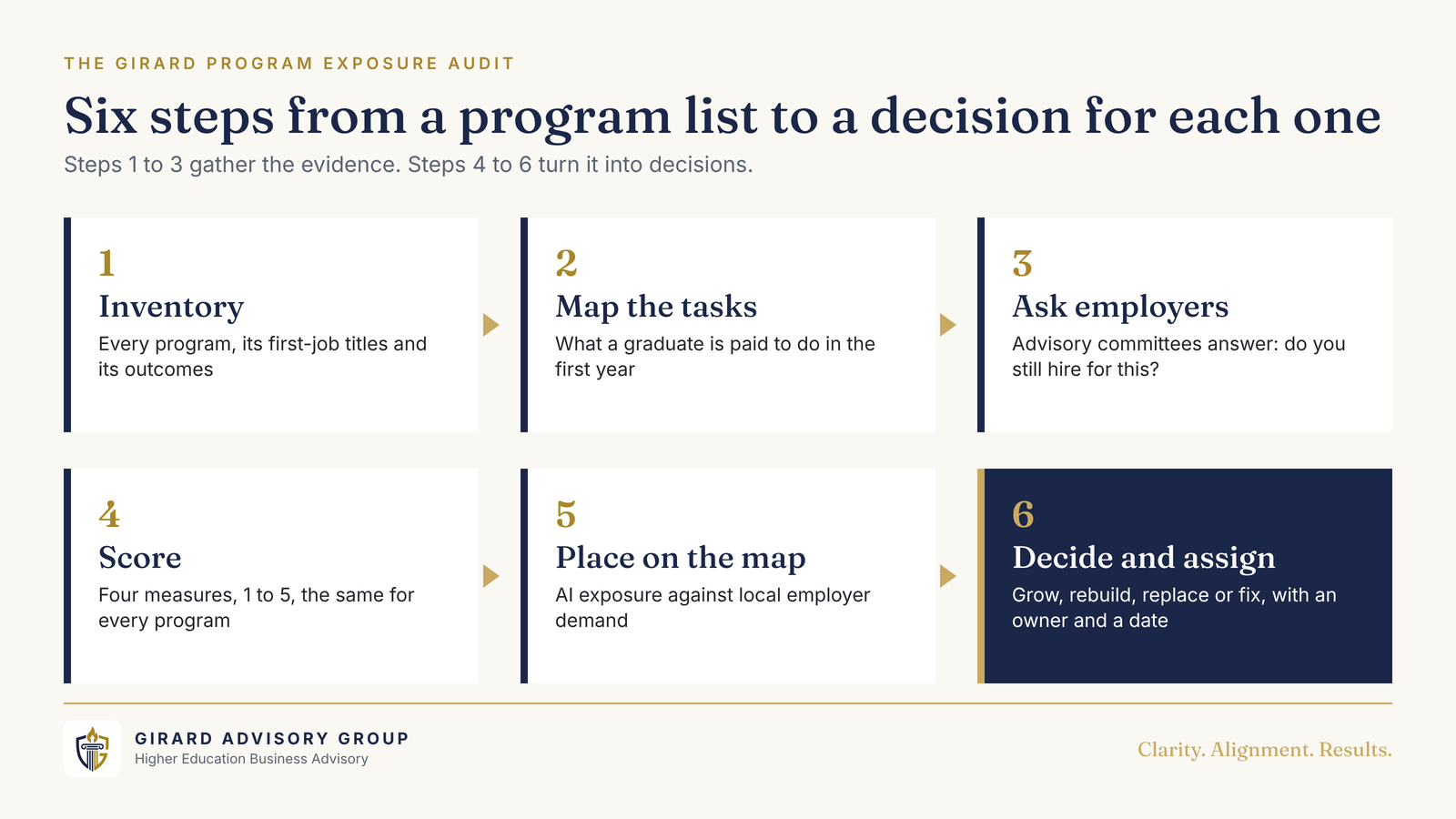
The first three steps gather evidence and the last three turn it into decisions. Step 3 is the one schools skip, and it is the one that matters most: the labor-market data tells you what is happening nationally, and only your employers can tell you what is happening in your market.
- Inventory. List every program with the job titles graduates are placed into and its graduation, placement and licensure rates against benchmark.
- Map the tasks. For each first job, write down the five to eight tasks a new hire spends the week on. Mark each one: can current AI tools do most of this?
- Ask employers. Take the task map to your advisory committees and to the employers who hired your last three cohorts. Ask what they still hire for, what they have stopped hiring for, and what they cannot find.
- Score. Rate every program on the same four measures.
- Place on the map. Plot each program by exposure and local demand.
- Decide and assign. Give every program one of four decisions, with an owner and a date.
Score, then sort
Score each program from 1 to 5 on four measures. Use the same definitions for every program so the results can be compared.
| Measure | What it asks | Where the answer comes from | Feeds |
|---|---|---|---|
| Task exposure | How much of the first job’s work can AI already do? | The task map from step 2 | Exposure |
| Human anchor | Does the work need hands, physical presence or a license? | Program requirements, state licensing rules | Exposure (a strong anchor lowers it) |
| Entry-rung health | Are local employers still posting and filling entry-level roles? | Employer interviews, local job postings, placement records | Demand |
| Outcomes margin | How far above benchmark are graduation and placement? | Your last accreditor annual report | Demand |
The first two measures set a program’s exposure. The second two set its demand. Together they place it on the map.
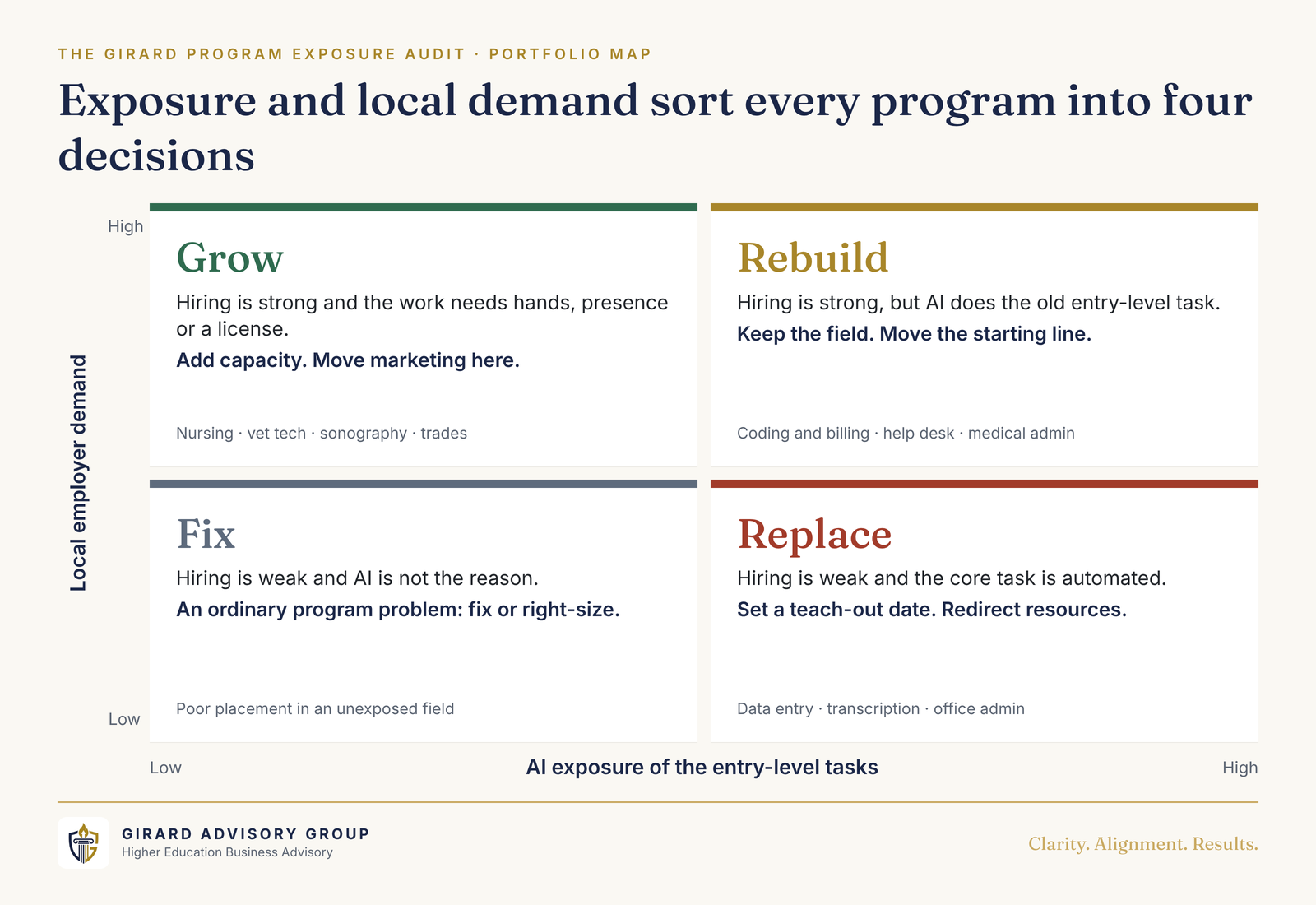
Read the map from the top right. High demand with high exposure is the most common result for allied-health administration and IT support programs, and it is the one that rewards early action.
What to do with each result
Every program lands in one of four places, and each place has a different instruction. The mistake to avoid is treating all four the same way, usually by adding an AI module to everything and calling it done.
| Result | What it means | Recommendation | Typical examples |
|---|---|---|---|
| Grow | Employers are hiring and the entry work needs hands, presence or a license | Protect quality, add capacity, and move marketing spend here. Add AI literacy so graduates can use the tools their employers are adopting. | Nursing, veterinary technology, sonography, surgical technology, skilled trades |
| Rebuild | Employers are hiring, but AI now does much of the old entry-level task | Keep the field, move the starting line. Teach graduates to verify, audit and manage the AI’s output, and to do the parts that need a person. | Coding and billing toward auditing and revenue cycle; help desk toward AI-assisted support and security; medical administration toward patient access and care coordination |
| Replace | Demand is weak and the core task is automated | Stop new enrollment on a planned date, teach out current students properly, and redirect the faculty, space and marketing to a Grow or new program. | Data entry, transcription, general office administration |
| Fix | Demand is weak but AI is not the reason | This is an ordinary program problem: employer relationships, externship quality, placement effort or local saturation. Fix it or right-size it. | Any program with poor placement in an unexposed field |
Rebuild is where the work is. A rebuilt program keeps its name recognition and its accreditation history, and changes what a graduate can do on day one. In practice that means three moves. Rewrite the program outcomes around judgment tasks: reviewing, correcting, explaining and escalating. Put the AI tools employers use into the labs, so students practice checking a machine’s work. And raise the human skills that tools cannot cover: patient and customer communication, privacy and compliance, and knowing when the output is wrong.
Replace needs a date. Programs rarely get closed; they get starved. A teach-out with a published end date, a named replacement and a plan for the faculty is kinder to students and staff than three years of shrinking cohorts.
New program and curriculum options
The audit tells you what to stop and what to protect. It should also produce a short list of what to build. Four options are worth a place on that list.
AI literacy in every program, taught in context. A stand-alone “Introduction to AI” course dates quickly and teaches the tool without the job. The better approach puts three things inside existing courses: how to use the tools the field has adopted, how to check their output against a standard, and what the rules are on privacy, documentation and disclosure. A medical assisting student learns it through charting. A veterinary technician learns it through records and client communication.
Rebuilt versions of exposed programs. These are the Rebuild results from the audit, relaunched with new outcomes and often a new name that matches the job titles employers now post.
Short, stackable certificates. Workforce Pell changes the math here. Since July 2026, Pell Grants can fund short-term programs of 8 to 15 weeks in fields each state identifies as in demand. It is not easy money: eligibility is decided state by state, and the program limits tuition against what graduates go on to earn. But it makes a first credential affordable for a student who cannot commit to a year, and it lets a school test demand before building a full program. Design each certificate to stack into a diploma or degree you already offer.
Upskilling for the people you already graduated. Your alumni in exposed roles need the rebuilt skills too, and their employers may pay for it. An evening or online certificate for working graduates is the lowest-cost enrollment a school can find, and it turns employers into partners.
A caution belongs here. Research on short-term programs is mixed: some deliver strong returns and many do not. A short program only makes sense if a named employer will hire from it.
Governance: who decides, and what the accreditor needs
An audit that ends in a slide deck changes nothing. Three structures turn it into decisions.
Put employers in the room first. Program advisory committees already exist at every accredited career college, and most meet to approve what the school has already decided. Reverse that. Bring the task map to the committee and ask one question per task: do you still hire someone to do this? Their answers are your best evidence, and they are the evidence your accreditor will want to see.
Treat the accreditor as a design constraint, not a hurdle. A rebuilt program may be a revision or a substantive change, depending on how much of the content, length or credential moves. A new program needs documented employment demand before it is approved. Read the standard before you design, build the application as you go, and the approval becomes a milestone in the plan.
Give every decision an owner and a date. Grow, Rebuild, Replace and Fix each need a named person, a budget line and a checkpoint.
I have run this sequence. As campus president at Stautzenberger College in Brecksville, I launched Surgical Technology, Diagnostic Medical Sonography and Cardiovascular Sonography. We did the market research first, to confirm graduates would be hired. The opening was real: a competitor that taught those programs had closed, leaving employers without a pipeline and experienced faculty without a school. We brought faculty over, but everything else had to be built: clinical partners, labs and equipment, credentialed program directors, advisory boards and programmatic accreditation. Those programs went on to drive a good share of the campus’s growth. AI did not create that opening, but the discipline is the same one this audit asks for: evidence of demand first, then the build, with the accreditor’s requirements in the plan from day one.
A 90-day timeline
| Days | Work | Output |
|---|---|---|
| 1–30 | Inventory programs, map entry-level tasks, pull outcomes and local postings | A scored sheet for every program |
| 31–60 | Advisory committee sessions and employer interviews; place each program on the map | A decision for each program, with the evidence behind it |
| 61–90 | Write the rebuild outcomes, the teach-out plans and the new-program short list; open conversations with the accreditor and state | An approved plan with owners, dates and budget |
Where this fits in the series
This is the latest post in my series on AI in career education, and each one answers a different question.
- How do prospects find and judge you? AI Is Now Your Prospective Student’s First Advisor: What Campus Leaders Should Be Asking Their Marketing Team explains the shift, and The Answer You Never See: A Quarterly AI Audit for Career Colleges shows how to check what assistants say about your school.
- What is AI learning about your reputation? The Reputation Blind Spot: What AI Is Learning About Your School That No One on Your Team Is Watching and Your Reviews Are Talking to AI. Is Anyone Answering? cover the signals answer engines read when nobody on campus is tending them.
- Where does AI belong inside the school? Where AI Belongs in School Operations — and Where It Doesn’t sorts the uses and the accreditation questions each one raises.
- What should you teach? That is this post.
The questions connect. A program that lands in Rebuild needs new outcomes in the catalog, a new answer on the website and in what AI assistants say about it, and a plan for the students who enrolled under the old version.
Five questions for your next leadership meeting
- For each program, what is the first task a graduate is paid to do, and can AI already do it?
- When did our advisory committees last tell us something we did not want to hear?
- Which program are we marketing hardest, and where does it sit on the map?
- If placement in our most exposed program fell ten points next year, what would we wish we had started today?
- Who owns the program portfolio, by name?
If those questions are hard to answer, that is the case for the audit. Girard Advisory Group runs the Girard Program Exposure Audit with campus leadership teams, from the task map through the accreditor conversation. Contact me at jpg@girardadvisorygroup.com to talk through where your catalog stands.
Take the audit to your next leadership meeting. The six-step process map and portfolio matrix are available as a PDF you can share with your team.
Frequently asked questions
What is the Girard Program Exposure Audit?
It is a six-step review, developed by Girard Advisory Group, that scores each program a career college offers on AI exposure and local employer demand, then assigns one of four decisions: Grow, Rebuild, Replace or Fix.
Is AI going to eliminate the jobs career colleges train for?
Not most of them. The evidence so far shows weaker hiring at the entry level in the most exposed occupations, not the disappearance of whole fields. The risk is concentrated in programs whose graduates start with routine, rules-based tasks.
Which career college programs are most exposed?
Programs built around data entry, medical coding and billing, transcription, general office administration and first-level technical support. Programs that require hands-on care, physical presence or a license, such as nursing, veterinary technology and the skilled trades, are the least exposed.
Should we close our medical billing and coding program?
Not on a headline. Run the audit. If local employers are still hiring, rebuild it toward auditing, revenue cycle and compliance work. If they are not, set a teach-out date and redirect the resources.
Is adding an AI course enough?
No. A single course teaches the tool without the job. AI literacy belongs inside existing courses, tied to the tasks, standards and rules of each field.
How does Workforce Pell fit in?
It makes short programs of 8 to 15 weeks eligible for Pell Grants in fields each state names as in demand. It suits stackable first credentials and upskilling certificates, provided a named employer will hire from them.
How long does the audit take?
About 90 days from inventory to an approved plan, if one person owns it and the advisory committees are engaged early.
Will our accreditor accept a rebuilt program?
Usually, with the right process. Whether a change is a revision or a substantive change depends on how much of the content, length and credential moves. Check the standard before you design, and document employer demand as you go.
About the author. John P. Girard is the founder of Girard Advisory Group. He has led five campus turnarounds, launched and accredited new allied-health programs as a campus president, and taken part in more than 14 re-accreditation cycles, 11 of them with no findings.
Sources
- Brynjolfsson, Chandar and Chen, Canaries in the Coal Mine? Six Facts about the Recent Employment Effects of Artificial Intelligence, Stanford Digital Economy Lab, August 2026 update
- CBS News, Anthropic is tracking which jobs are most exposed to AI, reporting Anthropic’s March 2026 labor market study and the Jobber Gen Z survey
- Becker’s Hospital Review, 5 health IT roles most at risk from AI in 2026, on the Bureau of Labor Statistics outlook for medical records specialists
- Simon Brookes, AI exposure and portfolio review, Wonkhe
- U.S. Department of Education, final rule creating the Workforce Pell Grant program, May 2026
- National Governors Association, Workforce Pell: An Overview for Governors, March 2026, on mixed returns from short-term programs
Explore Topics
Written by
John Girard
John P. Girard is the founder of Girard Advisory Group and a thirty-year veteran of career and proprietary higher education, with hands-on leadership across enrollment growth, campus operations, accreditation and compliance, curriculum development, brand and marketing, and P&L management. Over three decades he has held roles spanning Campus Director, Campus President, Regional Campus Director, and National Director of Marketing & Digital Media Brand Management, leading multi-campus organizations through growth, accreditation, and operational turnarounds. That range — from the admissions floor to the boardroom — is what shapes his advisory approach: strategy that has to hold up in daily campus operations, not just on a slide. John holds a Master's degree in Teacher Education from the University at Albany, SUNY, and has served on the Board of the Ohio-Michigan Association of Career Colleges and Schools.