AI Is Now Your Prospective Student’s First Advisor: What Campus Leaders Should Be Asking Their Marketing Team

John P. Girard
Founder, Girard Advisory Group
Nearly half of prospective students now use AI tools during their school search, and one in five has already ruled a school out based on what AI told them. Here’s what campus leaders need to understand about AEO — and the questions to ask your marketing team this week.
If you run a campus, a school, or a network of them, here is what changed while you were dealing with everything else:
A significant share of your prospective students are now asking an AI assistant about your school before they ever visit your website. The assistant answers them. If it doesn’t mention you, or mentions you inaccurately, you never find out — because there’s no inquiry, no form fill, no phone call, and no line in your CRM that says “removed from consideration.”
You don’t need to become an expert in this. You do need to know enough to ask your marketing and brand people the right questions and recognize whether the answers are real. That’s what this piece is for.
What actually changed, in plain English
For twenty years, search worked like a library card catalog. Someone typed a question, got a list of links, and clicked one. Your marketing team’s job was to make sure your link was near the top and worth clicking. That discipline is search engine optimization — SEO.
Search now increasingly works like a reference librarian. Someone asks a question, and a system reads a range of sources and hands back a synthesized answer. Sometimes it names sources. Sometimes it doesn’t.
That shift has produced a new discipline, usually called answer engine optimization (AEO), and sometimes generative engine optimization (GEO). The goal is no longer only to rank. It’s to be the source the machine reaches for, and to be described accurately when it does.
The scale isn’t speculative. Google’s AI Overviews now appear on roughly half of tracked queries, up more than 50 percent year over year. Pew Research Center’s behavioral study of nearly 69,000 real searches found that when an AI Overview is present, people click through to a traditional result about 8 percent of the time, compared to 15 percent when it isn’t. Seer Interactive’s longitudinal work across 25 million impressions found organic click-through rates falling from roughly 1.6 percent to 0.6 percent when an AI Overview appears.
And the education vertical is not average. BrightEdge’s early 2026 measurement put AI Overview presence in education as high as 83 percent of queries — among the highest of any sector tracked.
Translation for a campus president: the top of your funnel is being answered before anyone reaches you.
Why this lands harder on career and trade schools
There’s a version of this article written for flagship universities. This isn’t that version, because the dynamics are different and, frankly, sharper for us.
Our prospects are the ones most likely to use AI as a guidance counselor. Career college and trade school students skew toward first-generation, adult, career-changer, and under-advised. Many do not have a college-educated family member to call. They are making a five-figure decision without a professional advisor in their corner. A free, patient, non-judgmental advisor available at eleven o’clock at night is exactly the resource that population has never had. Of course they’re using it.
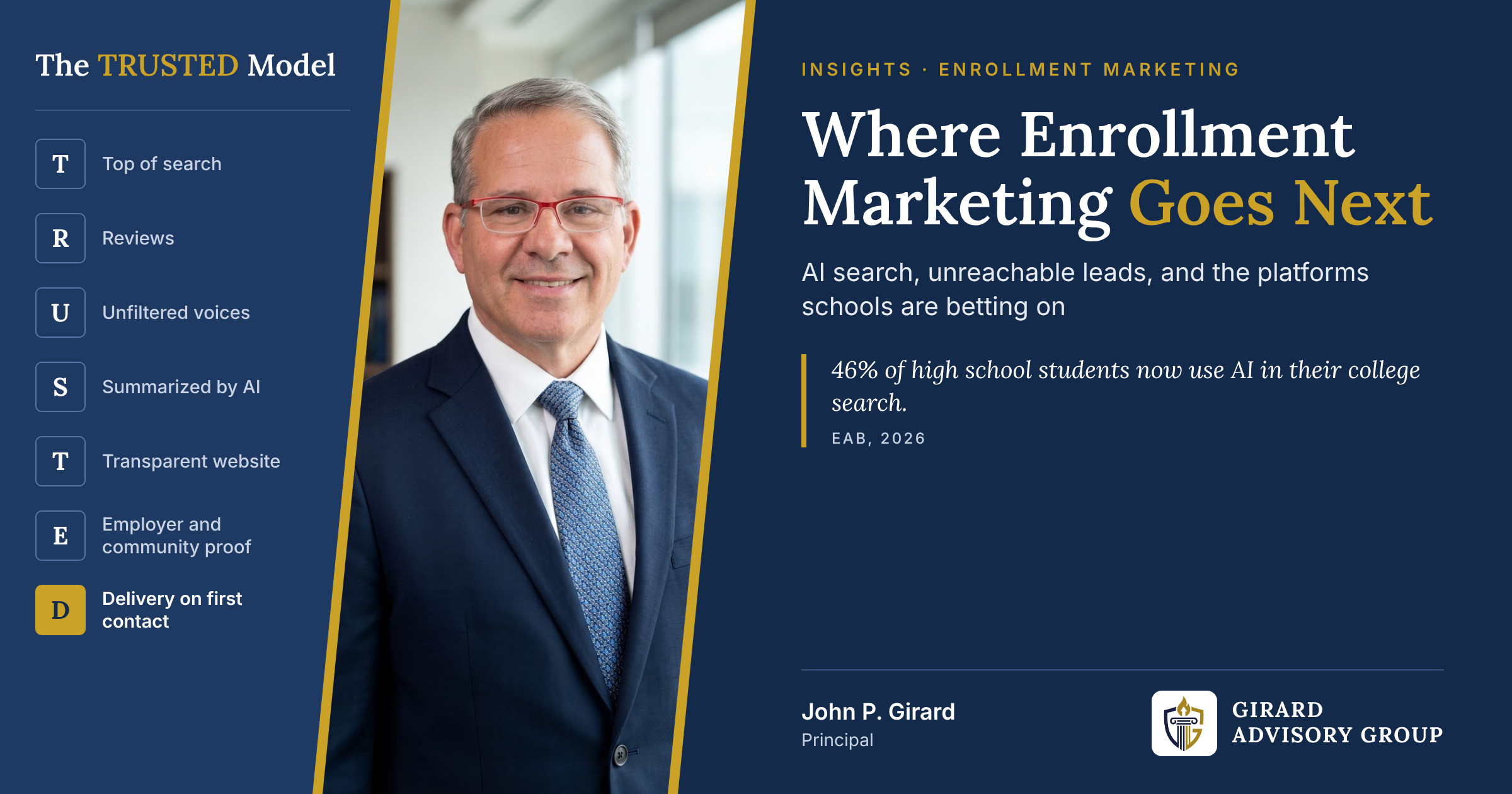
The data backs this up across the sector. EAB’s national survey of more than 5,000 high school students, released in February 2026, found 46 percent using AI tools during their school search — nearly double the 26 percent measured just months earlier in spring 2025. Eighteen percent had already removed a school from consideration based on something an AI told them. Thirty-four percent said their interest in a school increased because of AI research.
Sit with the 18 percent for a moment. Nearly one in five prospects has crossed a school off the list based on an AI answer, before that school knew the student existed. There is no report that captures this. It looks like nothing. It looks like a slow month.
Our questions are exactly the questions AI answers best. How much does the program cost. How long is it. Do they help with job placement. Is it accredited. Is it worth it. Is this school legitimate. These are informational and comparison queries — the category where zero-click behavior is highest and where AI Overviews trigger most reliably.
Our sector carries a reputational headwind. When a prospective student asks an AI assistant whether for-profit or proprietary schools are “worth it,” the answer is synthesized from a body of coverage that has not historically been kind to this sector. That is a brand management problem, and it now plays out in a channel most schools aren’t monitoring at all.
The part that should get your attention: you can’t buy your way in
For fifteen years, when organic visibility got difficult, this sector’s answer was to increase paid search. Bid harder. Buy the click.
That valve does not work here. There is no ad inventory inside a ChatGPT answer. You cannot bid your way into the shortlist an AI hands a prospect at 11 p.m. Whether your school is named is determined by what the system can find, verify, and trust about you across sources — most of which you don’t own.
Which is a different way of saying: this is a brand problem, not a media buying problem. And the people who solve it are your brand and data people, not your agency’s paid team. For a deeper look at how enrollment marketing breaks down in this sector, see Why Career College Marketing Stops Working.
There’s an upside worth naming, too. Seer Interactive found that brands cited inside AI Overviews earned meaningfully more organic clicks and substantially more paid clicks on the same queries than brands that weren’t cited. Being named in the answer appears to lift everything else you’re already paying for.
What determines whether an AI recommends your career college
Five things. Your marketing team should be able to speak to all five.
1. Whether the machine can resolve who you are
AI systems work with entities — a school, a campus, a program — assembled from many sources. If your program is called “Video Production” on your website, “Film and Video Production” in your catalog, “Digital Media” on IPEDS, and something else again on your Google Business Profile, the system has low confidence about what you actually offer. Low confidence means it either omits you or hedges.
Same for campus addresses, phone numbers, accreditor name, program lengths, and credential type. Contradictions across sources don’t just look sloppy anymore. They actively suppress you.
This is brand consistency. It’s the same discipline we’ve always preached — messaging, naming, brand pillars, visual identity — except the auditor is now a machine, it checks constantly, and it penalizes silently.
2. What third parties say about you
Models weight outside corroboration over self-description. What appears on Niche, Google reviews, your accreditor’s directory, College Scorecard, state authorization lists, local press, and industry coverage carries more weight than your own about-us page.
This is the reversal that should encourage anyone who has done the unglamorous work. If your school spent the last several years grinding a review average from the low threes into the high fours, you weren’t just doing reputation management. You were building the corroborating evidence layer that AI systems now draw from. That work is worth more today than it was when you did it.
Research from Yext in early 2026 also suggests citation rates decay without fresh coverage — roughly a six-to-twelve-month half-life. This isn’t a project you complete. It’s a program you run.
3. Whether your content is structured to be extracted
Pages that get cited tend to answer the question directly, early, in the language a real person would use, with clean structure underneath. Analysis of citation patterns has found that a large majority of pages cited by ChatGPT include structured data markup — the invisible code that tells a machine “this is the tuition figure, this is the program length, this is the accreditor.”
Your marketing team should know what schema is deployed on your program pages and when it was last validated. If the visible page and the underlying markup disagree, you’ve made things worse, not better.
4. Whether you publish the content you’ve been avoiding
Cost. Outcomes. Comparisons. “Is it worth it.” Most schools in this sector have historically kept those pages thin, vague, or absent — partly out of competitive caution, partly out of compliance caution.
Here’s the problem: the engines answer those questions anyway. Your only choice is whether your verifiable facts are part of the answer or whether it’s assembled entirely from third parties and competitors. Silence is not neutral. Silence is a decision to be described by others.
There’s a compliance dimension here, and it’s a real one — substantiation and misrepresentation rules still apply, and they apply to what you publish. But “we can’t say anything” and “we must say only what we can substantiate” are very different postures, and too many schools have been operating under the first when the second is the actual standard.
5. Whether anyone is checking
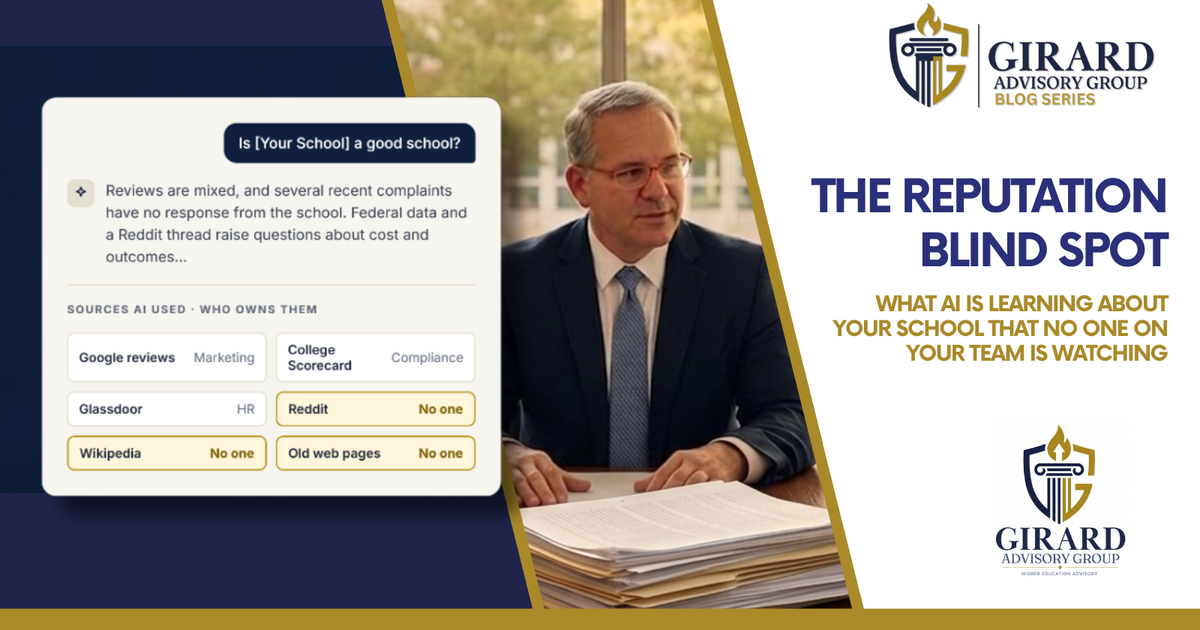
Almost no school is monitoring what AI says about them. There’s no dashboard, no alert, and typically no one who owns it.
Meanwhile the answers are out there containing outdated tuition, discontinued programs, the wrong accreditor, a campus you closed three years ago, or a conflation with a similarly named institution down the road that had a bad news cycle. This is an area where a structured advisory engagement pays for itself quickly — a single inaccurate AI description of your accreditation status can eliminate dozens of prospects before they ever reach your funnel.
Ten questions to ask your marketing and brand team about AEO
You don’t need to run these initiatives. You need to know whether they’re being run. Ask these, and listen for whether you get specifics or vocabulary.
- When was the last time we asked ChatGPT, Gemini, and Perplexity the ten questions our prospects actually ask — and what did they say about us? If nobody has done this, that’s your answer.
- Are we named in the AI answers for our core program searches in our markets? Which competitors are?
- Where does our institutional data disagree with itself? Program names, campus addresses, phone numbers, accreditor, program length, credential awarded — across our site, Google Business Profile, IPEDS, Scorecard, accreditor directory, review platforms, and state listings.
- Who owns entity consistency, and how often is it audited? If the answer is “everybody” or “the web person,” it’s nobody.
- What structured data is on our program and campus pages, when was it last validated, and does it match what’s visible on the page?
- What share of our organic traffic came from informational content, and what’s happened to it over the last eighteen months? This tells you how exposed you are.
- Do we have published, substantiated pages on cost, program length, and outcomes — or are we still avoiding those topics?
- What’s our review velocity by campus, and are we still generating fresh third-party coverage — or did that program stall after we hit our rating target?
- Have we blocked AI crawlers anywhere in our robots file or CDN settings? Blocking doesn’t remove you from the answers. It removes your voice from them.
- What are we measuring now that we weren’t twelve months ago? If the reporting package is unchanged, the strategy is unchanged.
What a good answer sounds like
“We run a fixed set of 25 prompts monthly across four platforms and log the results. We’re named in 14 of 25 for Cleveland, 9 of 25 for Columbus. The gap is program-specific — we’re strong on audio, invisible on sports broadcasting. We traced it to thin program pages and no third-party coverage on that program, and here’s the plan.”
What a warning sign sounds like
“We’re on top of AEO.” Followed by nothing specific. Or a proposal to buy a tool before anyone has established a baseline.
The uncomfortable part, and then the encouraging part
The uncomfortable part: a meaningful share of the content investment this sector made over the last decade — blog posts built to capture informational search traffic — is depreciating. Not worthless, but no longer producing what it produced. If your content plan for next year looks like your content plan from three years ago, you’re funding a channel that’s being quietly disintermediated.
The encouraging part is more interesting.
AI made polished content free. Anyone can now generate a flawless campus photo, a flawless program description, a flawless testimonial. Which means polish has stopped functioning as a signal of quality — and prospective students, who are natives of this technology, spot synthetic material faster than most marketing departments believe. This connects directly to the brand management argument for authentic student photography over stock or AI-generated imagery.
What’s left is proof that can’t be synthesized. Named instructors with verifiable credits and current industry work. Students on your actual floor, using your actual equipment, with dates attached. Employer partnerships that can be confirmed. Outcomes you can substantiate. Third-party recognition you actually earned.
That’s not a content strategy. That’s just being a good school and being willing to show it.
The schools best positioned for this shift are not the ones with the most sophisticated AI strategy. They’re the ones that spent the last few years doing dull, patient work on data accuracy, review generation, honest proof points, and consistent brand execution — and who can now be described accurately by a machine because there was never much distance between the claim and the reality.
If that describes your institution, this is an opportunity, not a threat. If it doesn’t, no amount of AEO tooling is going to fix it, because the machines are ultimately summarizing the truth about you as it appears across the internet.
What to do in the next 90 days
Days 1–30: Establish a baseline. Write down the 20–25 questions your prospects actually ask. Run them across the major AI platforms for each campus market. Log whether you’re named, what’s said, and whether it’s accurate. This costs nothing but an afternoon a month.
Days 31–60: Fix your facts. Audit every place your institutional data appears externally and reconcile the contradictions. Program names, addresses, phone numbers, accreditation, program length, credential. This is unglamorous and it is the single highest-return item on the list. It is also the foundation of the enrollment marketing work Girard Advisory Group does with multi-campus networks.
Days 61–90: Rebalance the content plan. Shift investment from volume toward substantiable proof and toward the cost, outcomes, and comparison pages you’ve been avoiding. Restart or accelerate review generation if it stalled. Add AI visibility to the monthly reporting package so it becomes something you manage rather than something you wonder about.
Then keep running it. The half-life on this work is short enough that it has to be a standing process, not a project with an end date. If you want a structured starting point, a marketing diagnostic can establish your baseline across all five AEO factors in a single engagement.
Frequently Asked Questions: AI, AEO, and Career College Marketing
What is answer engine optimization (AEO) for career colleges?
Answer engine optimization (AEO) is the discipline of ensuring your institution is named and accurately described inside AI-generated answers — from tools like ChatGPT, Google AI Overviews, Gemini, and Perplexity — when prospective students ask questions about programs, costs, accreditation, and outcomes. Unlike traditional SEO, which focuses on ranking in a list of links, AEO focuses on being the source an AI system reaches for when synthesizing an answer. For career colleges, where 83% of education queries now trigger an AI Overview, AEO is no longer optional.
What’s the difference between SEO and AEO?
SEO works to get your pages ranked and clicked in a list of search results. AEO works to get your institution named and accurately described inside a synthesized answer, whether or not anyone clicks. They overlap heavily and share a foundation, but they’re measured differently and AEO depends far more on third-party corroboration — Google reviews, accreditor directories, College Scorecard, and external press carry more weight than your own website copy.
Do we need to hire an AEO agency?
Not before you have a baseline. Establish what AI currently says about you, fix your entity data, and see how far that gets you. Most schools have significant, cheap gains available in data consistency alone. Buy tooling after you know what problem you’re solving, not before.
Can we pay to appear in AI answers?
Not currently, in the way you can pay for search ads. Visibility is earned through what can be found and verified about you across sources. That may change as these platforms commercialize, but it isn’t the situation today — which is why this is a brand and data problem, not a media buying problem.
Should we block AI crawlers to protect our content?
Consider this carefully. Blocking crawlers doesn’t remove your institution from AI answers — the models still assemble descriptions from third-party sources. It removes your ability to influence what those descriptions say. For most career colleges, that trade is a bad one.
How do we know if AI is describing us inaccurately?
Ask it. Run a consistent prompt set monthly, log the answers, and trace inaccurate claims back to their source. Then correct the source — the outdated directory listing, the stale review site profile, the old program page — rather than trying to argue with the output. This is one of the first things a marketing diagnostic surfaces.
Is AEO really urgent for career colleges, or is it another marketing trend?
The behavioral data is moving faster than the sector is. Student AI usage in the school search process roughly doubled in under a year, and nearly one in five prospects reports already eliminating a school based on an AI answer. Whether the specific tools persist in their current form, that behavior isn’t reversing. BrightEdge’s measurement of 83% AI Overview presence in education queries makes this the highest-priority channel shift in enrollment marketing right now.
Our enrollment is fine. Why should I care about AEO?
Because the loss here is invisible. A prospect who is never shown your school doesn’t become a lead you can lose. They become a lead you never had. By the time it shows up in your funnel numbers, you’ve been missing from the conversation for several cycles. The enrollment marketing diagnostic framework covers exactly this kind of invisible funnel erosion.
Sources: EAB, AI’s Influence on Education and Career Choices (February 2026); Pew Research Center, behavioral analysis of 68,879 Google searches (July 2025); Seer Interactive, longitudinal AI Overview CTR study (25.1M impressions, 2024–2025); BrightEdge, AI Overview prevalence by vertical (February 2026); Yext, AI Citation Refresh research (January 2026).
Explore Topics
Written by
John P. Girard
John P. Girard is the founder of Girard Advisory Group and a thirty-year veteran of career and proprietary higher education, with hands-on leadership across enrollment growth, campus operations, accreditation and compliance, curriculum development, brand and marketing, and P&L management. Over three decades he has held roles spanning Campus Director, Campus President, Regional Campus Director, and National Director of Marketing & Digital Media Brand Management, leading multi-campus organizations through growth, accreditation, and operational turnarounds. That range — from the admissions floor to the boardroom — is what shapes his advisory approach: strategy that has to hold up in daily campus operations, not just on a slide. John holds a Master's degree in Teacher Education from the University at Albany, SUNY, and has served on the Board of the Ohio-Michigan Association of Career Colleges and Schools.