The Reputation Blind Spot: What AI Is Learning About Your School That No One on Your Team Is Watching

John P. Girard
Founder, Girard Advisory Group
AI assistants are already teaching prospective students about your school — from reviews, federal data, Reddit threads, and pages your team forgot. Here is what they are reading, and how to take back the lesson.
I was trained as a teacher before I ever ran a campus. One of the first things you learn in a classroom is that students rarely remember what you meant to teach. They remember what they actually encountered: the readings, the examples, the offhand comment, the thing a classmate said in the hallway.
That lesson matters more than ever in enrollment. Today, a growing share of prospective students get their first lesson about your school from an AI assistant, not from your admissions team, your website, or your campus tour. EAB’s survey of more than 5,000 high school students found that 46% now use AI tools during their college search, up from 26% just a year earlier. Nearly one in five removed a college from consideration based on what an AI-generated answer told them.
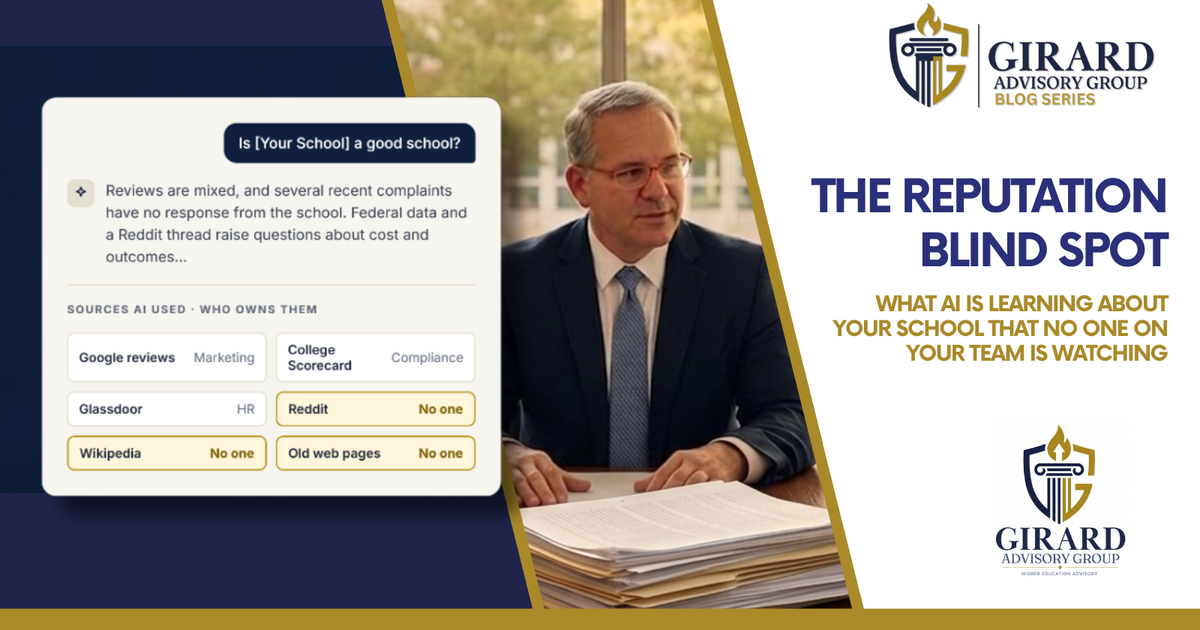
Here is the uncomfortable part. The AI is not reading your viewbook. It is reading your reputation, and that reputation is scattered across places most schools never look at together: reviews and whether anyone answered them, federal and accreditor records, employee reviews, Wikipedia, Reddit threads, old pages on your own website. Each of those sources belongs to a different department, or to no department at all.
In recent outside-in reviews of career colleges, I was surprised by how many schools were not paying attention to these reputational signals at all. Their marketing was active. Their compliance was in order. But no one owned the whole picture the AI was reading, and it showed in the answers. If you are not managing that picture, you have not stayed neutral. You have handed the microphone to the answer engine, and it will decide what your message is.
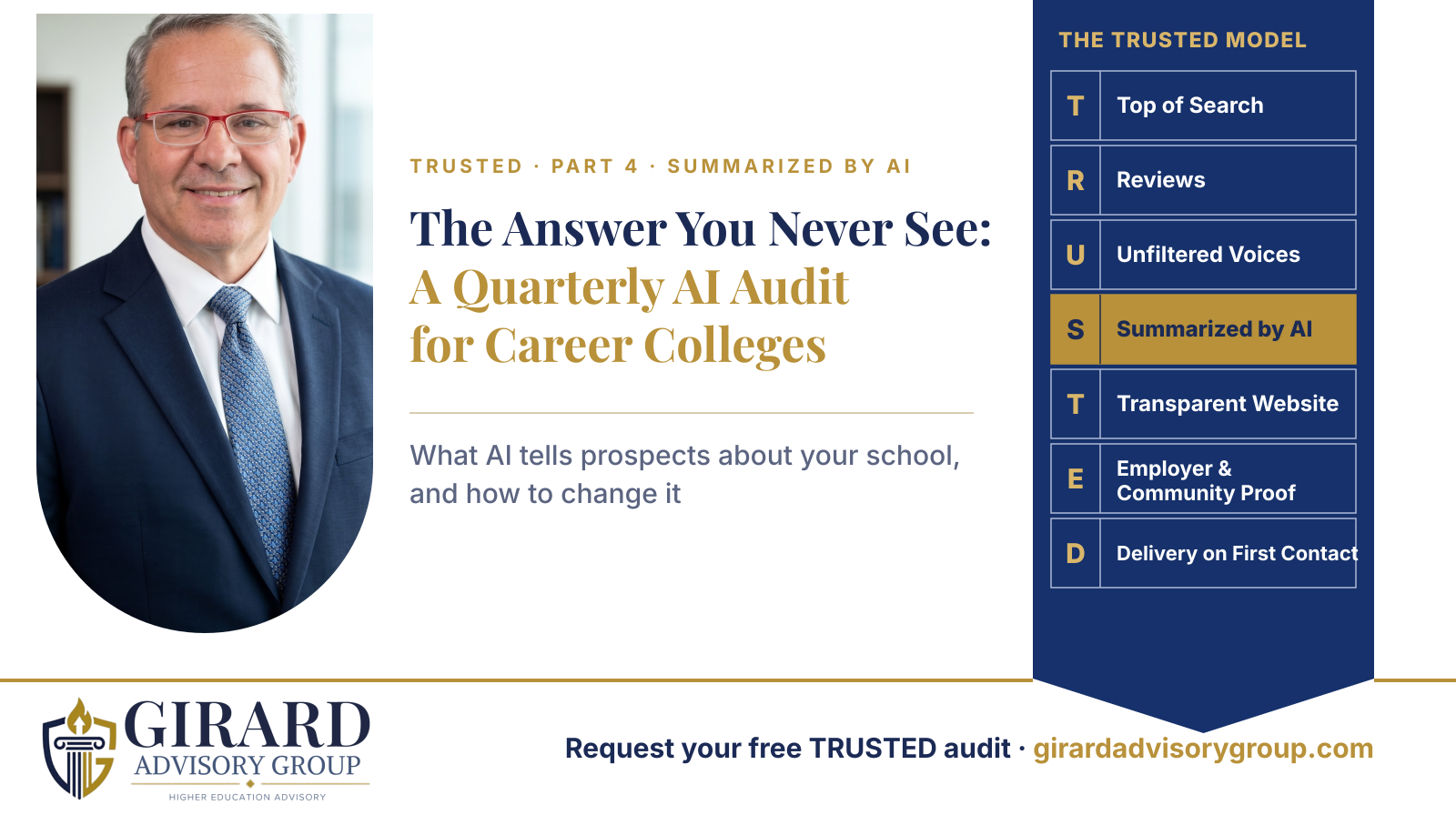
This post introduces the TRUSTED series: seven posts on how schools earn trust before a prospect ever inquires.
What AEO is, in plain language
Search engine optimization was about earning a spot on a list of links. Answer engine optimization is about earning a place inside the answer itself. Tools like ChatGPT, Gemini, Perplexity, and Google’s AI Overviews do not hand a student ten links to compare. They read many sources, decide what is true, and write one confident summary.
That shift has a measurable cost to anyone who still thinks of the website as the front door:
- Most searches no longer send a click. SparkToro’s 2026 analysis found that 68% of U.S. Google searches from January through April ended without a click to any website.
- AI answers make it worse. When an AI Overview appears, click-through to the results below it drops by close to 60%.
- Students often never reach you. In OHO’s March 2026 survey, nearly three-quarters of AI-using college researchers had received answers about a school without ever visiting its website. Among that group, AI and Google were nearly tied as the first place they turned.
In other words, the answer is the experience. For many prospective students, whatever the AI says about your school is the only thing they learn before deciding whether you are worth a phone call.
Why reputation, not your website, writes the answer
Most school leaders assume the AI pulls its answer from their website. Mostly, it does not. A June 2026 study of nearly 168,000 AI citations across 128 brands found that 85.7% pointed to sites the brand did not own. Only 14.3% came from the brand’s own properties. Wikipedia was the single most-cited domain in almost every language studied.
Think about what that means for a career college. When a student asks, “Is this school legit?” or “What do graduates say about this program?”, the assistant leans mostly on sources you do not control. The next section maps exactly what those sources are.
That is why I describe AEO as a reputation discipline first and a technical discipline second. Schema markup and well-structured FAQ pages help the AI read you accurately, a point I cover in AI Is Now Your Prospective Student’s First Advisor. But the AI will still check your homework against everyone else’s.
Students also trust the result more than they should. OHO found that 65% of AI-using students now rate AI information as accurate, up from 51% two years ago. Many trust an answer because sources are listed, not because they clicked through to check them. A citation looks like evidence, even when nobody reads it.
Any teacher will tell you that a misconception, once learned, is far harder to correct than a blank slate is to fill. AI answers work the same way. A student who “learns” something negative about your school in a 30-second exchange rarely comes back to unlearn it. They just move on to the next school on the list.
Nine places AI forms its opinion of your school
These are the reputation sources answer engines lean on most. Look at the last column. Almost every one belongs to someone different, and several belong to no one.
| Source | What the AI learns from it | Who usually owns it |
|---|---|---|
| Student reviews (Google, Niche, Indeed) | What the experience is like, and whether the school answers critics | Marketing, sometimes no one |
| Employee reviews (Glassdoor, Indeed) | Whether staff seem stable and supported, a signal that can surface when someone asks what a school is really like | HR, rarely monitored |
| Federal data (College Scorecard, College Navigator) | Cost, completion, and earnings, treated as objective truth | Compliance or institutional research |
| Accreditor and state board records | Whether the school is in good standing | Compliance |
| Complaints and legal records (BBB, lawsuits, settlements) | Whether there is a pattern of problems | Leadership, often reactive |
| Wikipedia | The “official” summary, often the most-cited source | No one |
| Reddit and community threads | What students say when the school is not listening | No one |
| Your own outdated web pages | Old tuition, retired programs, former leaders, presented as current | Marketing, but forgotten |
| Student-made video (TikTok, YouTube) | Unfiltered impressions of campus life and instruction | No one |
Two more forces sit on top of this list. Guilt by association: news about sector closures, a similarly named school, or your parent company can bleed into your answers. Inconsistent outcomes data: when placement or completion rates differ between your website, your disclosures, and federal data, the AI hedges or calls the information “unclear.” Neither one builds trust.
Silence is a statement
The most common gap I see is also the easiest to fix: reviews with no response. An answer engine never says “no comment.” If the school is silent, the AI still answers, using whatever it can find. A thoughtful reply to a complaint shows accountability and becomes part of the record the AI reads. Silence reads as indifference, or as agreement, and the critic gets the last word.
From the field: making reviews a weekly KPI
At a seven-campus network where I led marketing, we stopped treating reviews as something that would happen on its own. We made positive reviews a priority and put them on the weekly scorecard: two new reviews per campus, every week. Campus directors, not the marketing team, were accountable for securing them. Every review, positive or negative, also had to receive a response within 48 hours of being posted.
We were also deliberate about whose voices we asked for. Each week, we aimed for two kinds of review:
- An active student, ideally in the second semester of a two-semester program. By then, students have enough experience to speak credibly about instruction and support, and they are still engaged enough to want to share it.
- A graduate, employer, or partner. These reviews speak to outcomes, the thing prospects and AI tools care about most, and they come from people with no reason to flatter the school.
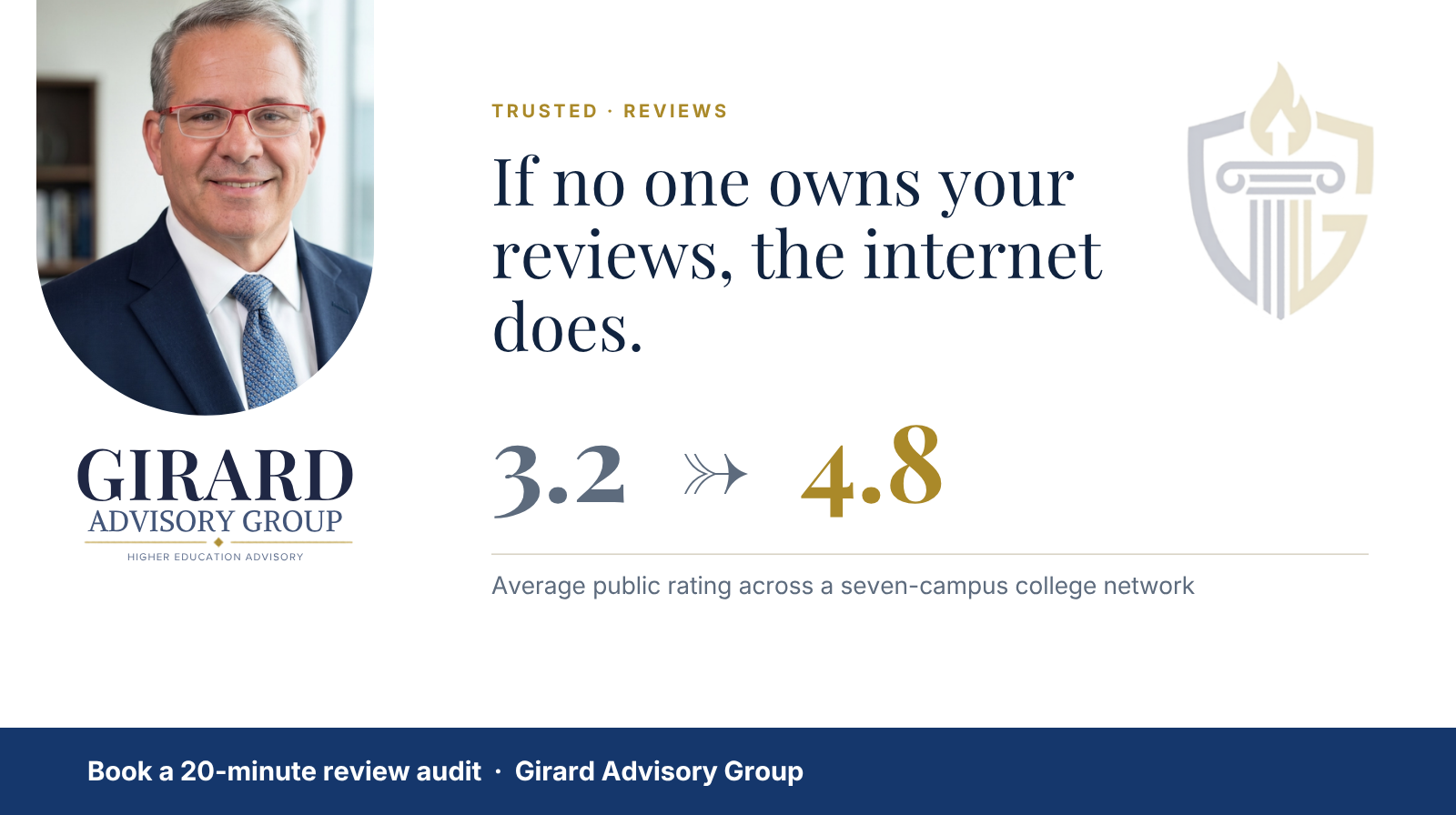
The result was a steady, current stream of authentic reviews. Over time, our average ratings climbed from the low 3s into the high 4s, and the recurring themes in those reviews, such as hands-on training and instructor support, became the story told about the schools. That is the point: when you give real people a reason and a moment to speak, they write your reputation for you, and the AI reads it.
Why it falls through the cracks
The schools I reviewed were not careless. They were organized the way most schools are organized. Marketing owns ads and the website. Compliance owns the regulatory record. HR owns hiring. Career services owns outcomes. Leadership handles complaints when they escalate.
Each department does its job well. But the AI does not read departments. It reads the whole public record at once and blends it into a single answer. When no one is responsible for that blended picture, small gaps compound: a stale page here, an unanswered review there, a Wikipedia entry no one has looked at in five years.
In accreditation terms, this is a governance gap, not a marketing gap. And like any governance gap, it closes with a named owner, a standard, and a regular review cycle.
Five moves to shape what AI teaches about your school
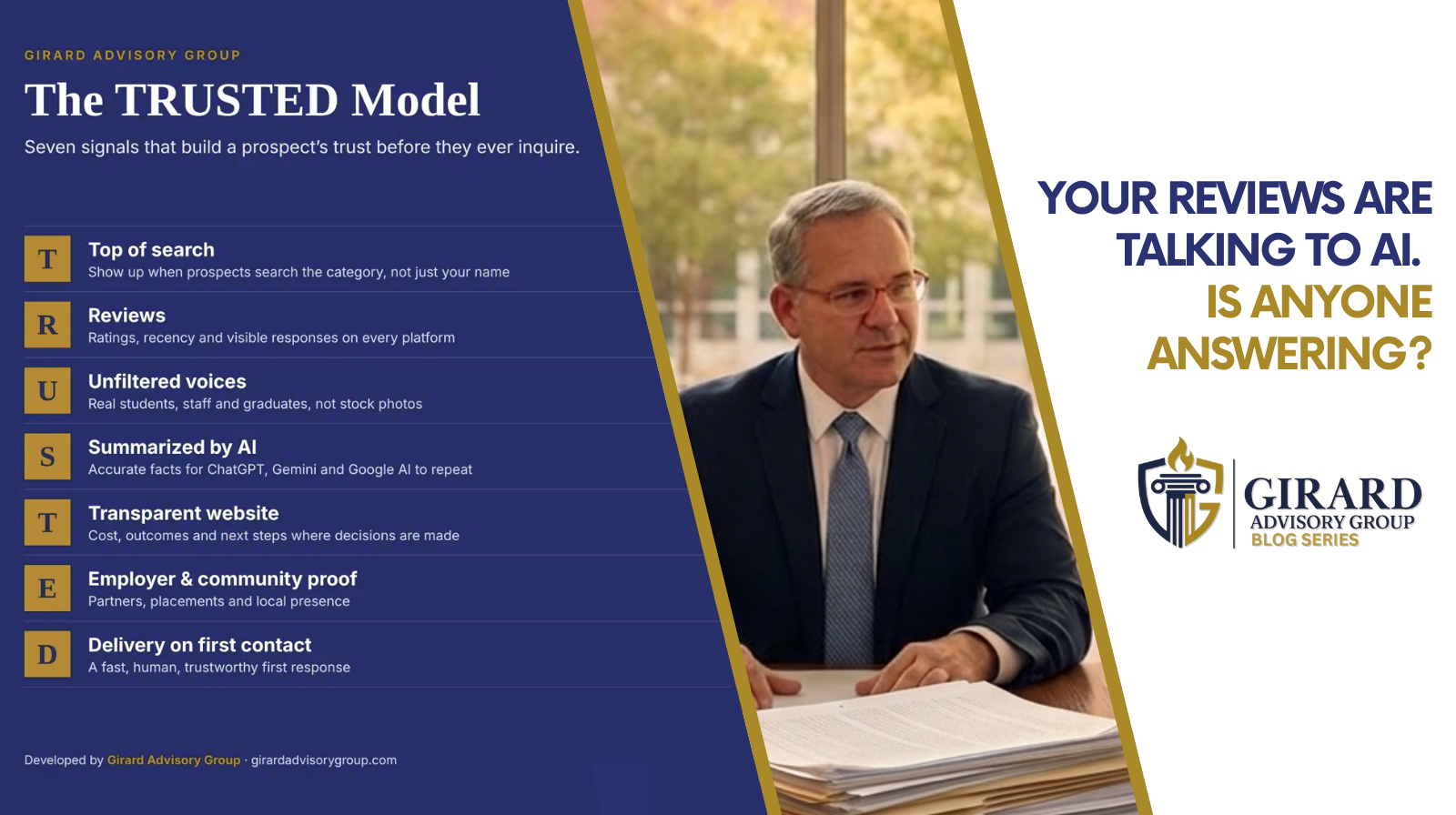
Reputation can be managed with the same discipline you already bring to accreditation: clear standards, named owners, and a regular review cycle. Each move below maps to the TRUSTED model, the pre-inquiry trust framework developed by Girard Advisory Group. Each element gets its own post in this series; what follows is the short version.
| Move | TRUSTED element | Who is involved |
|---|---|---|
| 1. Name an owner and review quarterly | Summarized by AI | Campus leadership, with every department below |
| 2. Run reviews as a system | Reviews | Student services, HR, marketing |
| 3. Make the public record say one thing | Top of search, Transparent website | Compliance + marketing |
| 4. Earn third-party proof | Employer and community proof | Career services + campus director |
| 5. Put real voices where AI looks | Unfiltered voices | Marketing + faculty |
1. Name an owner and hold a quarterly reputation review. Make one leader accountable for the blended picture, not just their slice of it. Each quarter, ask ChatGPT, Gemini, Perplexity, and Google the questions your prospects ask. Is this school accredited? What do graduates say? Is it worth the cost? Record each answer and the sources it cites, then walk through the nine sources above with marketing, compliance, HR, and career services in the room.
2. Run reviews as a system, not a hope. Ask students for reviews at natural high points, such as a completed externship, a passed certification exam, or graduation. Set a response standard: every review answered within 48 hours, by a real name, with a real next step. Apply the same attention to employee reviews, because the AI reads those too. Recency matters as much as the average rating.
3. Make the public record say one thing. Pick a single source of truth for cost, program length, and outcomes. Then make your website, catalog, Google Business Profile, directory listings, and disclosures match it, and know how your numbers appear on College Scorecard. Retire or redirect outdated pages. If your school has a Wikipedia entry, read it. Compliance teams already reconcile these numbers for accreditors; ask them to help marketing do the same for the public.
4. Earn third-party proof. The AI trusts what others say about you more than what you say about yourself. Invite local press to graduations and employer events. Ask hiring partners to post about your graduates. Get advisory board members to speak on the record. Every credible mention gives the AI one more independent source that tells the true story.
5. Put real voices where AI looks. Unpolished video of real students and instructors on YouTube does more than a stock-photo landing page ever will. Today’s students spot staged and AI-generated content quickly, and they discount it. Authentic voices become the evidence the AI quotes back.
One last element of TRUSTED belongs here too: Delivery on first contact. When a student does reach out, what they hear on the phone must match what the AI told them. If the answer engine says your school is responsive and your admissions team takes two days to call back, you have taught the student a contradiction.
The quarterly reputation review: a one-page checklist
- Ask four AI tools the top five questions prospects ask, and save the answers and cited sources
- Confirm every student review from the past 90 days has a response from a named person
- Scan employee reviews on Glassdoor and Indeed, and route themes to HR
- Check College Scorecard and College Navigator figures against your website and disclosures
- Confirm accreditor and state board standing is accurately reflected online
- Read your Wikipedia entry, if one exists, and note anything outdated
- Search Reddit and YouTube for your school name, and log new threads or videos
- Find and retire outdated web pages: old tuition, retired programs, former staff
- Verify your Google Business Profile hours, photos, and Q&A
- Assign an owner and a due date to every gap found
Your reputation is the curriculum
For most of my career, a school’s reputation traveled by word of mouth: a cousin who graduated, a high school counselor, an employer who hired your grads. That word of mouth still exists. It just runs through a machine now, at scale, around the clock, and it reaches students before you do.
The schools that win in this environment will not be the ones with the cleverest prompts or the most AI-generated content. They will be the ones that treat reputation as a shared responsibility, with one leader watching the whole picture the AI reads. Do that work, and the AI will teach the right lesson about you.
Next in the series: Top of search, and why the first page of results is now your front door. You can follow all seven elements on the TRUSTED framework page.
Want to know what AI is teaching prospective students about your school? Girard Advisory Group offers a free TRUSTED audit: an outside-in review of what students find before they ever inquire, with specific, prioritized fixes. Reach out at jpg@girardadvisorygroup.com to request yours.
Frequently asked questions
What is answer engine optimization (AEO)?
AEO is the practice of making sure AI tools such as ChatGPT, Gemini, Perplexity, and Google AI Overviews give accurate, favorable answers about your organization. Where SEO aims for a ranking on a list of links, AEO aims for a place inside the AI’s written answer.
How is AEO connected to brand reputation?
AI assistants build their answers mostly from sources a brand does not own, such as reviews, news coverage, public records, and community discussion. Your reputation across those sources largely determines what the AI says about you.
Can a school control what ChatGPT says about it?
Not directly. A school can influence it by keeping its public information consistent, earning steady reviews and third-party coverage, and publishing clear, structured answers to common questions on its own site.
How often should we check what AI says about our school?
At least quarterly, and after any major change such as a new program, a leadership transition, an accreditation action, or a burst of news coverage.
Who should own reputation and AEO at a career college?
One senior leader should own the blended picture, usually the campus director or a network-level operations or marketing leader. The work itself is shared: compliance owns the regulatory record, HR owns employee reviews, career services owns outcomes, and marketing owns the website and student reviews.
Do employee reviews affect what AI says about a school?
They can. AI answers about organizations as employers lean heavily on sites like Glassdoor, Indeed, and Reddit. When a prospect asks what a school is really like, that staff sentiment is part of the public record the AI may draw on. It is a low-cost signal to monitor.
Does AEO replace traditional SEO and advertising?
No. Many students still search the traditional way, and paid media still drives inquiries. AEO adds a parallel discipline focused on what students learn before they ever click. The complete seven-surface model is documented on the TRUSTED Pre-Inquiry Framework page.
Sources
- EAB, Nearly Half of High School Students Now Use AI in College Search (Feb 2026)
- OHO, Four in Ten Students Already Ask AI About Colleges. What Are They Learning About Yours? (Apr 2026)
- Search Engine Land, Google zero-click searches hit 68% in early 2026: Study (SparkToro data)
- Zatuchin, How Large Language Models Source Brand Reputation Across Languages and Markets (arXiv, Jun 2026)
Explore Topics
Written by
John P. Girard
John P. Girard is the founder of Girard Advisory Group and a thirty-year veteran of career and proprietary higher education, with hands-on leadership across enrollment growth, campus operations, accreditation and compliance, curriculum development, brand and marketing, and P&L management. Over three decades he has held roles spanning Campus Director, Campus President, Regional Campus Director, and National Director of Marketing & Digital Media Brand Management, leading multi-campus organizations through growth, accreditation, and operational turnarounds. That range — from the admissions floor to the boardroom — is what shapes his advisory approach: strategy that has to hold up in daily campus operations, not just on a slide. John holds a Master's degree in Teacher Education from the University at Albany, SUNY, and has served on the Board of the Ohio-Michigan Association of Career Colleges and Schools.