The Answer You Never See: A Quarterly AI Audit for Career Colleges

John P. Girard
Founder, Girard Advisory Group
AI assistants are answering your prospects’ questions right now — and most schools have never checked what they say. Part 4 of the TRUSTED series: a five-step quarterly audit any campus can run in two hours.
Somewhere tonight, a prospective student will type a question about your school into ChatGPT, Gemini, or Google. Is it legit? What does it cost? Do graduates get jobs? They will get a confident, well-written answer in a few seconds.
You will never see that answer. Neither will your admissions team. And unless someone on your staff has asked the same question recently, nobody at your school knows what it said.
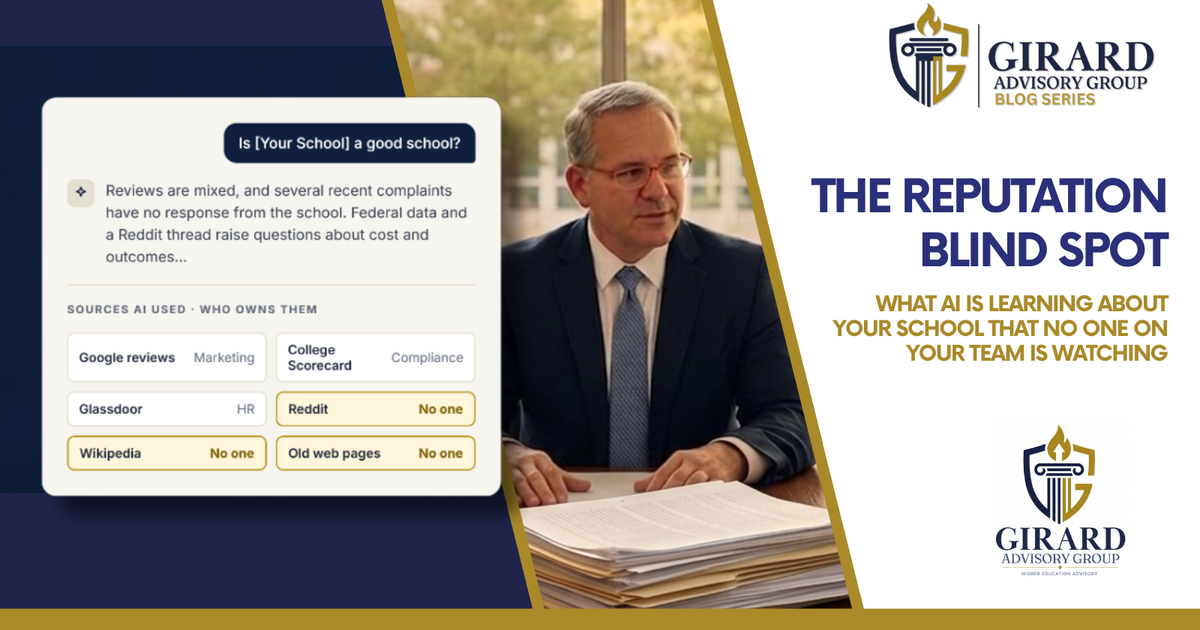
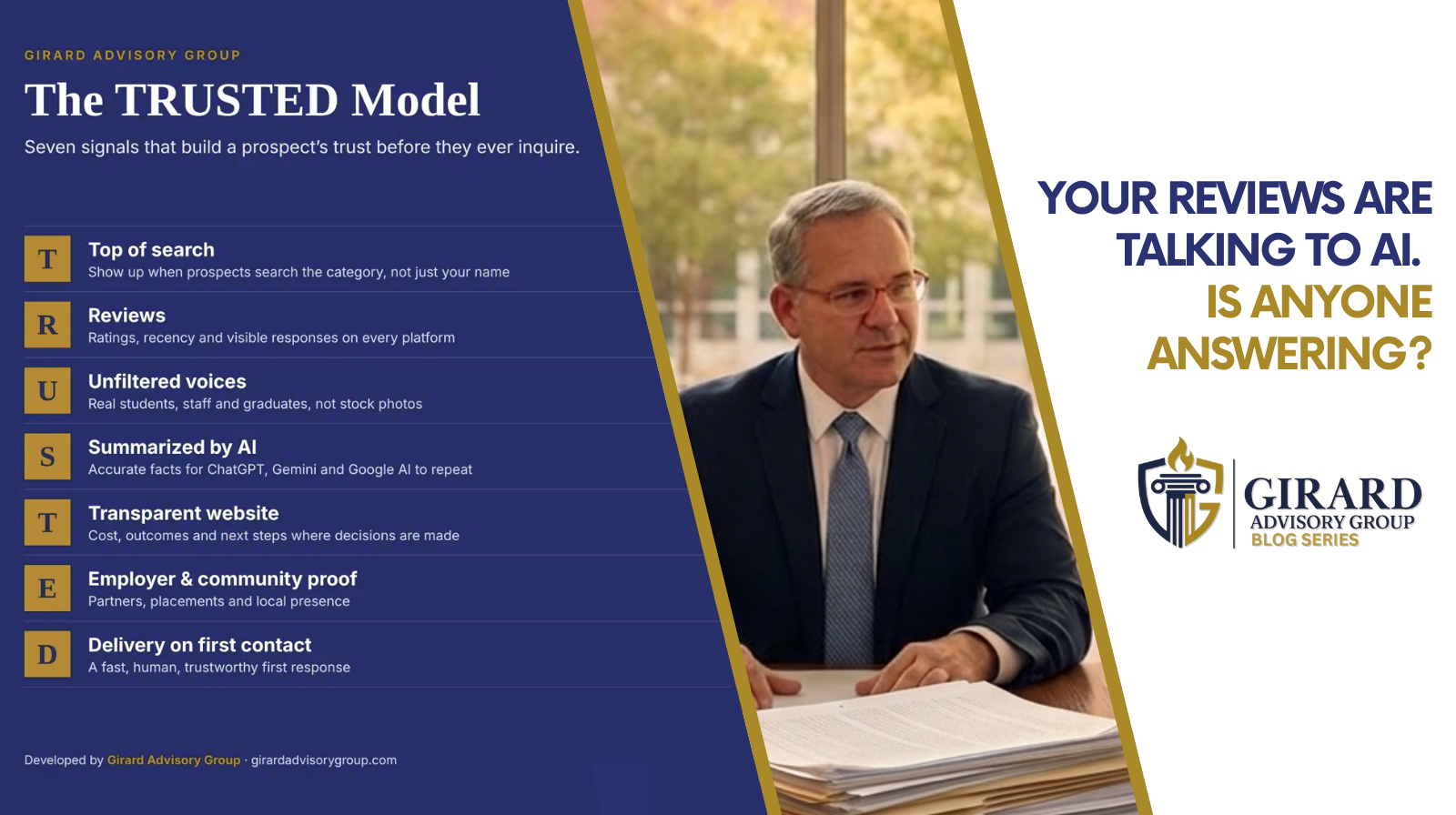
This is the fourth element of the TRUSTED model: Summarized by AI. It means the answer an AI assistant gives when someone asks about your school, built from your website, your reviews, federal data, Reddit, video, and everything else it can find. In the series opener, “The Reputation Blind Spot,” I argued that when a school is silent, AI writes the message for it. And in AI Is Now Your Prospective Student’s First Advisor, I made the broader case for why campus leaders should care. This post is about how to find out what that message is, and how to change it.
The method is simple: ask, every quarter, and write down what you hear.
AI is now the first advisor, and it is deciding
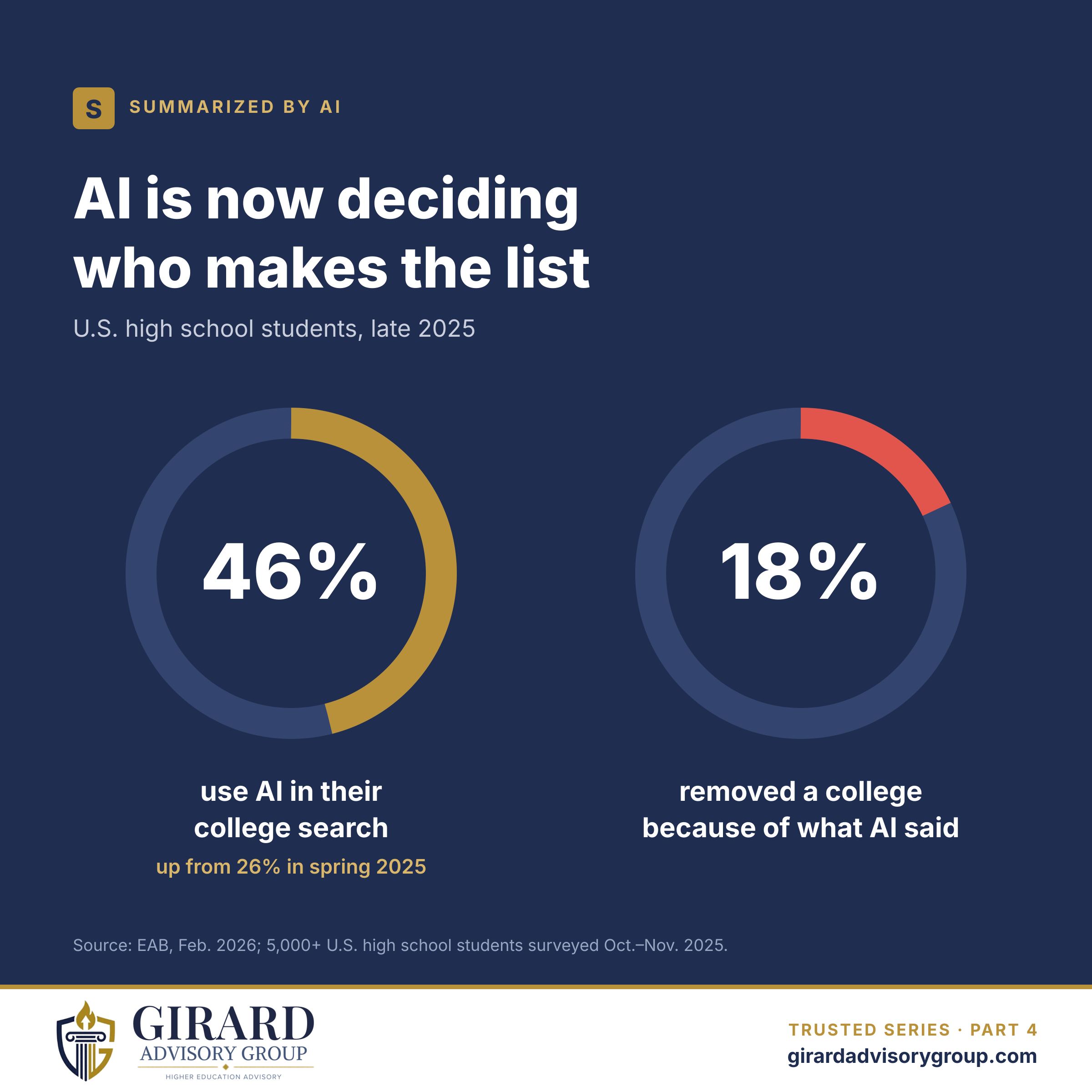
AI use in the college search nearly doubled in a year. EAB surveyed more than 5,000 U.S. high school students in late 2025 and found:
- 46% use AI in their college search, up from 26% in spring 2025
- 18% have removed a college from consideration based on what AI told them
The picture is similar for adults, the core of most career colleges. In Grand Canyon Education’s September 2026 survey of 1,518 U.S. adults researching degree programs:
- 87% have used or considered AI in their search
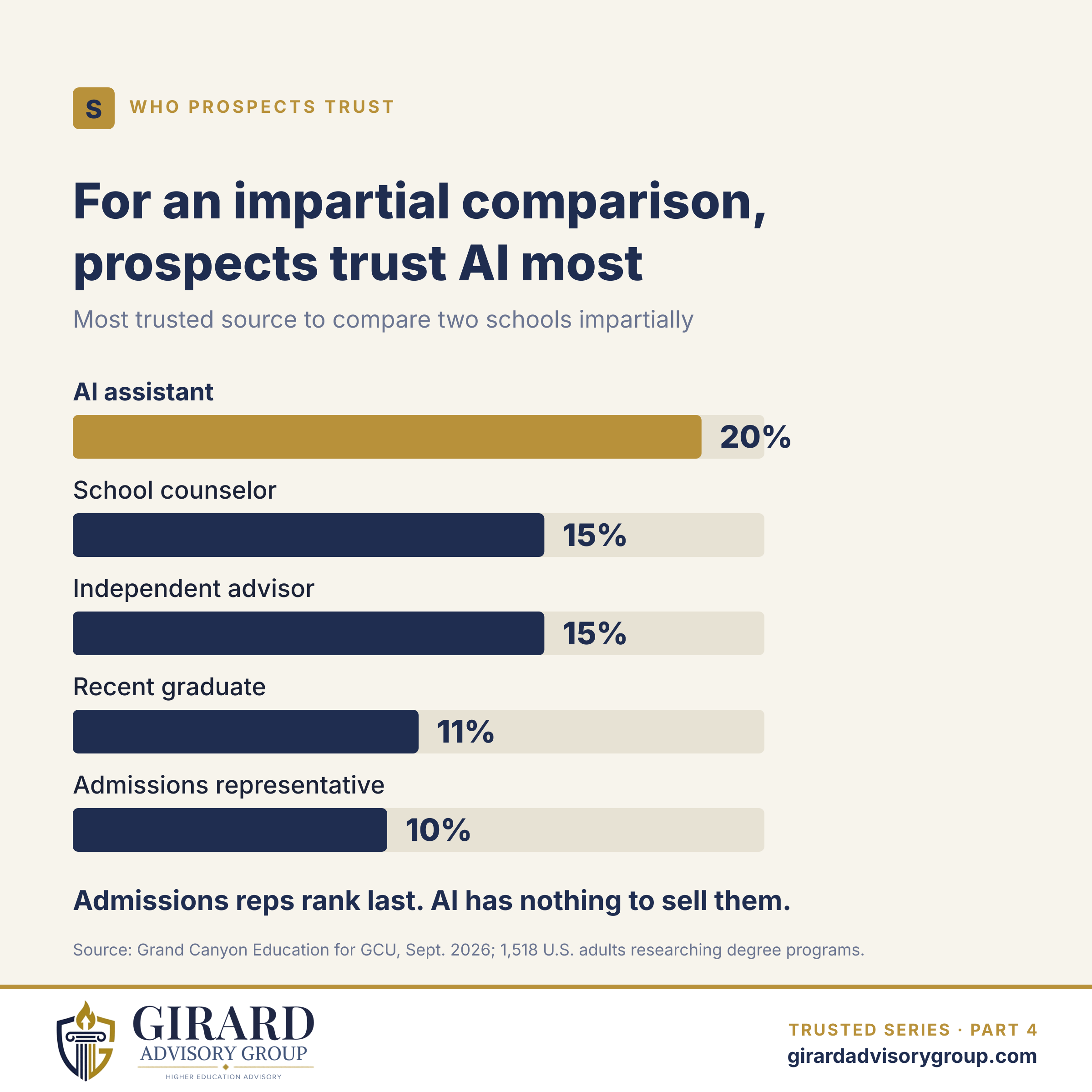
- An AI assistant was the most trusted source for an impartial comparison of two schools (20%), ahead of school counselors (15%) and admissions representatives (10%)
- The top tasks: finding schools that offer a program (35%), comparing tuition and fees (32%), and building a shortlist (28%)
That last list matters. Prospects are using AI for exactly the questions that decide whether you make the list at all. And they mostly don’t check its work. In a March 2026 survey by the agency OHO, nearly three-quarters of students had received answers about a college without ever visiting its website.
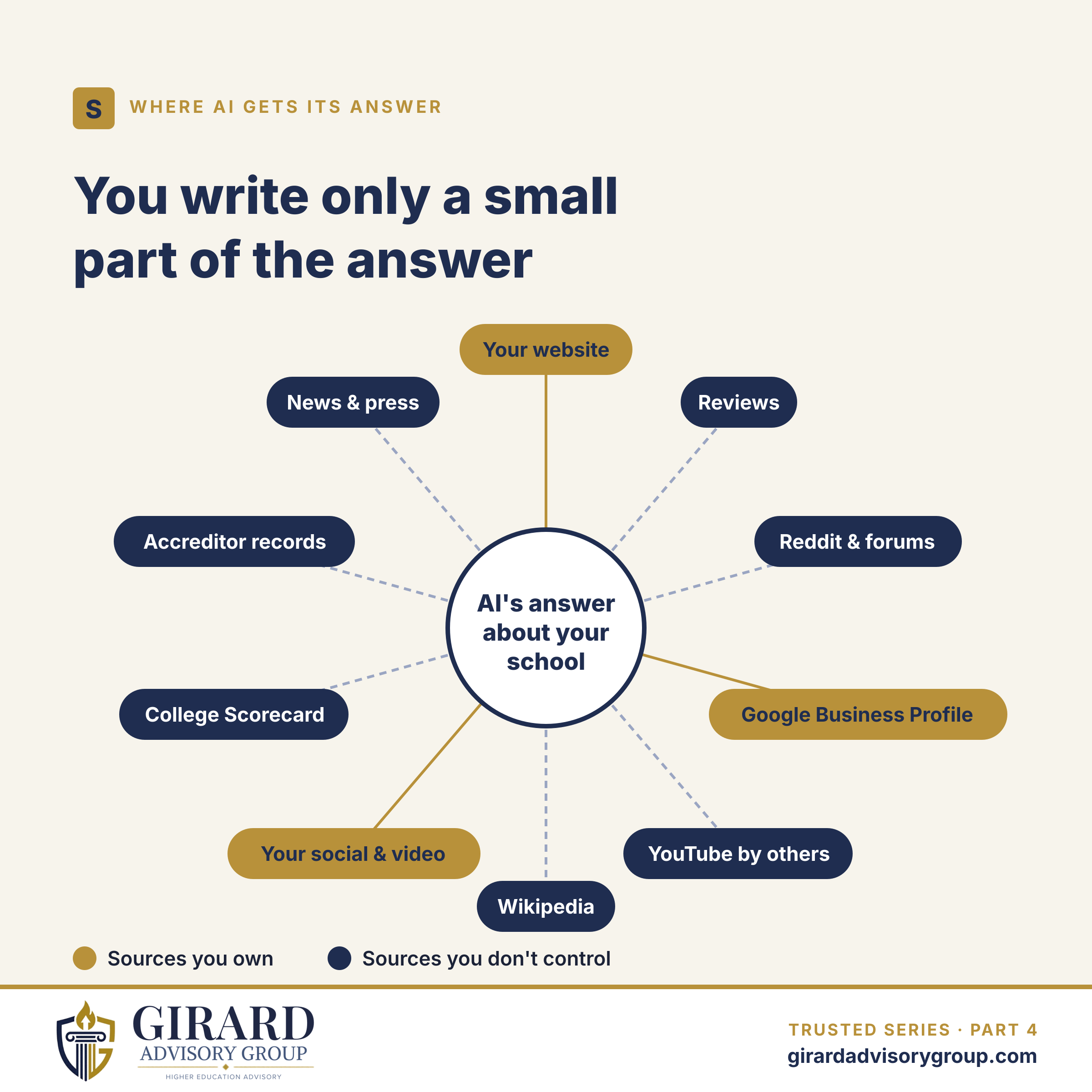
AI does not read only your website. Studies of AI citations show assistants lean heavily on sources the school doesn’t own: Wikipedia, Reddit, YouTube, review platforms, and comparison lists. Federal data like College Scorecard and your accreditor’s public records can be in the mix too. And the answers shift. In one study, only about 30% of brands stayed visible from one AI answer to the next for the same question. A single check tells you what AI said once. A quarterly audit tells you what it keeps saying.
The quarterly AI audit: five steps, about two hours
The audit is not a technical project. It is a structured version of what your prospects already do, run on a schedule, with the answers saved so you can see what changes.
1. Pick the assistants your prospects use. At minimum: ChatGPT, Google (the AI Overview and AI Mode), Gemini, and Microsoft Copilot. Add Perplexity if you have time. Run every prompt in a private or logged-out browser so your own history doesn’t shape the answer.
2. Ask the questions prospects ask. Use the same set every quarter so results are comparable. Ten prompts cover most of it:
| # | Prompt | What it tests |
|---|---|---|
| 1 | What is [school name]? | Basic identity and accuracy |
| 2 | Is [school name] legit? | Trust, accreditation, scam language |
| 3 | [School name] reviews | Which review themes AI repeats |
| 4 | How much does [program] at [school name] cost? | Cost accuracy |
| 5 | Do [school name] graduates get jobs? | Outcomes and where AI gets them |
| 6 | Best [program] schools near [city] | Whether you make the list at all |
| 7 | [School name] vs. [top competitor] | How AI compares you |
| 8 | Is [school name] accredited? | Accreditor and status accuracy |
| 9 | What do students say about [school name] on Reddit? | Unfiltered sentiment |
| 10 | Should I go to [school name] for [program]? | The bottom-line recommendation |
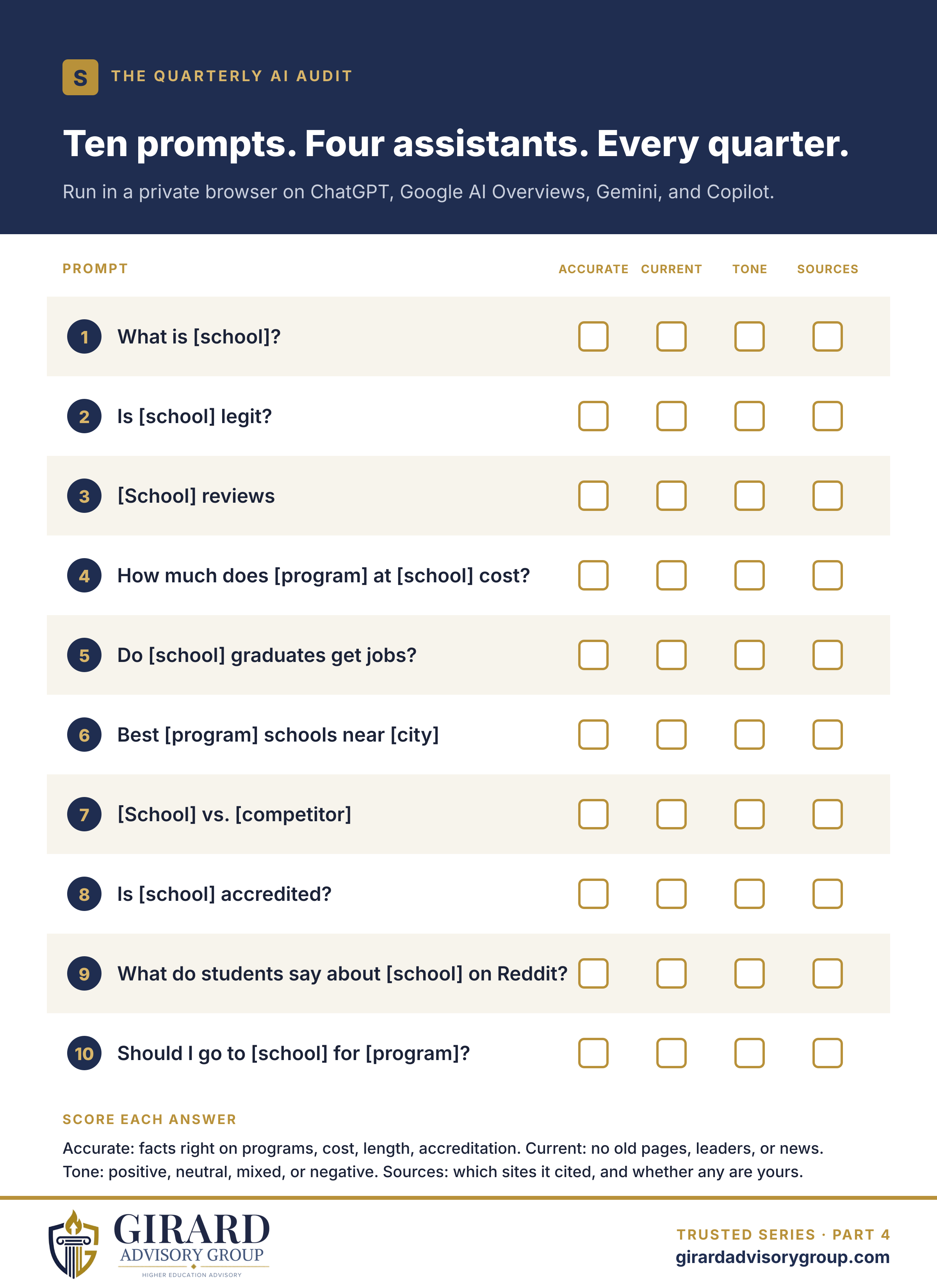
3. Score every answer the same way. For each prompt and assistant, record four things:
- Accurate? Are the facts right: programs, cost, length, accreditation, location, hours?
- Current? Is it citing old programs, old leaders, old pages, or old news?
- Tone? Positive, neutral, mixed, or negative, and why?
- Sources? Which sites did it cite, and are any of them yours?
4. Save the evidence. Screenshot or copy each answer into a shared folder, dated by quarter. A simple spreadsheet with one row per prompt and assistant is enough. The point is to compare this quarter to last quarter, not to build a dashboard.
5. Turn findings into owned fixes. Every problem the audit finds goes on a list with a named owner and a date. An audit that ends in a folder of screenshots changes nothing.
Download the free quarterly AI audit worksheet: all ten prompts on one page, with boxes to score each answer for accuracy, currency, tone, and sources.
Download the AI Audit Worksheet (PDF)Fixing what the audit finds
You can’t edit an AI’s answer directly. You can change what it reads. Nearly every problem an audit turns up traces back to a source, and every source has a logical owner.
| What the audit finds | Where AI likely got it | Who owns the fix |
|---|---|---|
| Wrong cost, length, or program list | Old web pages, outdated PDFs, third-party directories | Marketing, with the registrar |
| Wrong or missing outcomes | College Scorecard, old press, competitor comparisons | Career services and compliance |
| “Is it a scam?” language | Unanswered complaints, Reddit threads, news | Campus director and marketing |
| Negative review themes | Google, Niche, and other review platforms | Campus director (see Part 2) |
| School missing from “best [program] near me” | Thin Google Business Profile, few reviews, no comparison mentions | Marketing (see Part 1) |
| Old leaders, programs, or locations | Wikipedia, LinkedIn, stale news, old pages still live | Marketing and HR |
| Accreditation stated wrong | Old pages, accreditor directory, Wikipedia | Compliance |
| Thin or no student voice | Little real video or community content | Marketing and program leads (see Part 3) |
Make your own site easy to quote. Put clear, plain-language answers to the top prospect questions on your program pages: total cost, program length, schedule, accreditation, and outcomes, all matching your catalog and disclosures. Short question-and-answer sections help, and so does structured data that tells search engines what each page is about. Part 5 of this series, Transparent website, goes deeper.
Retire what’s wrong. Old program pages, expired PDFs, and outdated press releases keep getting read. Redirect them or take them down.
Correct the public record. Check your College Scorecard and College Navigator data, your accreditor’s directory listing, your Google Business Profile, and any Wikipedia entry. Where Wikipedia is wrong, request a correction through its talk page with a reliable source. Don’t edit your own entry directly; Wikipedia’s conflict-of-interest rules discourage it.
Treat consistency as a compliance issue, not just a marketing one. When your cost or outcomes read one way on your website, another on College Scorecard, and a third in your catalog, AI gives prospects inconsistent answers. Inconsistent public claims are also exactly what an accreditor or regulator notices. One set of numbers, matching everywhere, protects both your reputation and your standing.
Then re-run the audit next quarter. Changes take time to show up in AI answers. Tracking them quarter over quarter is how you know which fixes worked.
From the field: what the audits keep turning up
Over the past few weeks, I have run outside-in TRUSTED audits for several schools. Every one starts the same way: I ask the AI assistants what a prospect would ask, and I write down what comes back.
What surprised me most was not how often the answers were wrong. It was how rarely anyone at the school had looked. Marketing was active and compliance was in order, but nobody owned the question “what is AI telling people about us?”
The problems followed a pattern. Old program pages, still live, that AI quoted as current. Review complaints that went unanswered and resurfaced as themes in the AI summary. And in one case, an assistant tied a school to a data breach that had actually happened at one of its software vendors. To a prospect skimming the answer, that distinction disappears.
None of these took a big budget to fix. They took someone asking the question, on a schedule, and owning what they found. That is all the quarterly audit is.
Score yourself: Summarized by AI
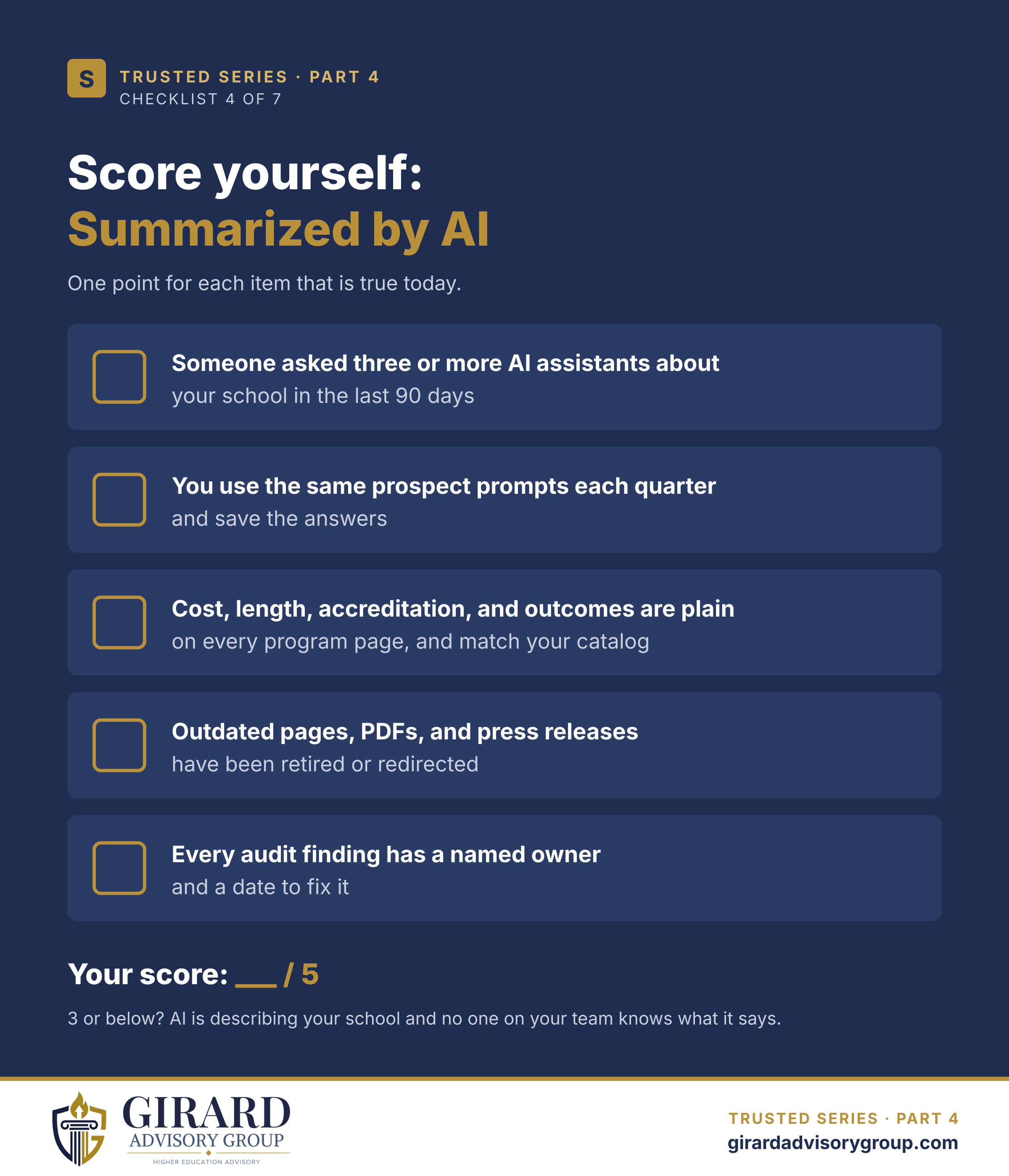
Give your school one point for each item that is true today. This is the fourth of seven checklists in the TRUSTED series.
- Someone has asked at least three AI assistants about your school in the last 90 days
- You use the same set of prospect prompts each quarter and save the answers
- Cost, program length, accreditation, and outcomes are stated plainly on every program page, and match your catalog
- Outdated pages, PDFs, and press releases have been retired or redirected
- Every audit finding has a named owner and a date to fix it
Your score: ___ / 5. A score of 3 or below usually means AI is describing your school and no one on your team knows what it says.
Ask the question before your prospects do
You already audit your files, your financial aid, and your placement records, because an accreditor will ask. Your prospects are asking AI about you right now, every day, and most schools have never checked the answer.
Put the AI audit on the calendar next to your other quarterly reviews. Ten prompts, four assistants, one spreadsheet, and a named owner for every fix. It is the cheapest piece of reputation management you will ever do, and the one most schools are skipping.
Next in the series: Transparent website, and why one set of numbers, matching everywhere, does more for trust than any redesign. You can follow all seven elements on the TRUSTED framework page.
Want to know what AI is telling prospects about your school? Girard Advisory Group offers a free TRUSTED audit: an outside-in review of what prospects find before they ever inquire, including what the major AI assistants say about you, with specific, prioritized fixes. Reach out at jpg@girardadvisorygroup.com to request yours. The complete seven-surface model is documented on the TRUSTED Pre-Inquiry Framework page.
Frequently asked questions
- What is an AI audit for a school?
- A structured check of what AI assistants such as ChatGPT, Gemini, Copilot, and Google’s AI Overviews say when prospects ask about your school. You run the same prompts each quarter, score the answers for accuracy, currency, tone, and sources, and assign fixes.
- How often should we run it?
- Quarterly is enough for most schools. AI answers shift from one run to the next, so a single check can mislead. Comparing quarter to quarter shows the real trend.
- Can we change what AI says about us?
- Not directly. You change what it reads: your own pages, your reviews and responses, your public data, and what others say about you. Accurate, consistent, current information across those sources is what moves the answer over time.
- Who should own the audit?
- Marketing can run it, but the fixes cross departments. Compliance owns accreditation and disclosure accuracy, career services owns outcomes, and campus directors own reviews. Treat it like any other cross-department review, with a named owner per finding.
- Do we need special software?
- No. A private browser, a set of prompts, and a shared spreadsheet are enough to start. Paid AI-visibility tools can help at scale, but they don’t replace someone reading the answers the way a prospect would.
- What if AI says something false about us?
- Find the likely source and fix or correct it there: retire the old page, update your Google Business Profile, respond to the review, or request a correction on Wikipedia’s talk page with a reliable source. Then check again next quarter.
Sources
- EAB, AI in College Search Survey (Feb 2026; 5,000+ U.S. high school students, surveyed Oct–Nov 2025)
- Grand Canyon Education and Cherry Data Signals for Grand Canyon University, How AI, Social Media and Reddit Are Reshaping the Way Students Choose a College (Sep 2026; 1,518 U.S. respondents)
- OHO, Four in Ten Students Already Ask AI About Colleges. What Are They Learning About Yours? (Apr 2026; 530 respondents)
- AirOps, AI Search Statistics (Oct 2026; vendor research compilation on AI citation sources and answer volatility)
Explore Topics
Written by
John P. Girard
John P. Girard is the founder of Girard Advisory Group and a thirty-year veteran of career and proprietary higher education, with hands-on leadership across enrollment growth, campus operations, accreditation and compliance, curriculum development, brand and marketing, and P&L management. Over three decades he has held roles spanning Campus Director, Campus President, Regional Campus Director, and National Director of Marketing & Digital Media Brand Management, leading multi-campus organizations through growth, accreditation, and operational turnarounds. That range — from the admissions floor to the boardroom — is what shapes his advisory approach: strategy that has to hold up in daily campus operations, not just on a slide. John holds a Master's degree in Teacher Education from the University at Albany, SUNY, and has served on the Board of the Ohio-Michigan Association of Career Colleges and Schools.