Culture Is a Leadership Output: Making CARING+ Real
John P. Girard
Founder, Girard Advisory Group
How career college leaders turn a culture model into daily practice through experience, trusted peer coaches, protected dialogue, and sustained accountability.
When I published the CARING+ Model of Campus Engagement, Mike Gutierrez — the campus director I built it with — made an observation that sharpened the whole argument. The toughest and most satisfying part was getting associates to buy into the concept. The most surprising outcome was not on the student side at all. It was how associates began treating one another: year-over-year turnover under one percent and employee satisfaction at an all-time high.
Both observations are about leadership. The first names the actual work. The second names what that work can produce when it lands. This is the part I underplayed in the original CARING+ piece: what leadership has to do for a culture model to become a culture rather than a binder.
The uncomfortable premise
Whatever culture a campus has right now is the culture its leadership has built, permitted, or failed to notice. That is not a motivational statement. It is a diagnostic one.
If associates are short with students under pressure, someone decided that pressure was acceptable and that the behavior it produced was survivable. If advisors approach students as a list of deficiencies to correct, someone hired for that, trained it, or modeled it. If the front desk treats a struggling student as an interruption, that is not a front desk problem.
Culture is not what leaders announce. It is what leaders design, model, reward, and tolerate. Of those four, tolerate does the most work. The real standard is the worst behavior leadership walks past.
What we were actually changing
At the college, advising was the lynchpin of the student-success model. It was deliberately structured as a collective, interdepartmental function rather than a department. Admissions, financial aid, student services, career services, and instruction each carried advising responsibility. Every one of those people had a distinct role in a student’s development and, in practice, was an advisor.
That structure was a strength, and it was also why change was difficult. There was no single team to convert. The change had to move through five functions with different reporting lines, pressures, vocabularies, and ideas about what a student conversation was for.
Underneath that sat something harder than structure. Advising largely operated from a deficit lens: what is wrong, what is missing, what needs remediation, what puts this student at risk. The proposed change was a different lens entirely: identify, affirm, and build on what a student is already good at, then make that the organizing principle of the conversation. Not ignoring obstacles — reordering which one comes first and what the student walks out believing about themselves.
Why rolling out a culture model fails
This was not a new procedure or a form to complete differently. It asked experienced professionals across five departments to abandon an instinct they believed was responsible practice and adopt one that, on first hearing, could sound softer and less rigorous.
That is a change of worldview. It has to happen inside individual people before it can happen anywhere else. A directive can produce compliance behavior: the language changes in the meeting and the practice stays the same. Mental models change through experience and dialogue, not instruction.
Leaders often treat culture work as a communication problem, so they communicate harder: a bigger launch, a better deck, more repetition. But resistance is not necessarily a comprehension failure. People may disagree, remain unconvinced, or have survived previous initiatives that evaporated. The sequence below worked because it addressed that reality.
The sequence that worked
Let people experience it before you explain it
We did not begin by teaching a strengths-based philosophy. We began by putting a small group of campus leaders through it themselves. Each person assessed their own strengths and spent focused time working with the results.
Someone who has been seen for what they are good at, rather than audited for what they lack, does not need to be persuaded that the experience matters for students. They have felt the difference. This is the highest-leverage stage in the sequence, and it is often skipped because it is slow and does not initially look like student work.
Start small and choose for influence, not rank
We did not launch campus-wide. We identified a pilot group drawn from the functional leaders connected to advising: instruction, student support, admissions, financial services, and career services. Functional position mattered, but informal influence mattered more.
The people who carry culture are internal networkers: people who already talk to everyone, whose opinion carries weight informally, and who can get others talking to one another. Culture spreads through relationships, not org charts. A pilot group selected only by title chooses for authority and against influence. In the CARING+ framework, these individuals are the seed carriers of the I Belong condition — the people through whom belonging spreads before it becomes a campus-wide standard.
Those individuals became coaches for their own teams, not trainers delivering a module. Change delivered by an outsider gets evaluated. Change delivered by a respected colleague gets adopted.
Give teams protected time to think together
Each team spent structured time every week in dialogue about their own strengths and how to apply them in their work with students. A weekly meeting can sound unremarkable, but culture is shared understanding, and shared understanding is constructed when people surface what they believe and hear respected colleagues describe how they would handle a real situation.
That cannot be shortcut with a memo. It requires protected, recurring time whose explicit purpose is thinking together rather than reporting status. The willingness to spend real staff hours on that is where leadership commitment becomes visible. Everyone can tell the difference between a priority that gets calendar time and one that gets a mention.
Embed it in something real, then in hiring
Only after the perceptual work was underway did we formally build it into processes. We integrated strengths into the first-year seminar, where every new student received structured group advising each week with deliberate connection points across instruction, student support, financial aid, and career services.
Embed too early and people follow a procedure without believing. Embed too late and belief has no structure to live in. Sustainability then becomes a leadership function: new associates need the same personal strengths experience at orientation, with a coach attached, so they enter the culture rather than encounter it secondhand. Over time, hiring should select for the talents the culture needs. Culture is far cheaper to hire than to install.
The transferable architecture
Strip out strengths-based advising and CARING+ entirely and the architecture still applies to any change that requires people to think differently rather than merely do differently:
- A small pilot group chosen for influence, not rank, drawn from every function the change touches.
- Personal experience before explanation, so the group can carry a change it has felt rather than merely heard about.
- Trusted colleagues coaching their own teams in the context of real work.
- Recurring, protected time for dialogue rather than a one-time launch.
- Embedding in one visible workflow before extending the change across the institution.
- Onboarding and hiring as the mechanism that keeps the work from being reinstalled every two years.
This structure works for a technology implementation, a compliance overhaul, a curriculum redesign, or a customer-service standard. Most change efforts fail not because the idea was wrong, but because the organization was told rather than involved. The architecture inverts that pattern: small before large, experience before explanation, colleague before authority, and recurring before one-time.
One caution: choose the pilot group honestly. The temptation is to select agreeable people who will not slow things down. That produces a group with no credibility. Include at least one respected skeptic. If the change cannot survive contact with them, it will not survive contact with the campus.
The four things leadership actually does
Peter Senge described leaders of change as designers, stewards, and teachers. I would add a fourth role: coach and mentor.
- Designer. Leaders create the conditions in which people can change how they think: the pilot group, structured experiences, weekly dialogue time, and safety to try something that may not work.
- Steward. Leaders keep the vision visible after the initial energy fades. Stewardship is the same message, expectations, and standard past the point where the leader is bored of repeating them.
- Teacher. Leaders keep the learning going rather than declaring the training complete. A culture that stops learning calcifies into rules.
- Coach and mentor. Leaders share their own experience, including where they got it wrong. A leader who cannot describe their own failure has not given anyone permission to admit theirs.
Notice that none of these roles is announcer. The launch meeting is the smallest part of the job and the part most leaders overweight.
The outcome we did not design for
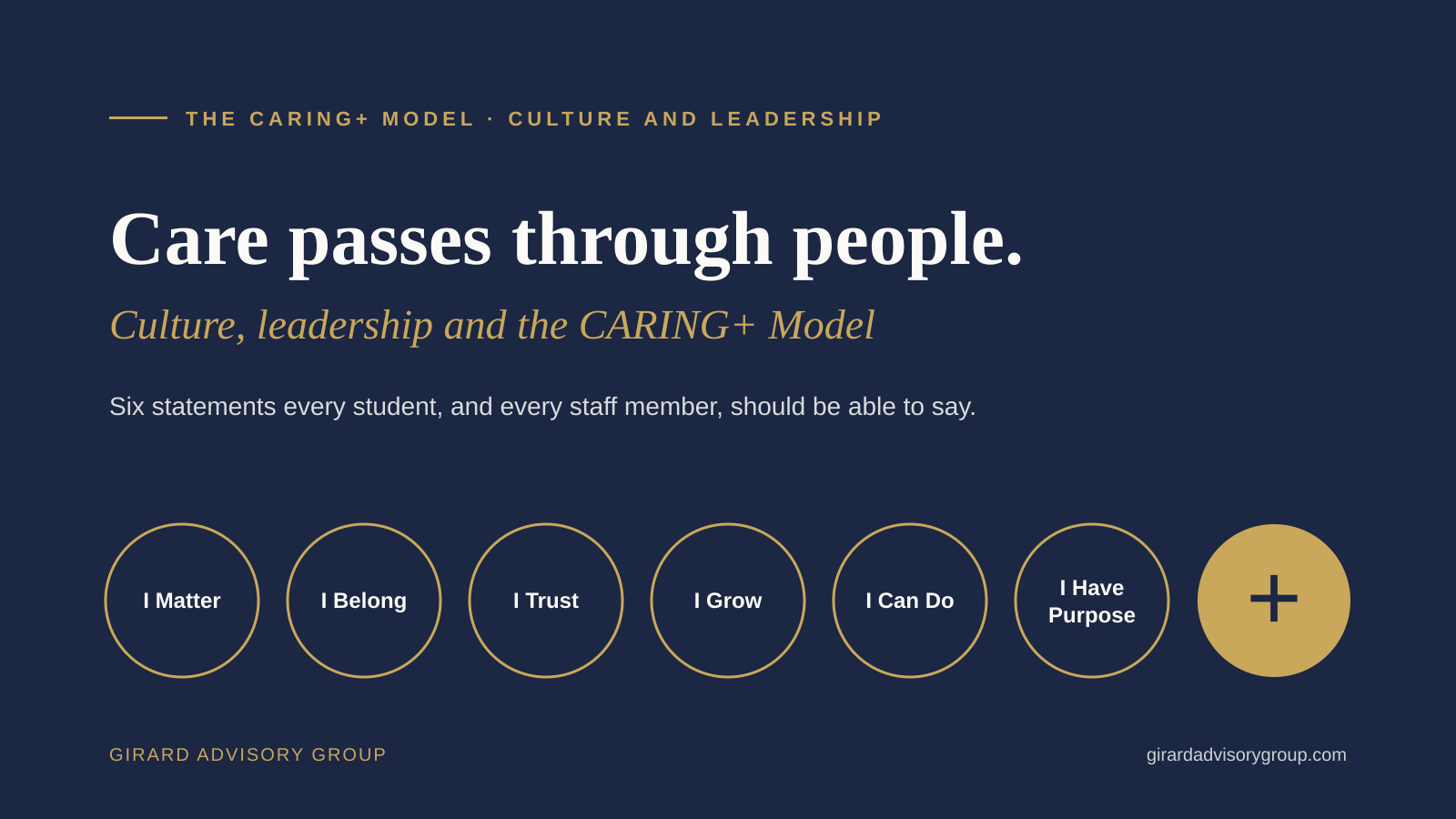
We built the model for students. The most durable effect was on associates. In hindsight, it should have been predictable. We framed the model reciprocally from the beginning: I Matter, You Matter. I Belong, You Belong. We treated that as a training device. It turned out to be the mechanism.
You cannot ask people to make students feel they matter while they themselves feel invisible. Emotional labor is not sustainable on empty. When leadership applied the same standard internally — people were seen for their strengths, their contributions were named, and they were not audited primarily for deficiency — student-facing behavior became sustainable and the campus became a place people did not want to leave.
“The part of the journey that was most satisfying and the toughest was getting all associates to buy into the concept. The most surprising outcome was how we as associates treated each other. Our turnover rates year over year were less than 1% and employee satisfaction was at an all-time high.”
Michael Gutierrez
Mildred Elley College
Campuses are complicated, and many things change at once. But a strengths-based, high-care culture is not simply a cost center offset by student outcomes. It is also a staff-retention strategy. In a sector where turnover in admissions, advising, and instruction is chronically high and expensive, that may be the more immediate business case.
What I would tell a leader considering this
- Do not announce it. Start with a small group and let the work be noticed rather than proclaimed.
- Expect the timeline to be uncomfortable. Behavior can shift within a term; culture takes years because it must survive departures, difficult cases, and pressure.
- Do not delegate it. A culture model owned by a coordinator while senior leadership continues as before will be read correctly as optional.
- Watch what you tolerate more closely than what you say. One retained high performer who treats colleagues badly teaches the campus more about the real standard than any training can.
- Include yourself in the standard. If the model does not apply to how leadership runs meetings, gives feedback, or handles mistakes, everyone learns what it is really for.
- Resist measuring it too early. First-quarter compliance metrics can be fully satisfied while nothing meaningful changes.
The through-line
Consistency is credibility. AI is changing where trust gets formed. A caring culture is the asset a competitor cannot copy. This is the part that makes any of it real.
A framework is a claim about what an institution intends. Culture is what leadership actually builds, models, and refuses to walk past. Everything else is documentation.
Frequently Asked Questions
We tried a culture initiative before and it faded. Why would this be different?
It will not be different if it is run the same way. Most efforts fade because they were announced rather than experienced, delegated away from senior leadership, or given no protected time. Those are leadership decisions and they are within your control.
Do we have to use a strengths assessment?
The instrument matters less than the experience of being seen for strengths before being asked to do that for students. Any credible method that creates that experience can serve.
How do we handle people who will not get on board?
Distinguish skeptics from refusers. Skeptics often become strong adopters when they see evidence. How leadership handles a respected, high-performing refuser is the clearest signal the campus receives about whether the change is real.
Where does this show up financially?
Student retention and graduation improve slowly and are difficult to attribute cleanly. Staff turnover often moves sooner and is easier to cost out, making associate retention a practical year-one business case.
The CARING+ Model of Campus Engagement was developed collaboratively at the Albany campus of Bryant & Stratton College by John P. Girard, Mike Gutierrez, and Gina Cassidy. The change approach described here draws on Peter Senge’s work on learning organizations, David Cooperrider’s Appreciative Inquiry, and Frank Barrett’s work on appreciative learning cultures. The complete five-condition model is documented on the CARING+ Model of Campus Engagement page.
Explore Topics
Written by
John P. Girard
John P. Girard is the founder of Girard Advisory Group and a thirty-year veteran of career and proprietary higher education, with hands-on leadership across enrollment growth, campus operations, accreditation and compliance, curriculum development, brand and marketing, and P&L management. Over three decades he has held roles spanning Campus Director, Campus President, Regional Campus Director, and National Director of Marketing & Digital Media Brand Management, leading multi-campus organizations through growth, accreditation, and operational turnarounds. That range — from the admissions floor to the boardroom — is what shapes his advisory approach: strategy that has to hold up in daily campus operations, not just on a slide. John holds a Master's degree in Teacher Education from the University at Albany, SUNY, and has served on the Board of the Ohio-Michigan Association of Career Colleges and Schools.