Care Passes Through People: Culture, Leadership and CARING+
John P. Girard
Founder, Girard Advisory Group
Care passes through people: staff treat students the way leadership treats staff. How the CARING+ Model builds culture for staff and students alike.
Every campus I have walked into had its values on a wall. Not one of them had its culture there.
Culture lives in smaller places. It is in whether the instructor is in the room before the students are. It is in what happens when a student misses two days and whether anyone calls. It is in how a director talks about the admissions team when the admissions team is not in the room.
I have led five campuses and been part of the turnaround at each one. The pattern has never changed: culture is the sum of what leaders do, tolerate, and repeat. Students and staff read that long before they read the mission statement.
The CARING+ Model gave me a way to lead that on purpose. This post is about how.
Culture is a leadership outcome
Leaders tend to treat culture as something that happens to them. They inherit it, complain about it, and commission a survey on it. Then they go back to managing the numbers.
The numbers are the culture, measured late. Retention, graduation, placement, staff turnover and reviews are all downstream of thousands of daily encounters between people. A leader does not control those encounters. A leader sets the conditions that shape them.
Three things set those conditions:
- What you model. People copy the leader’s behavior, not the leader’s memo.
- What you tolerate. The standard on your campus is the lowest behavior you have let pass without comment.
- What you measure and celebrate. Staff learn what matters from what gets asked about on Monday morning.
Students are watching all three. Enforce an attendance policy while faculty arrive late, and students learn the policy is about power, not about them. Advertise an open door culture behind closed doors, and they learn to stop knocking.
The CARING+ Model in one page
CARING+ began at the Albany campus of Bryant & Stratton College. I built it with Mike Gutierrez, then the campus director, and Gina Cassidy, then the director of career services. The campus had graduation rates under 40 percent and weak semester-to-semester retention. We stopped asking what was wrong with our students and started asking what a student needs to be able to say in order to stay.
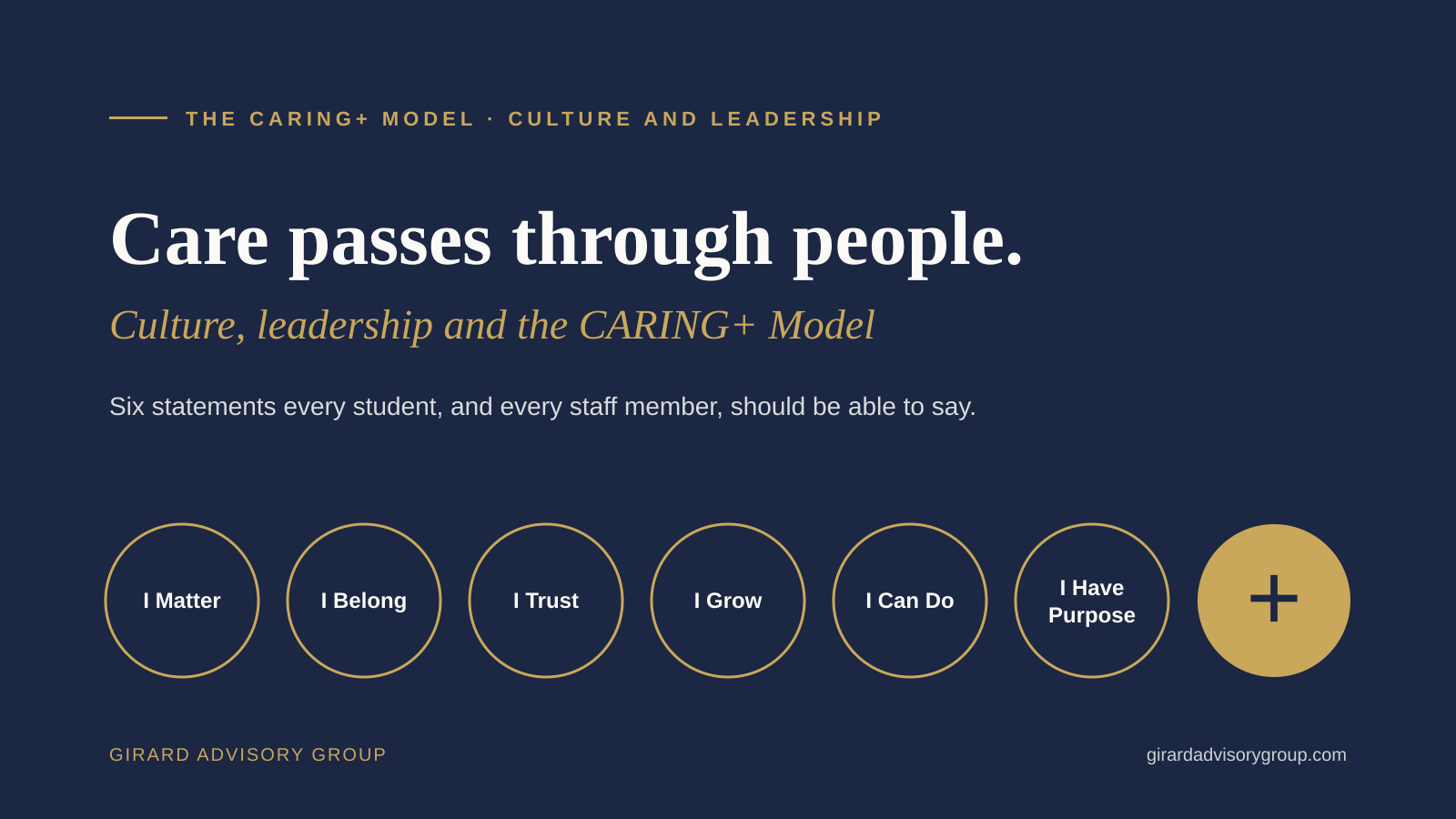
The model is those answers. It is not an acronym. It is six statements, in the student’s own voice:
| Statement | What the student is telling you |
|---|---|
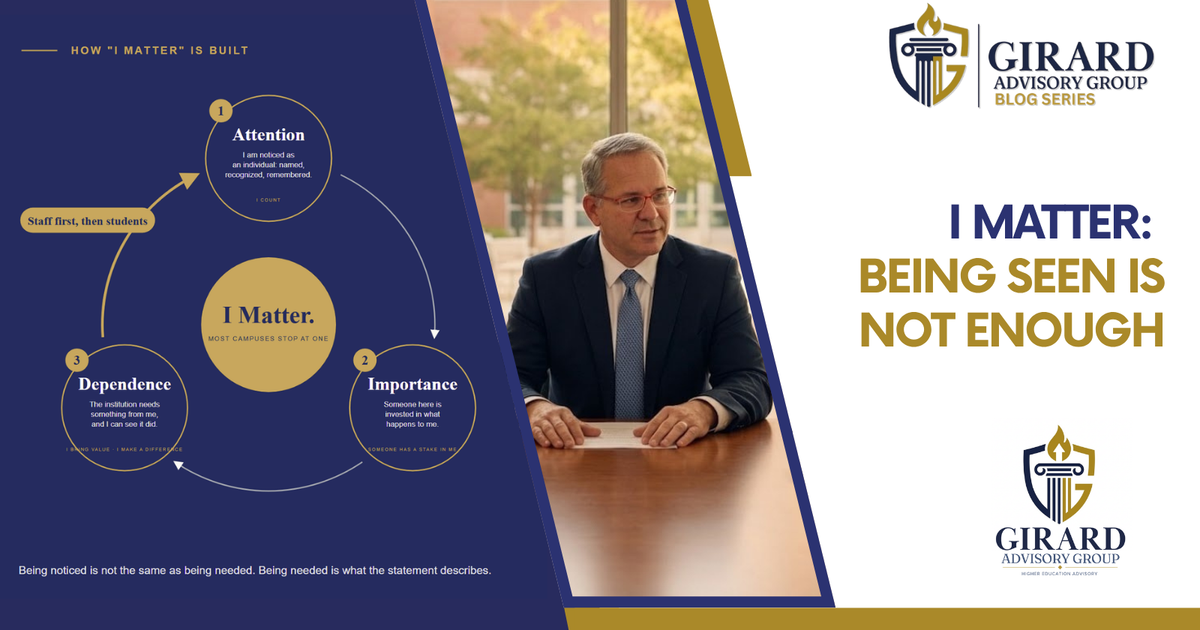
| I Matter | Someone here would notice, and miss, what I contribute. |
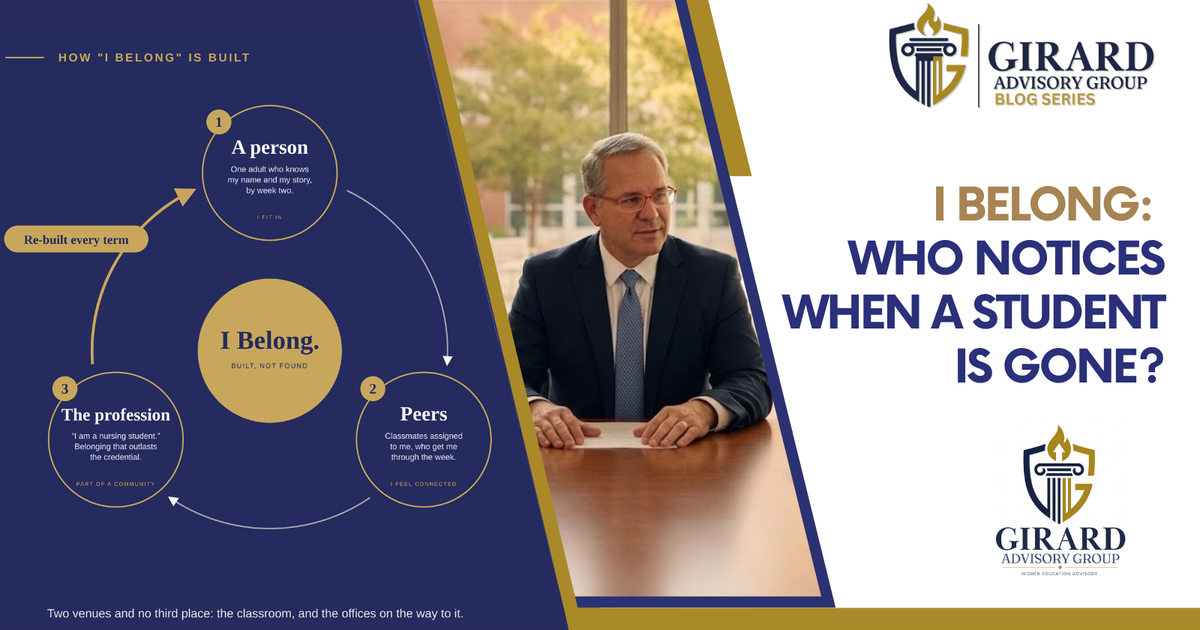
| I Belong | I have a place with these people and in this profession. |
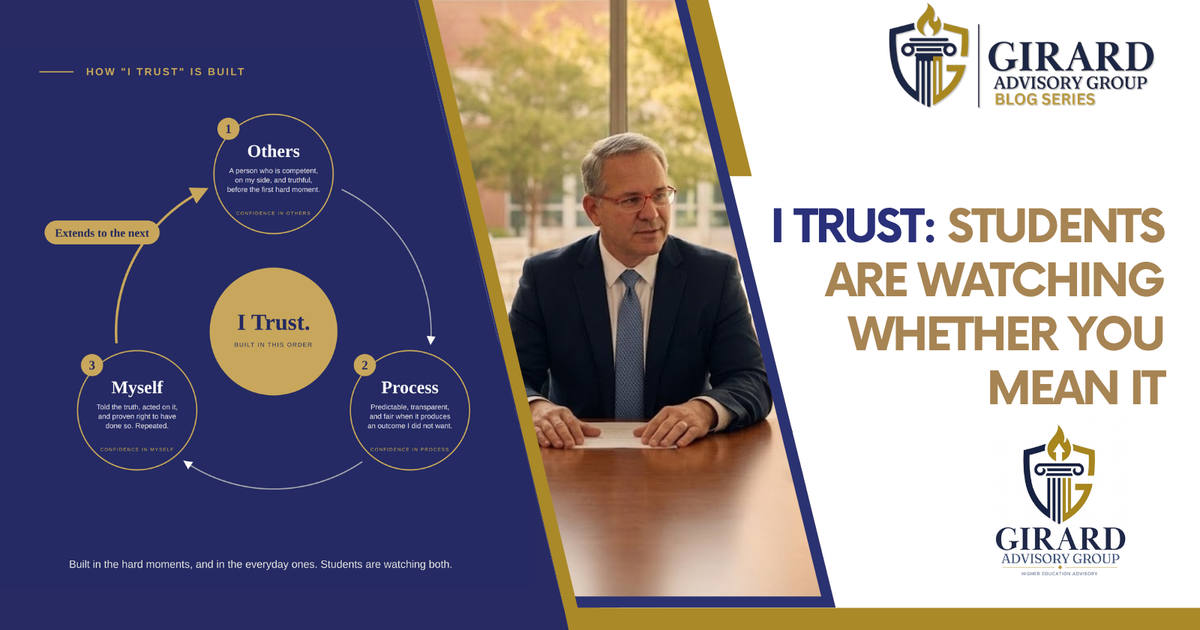
| I Trust | What this school says and what it does are the same thing. |
| I Grow | I can see my own progress, and so can someone else. |
| I Can Do | I believe I am capable of the work in front of me. |
| I Have Purpose | I know where I am going, how I get there, and that it is worth it. |
A student who can say all six is very hard to lose. A student who cannot say two or three is already leaving, whether or not the withdrawal form has been filed.
Albany went from that starting point to the highest-retention campus in the system, year after year. It held that position after I left for my next campus, which is the real test of a culture. It was not dependent on one person.
The plus is where leadership lives
The six statements describe the student. The plus describes everyone else.
The plus is a reciprocal standard: staff will treat students the way leadership treats staff. You cannot ask an advisor to make a student feel that they matter if that advisor feels invisible in your building. Care does not pass through people who are not receiving any.
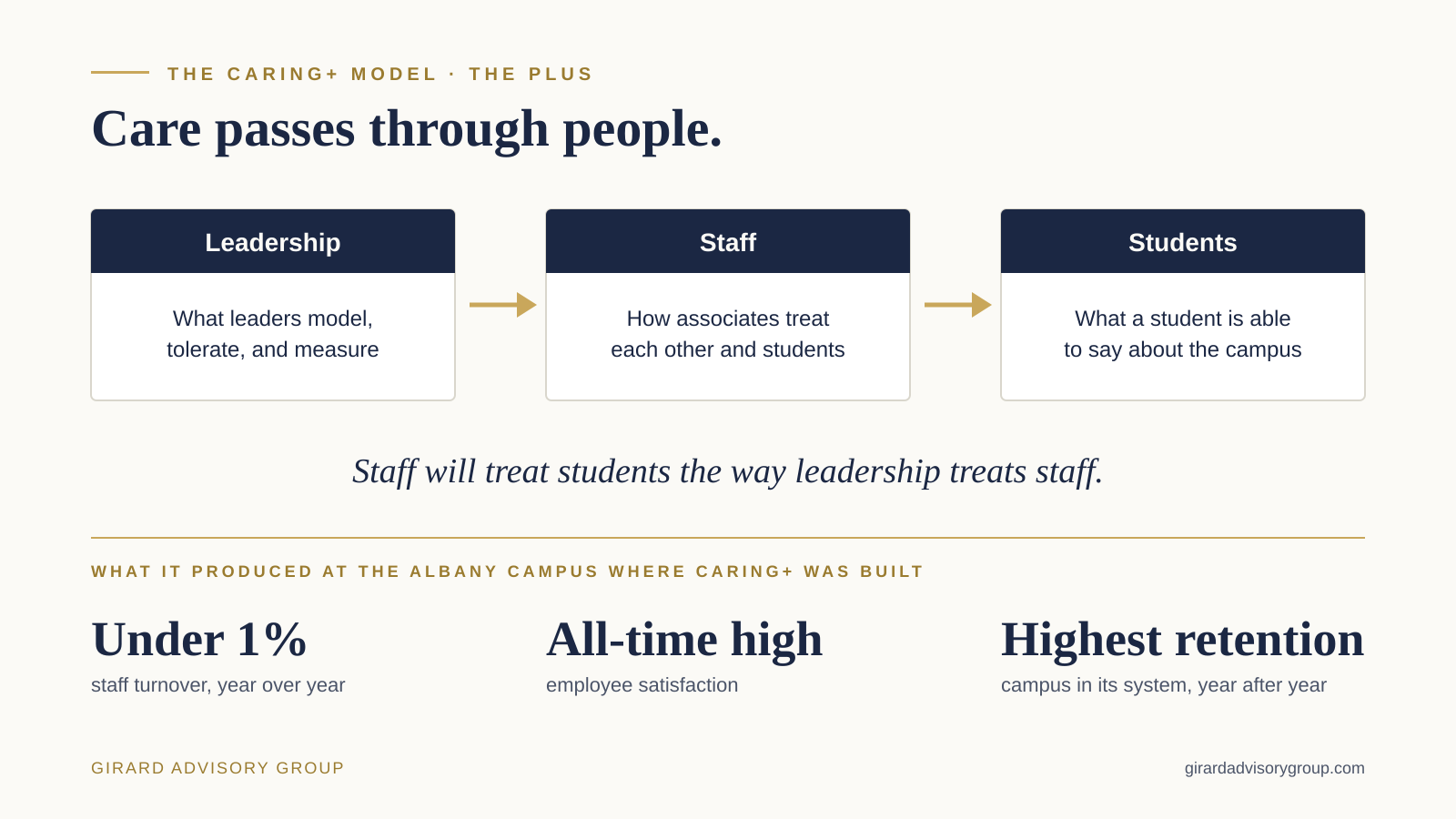
That is why CARING+ was for the staff as much as it was for the students. Every associate on the campus deserved to say the same six statements about their own work: I matter here, I belong here, I trust the people leading me, I am growing, I can do this, and my work has purpose.
Getting there was not quick. Buy-in was the hardest part of the rollout. Mike Gutierrez, who directed the campus, described what happened once it took hold:
“The most surprising outcome that came out of this model was how we as associates treated each other. Our turnover rates year over year was less than 1% and employee satisfaction was at an all time high.”
Mike Gutierrez, co-creator of the CARING+ Model
Picture how that reaches a classroom. A dean sits in on an instructor’s class. Under the old habit, the follow-up meeting opens with a list of what went wrong. Under CARING+, it opens with what the instructor did well, names one thing to work on, and sets a date to come back and see it. The instructor is assessed on delivering the CARING+ behaviors, and those behaviors are acknowledged in the review session.
The next week that instructor hands back a failed exam. Instead of writing “see me” at the top, she tells the student that missing on a first attempt is expected, shows exactly where the gap is, and schedules the second attempt. She is doing for the student what was just done for her. No one trained her to do it that week. She had experienced it.
This is why I call CARING+ a leadership model and not a student services program. The retention gains were real, but they followed from something else: a staff who could say the six statements about their own work.
Six things a leader does on Monday
Read the statements again, this time in the voice of someone who works for you. Each one turns into a leadership behavior.
- I Matter: give people work the place would miss. Attention is not enough. People need a role where their absence would be felt. Name what each person carries, and say it out loud in front of others.
- I Belong: notice who is missing. At one campus I built a daily routine around students absent two days in a row, with a named person accountable for the outreach. The same rule applies to staff. Who has gone quiet in your meetings?
- I Trust: close the gap between the message and the behavior. Deliver hard news with the truth, the reason, your belief in the person, and the next step. Then make sure your own conduct matches every policy you enforce.
- I Grow: lead from strengths, not deficits. I once had a career services director who was failing in the role. That person had real empathy and a drive to lift people up. I moved them to student services, where they excelled and later became a campus director.
- I Can Do: build confidence through evidence. Set a goal people can hit this week, then show them the scorecard. Confidence follows small, visible wins. It does not follow speeches.
- I Have Purpose: connect the task to the student. A file audit is tedious until someone explains that a clean file is a graduate who gets hired. Say why the work matters every time you assign it.

None of this is soft. At a campus I took over while it was on accreditor reporting for student outcomes, I ran a daily standup, weekly metrics with a named owner for each, and tight admissions accountability. First-year retention moved from 57 percent to 72 percent. Accountability and care are not opposites. Accountability is how people know you meant it. But the leadership is in the delivery, and in the care you show while you hold the standard. The same expectation can build a person up or shut them down, depending on how it is delivered.
Hiring follows the same logic. Over time I replaced much of that faculty with people who fit the CARING+ culture. Skill can be taught. The disposition to care about whether a student makes it cannot be installed after the fact.
Four ways leaders kill it
A culture of care takes years to build and one exception to damage. These are the four I have seen most often.
- The exempt star. A top performer who is allowed to ignore the standard tells everyone else the standard is negotiable. Results do not buy an exemption from how people are treated.
- Praise in the meeting, criticism in the hallway. Staff hear both. Once they know a leader talks about people behind their backs, they assume they are next, and trust is gone.
- Rules that only point down. A leader who asks for scorecards but never shares their own, or who enforces punctuality and arrives late, teaches that policy is about rank.
- Asking and not acting. A survey or a listening session with no report back is worse than not asking. People learn the question was a formality and stop answering honestly.
Start with one question
You do not need a rollout plan to begin. Ask your leadership team one question this week: which of the six statements could our own staff not say today?
The honest answer tells you where your culture is leaking. It also tells you which student statement is at risk, because the two almost always match. A staff that does not trust leadership will not build trust with students. A staff that cannot see its own growth will not notice a student’s.
If you would rather measure it than guess, that is what the CARING+ Pulse is for. It asks the same six questions of staff and of students, on one page each. The staff form is anonymous and it is read first, because the staff answers predict the student answers. Run it before the term starts, then put the two sets of results side by side.
Then pick one behavior from the list above and do it visibly for 30 days. Culture does not change when a leader announces it. It changes when people see the same behavior often enough to believe it.
The values on the wall can stay. Just make sure the hallway agrees with them.
Frequently asked questions
What is the CARING+ Model?
The CARING+ Model is a culture framework built on six first-person statements: I Matter, I Belong, I Trust, I Grow, I Can Do, and I Have Purpose. A campus is healthy when students and staff can both say all six. The plus is the reciprocal standard that staff will treat students the way leadership treats staff.
Is CARING+ for students or for staff?
Both. It was written in the student’s voice, but it was for the staff as much as for the students. Staff who cannot say the six statements about their own work will not be able to create them for anyone else.
Does campus culture really affect retention?
Yes. Retention is the result of thousands of daily encounters between students and staff. At the Albany campus where CARING+ was built, graduation rates started under 40 percent. The campus became the highest-retention campus in its system, year after year.
Can accountability and care exist together?
They have to. Accountability is how people know the standard is real. The leadership is in the delivery, and in the care shown while holding the standard.
How long does buy-in take?
Longer than most leaders plan for. Buy-in was the hardest part of the rollout at Albany. Start with a small group of people others already listen to, and expect to model the behavior yourself well before anyone copies it.
How do you measure culture?
Ask the six questions. The CARING+ Pulse puts the same six statements to staff and to students several times a term and tracks the percentage who answer yes. The staff results are read first.
Does this apply outside higher education?
The six statements describe people, not schools. Any organization where staff serve customers, clients or patients runs on the same reciprocal standard.
Related reading
- The CARING+ Framework — the canonical framework page that sequences the full series
- The CARING+ Model of Campus Engagement — the original post introducing the framework
- Culture Is a Leadership Output: Making CARING+ Real — how leaders turn the model into daily practice
- I Matter: Being Seen Is Not Enough
- I Belong: Who Notices When a Student Is Gone?
- I Trust: Students Are Watching Whether You Mean It
- I Grow: Why Students Have to See It to Believe It
- I Can Do: Students Decide They Can Finish Before They Finish
John P. Girard is the founder of Girard Advisory Group and a co-creator of the CARING+ Model. Download the CARING+ Pulse to see where your campus or organization stands on the six statements, or get in touch.
Explore Topics
Written by
John P. Girard
John P. Girard is the founder of Girard Advisory Group and a thirty-year veteran of career and proprietary higher education, with hands-on leadership across enrollment growth, campus operations, accreditation and compliance, curriculum development, brand and marketing, and P&L management. Over three decades he has held roles spanning Campus Director, Campus President, Regional Campus Director, and National Director of Marketing & Digital Media Brand Management, leading multi-campus organizations through growth, accreditation, and operational turnarounds. That range — from the admissions floor to the boardroom — is what shapes his advisory approach: strategy that has to hold up in daily campus operations, not just on a slide. John holds a Master's degree in Teacher Education from the University at Albany, SUNY, and has served on the Board of the Ohio-Michigan Association of Career Colleges and Schools.