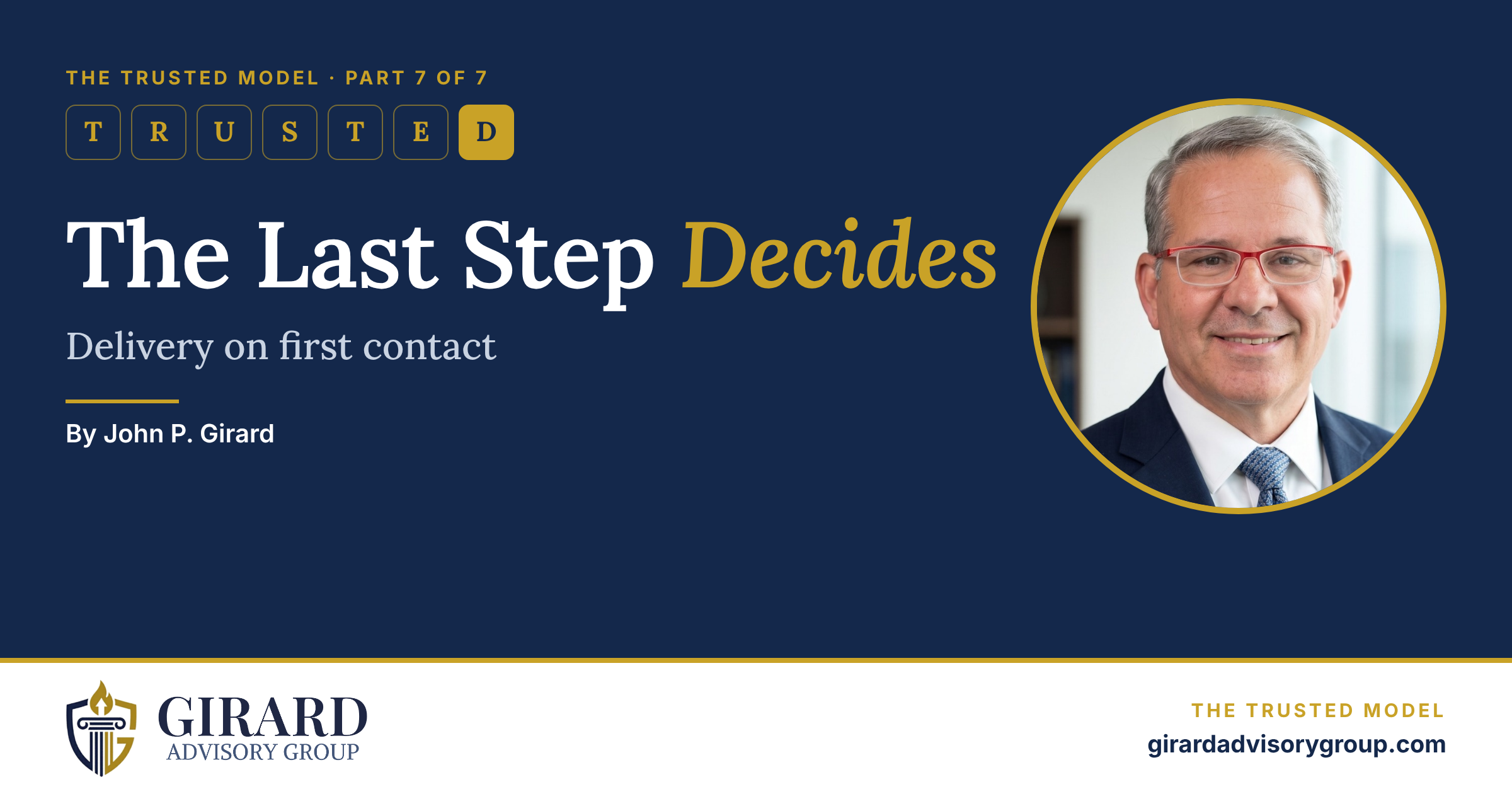
The Last Step Decides: Delivery on First Contact

John P. Girard
Founder, Girard Advisory Group
By the time a prospect fills out your form, they’ve already decided you might be worth trusting. The first call is where your school confirms that decision or breaks it. Part 7 of the TRUSTED series: speed to lead, honest first conversations, and the four handoffs that keep the promise.
By the time a prospective student fills out your form, they have already decided you might be worth trusting. The first contact is where your school confirms that decision or breaks it.
Think about what happened before the inquiry. They searched your name. They read the reviews. They watched your students on video, asked an AI assistant about you, checked your website for cost and outcomes, and maybe heard from an employer who hires your graduates. Six elements of the TRUSTED model did their work, and none of them involved your admissions team.
Then the prospect raises a hand. Everything they learned set an expectation: this school is responsive, honest, and knows what it is doing. The first call, text, or email is the first time they can test that against a real person.
This is the D in TRUSTED: Delivery on first contact. It is the last element because it comes last in the prospect’s journey. It is also the only one where a single employee, on a single afternoon, can undo months of work by everyone else.
I wrote about why inquiries go cold in The Contactability Problem. This post goes one step further. The question is not only whether you reach the prospect. It is whether the school they reach matches the school they were promised.
Speed is the first promise you keep or break
Most schools track speed to lead as a sales number. I think of it as the first piece of evidence a prospect gets about how the school treats people.
The research on speed has been consistent for nearly twenty years. The Lead Response Management study, led by Dr. James Oldroyd of MIT with InsideSales.com, covered more than 15,000 leads and 100,000 call attempts. The odds of reaching a lead fell 100 times when the first call came at 30 minutes instead of 5. The odds of qualifying that lead fell 21 times.
Higher education is nowhere near that standard. UPCEA’s December 2025 secret shopper analysis sent 1,000 inquiries to 182 institutions.
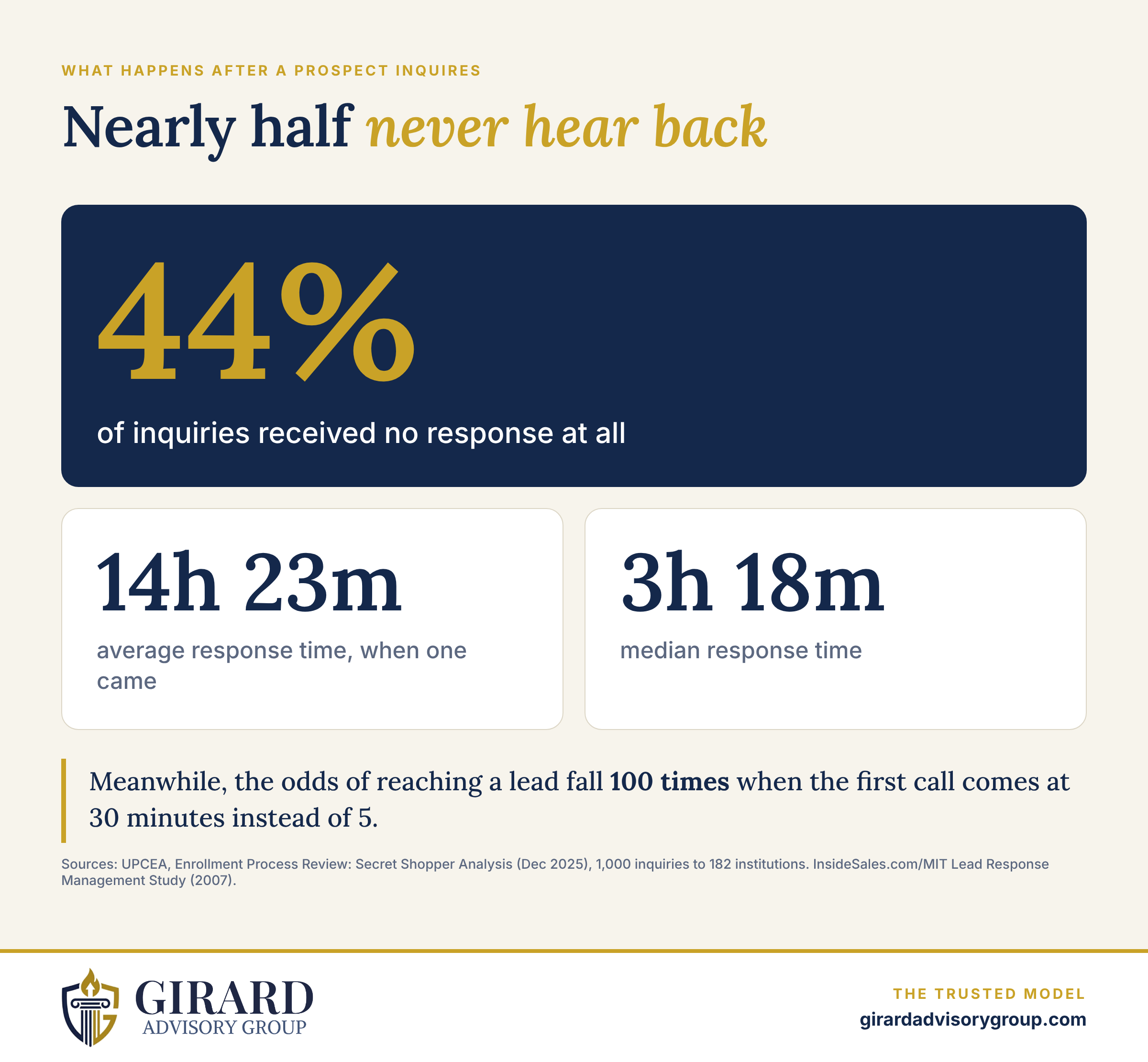
Nearly half of the people who asked a school a question never heard back. UPCEA also found that personalized follow-up was the exception, not the norm.
Schools usually do not know this about themselves. In the 2025 NAGAP and Liaison inquiry response study, 62% of graduate enrollment professionals believed their institution answered inquiries within 24 hours. Secret shoppers found that 21% did. In the same study, 60% of students said the speed of communication influenced their decision to apply.
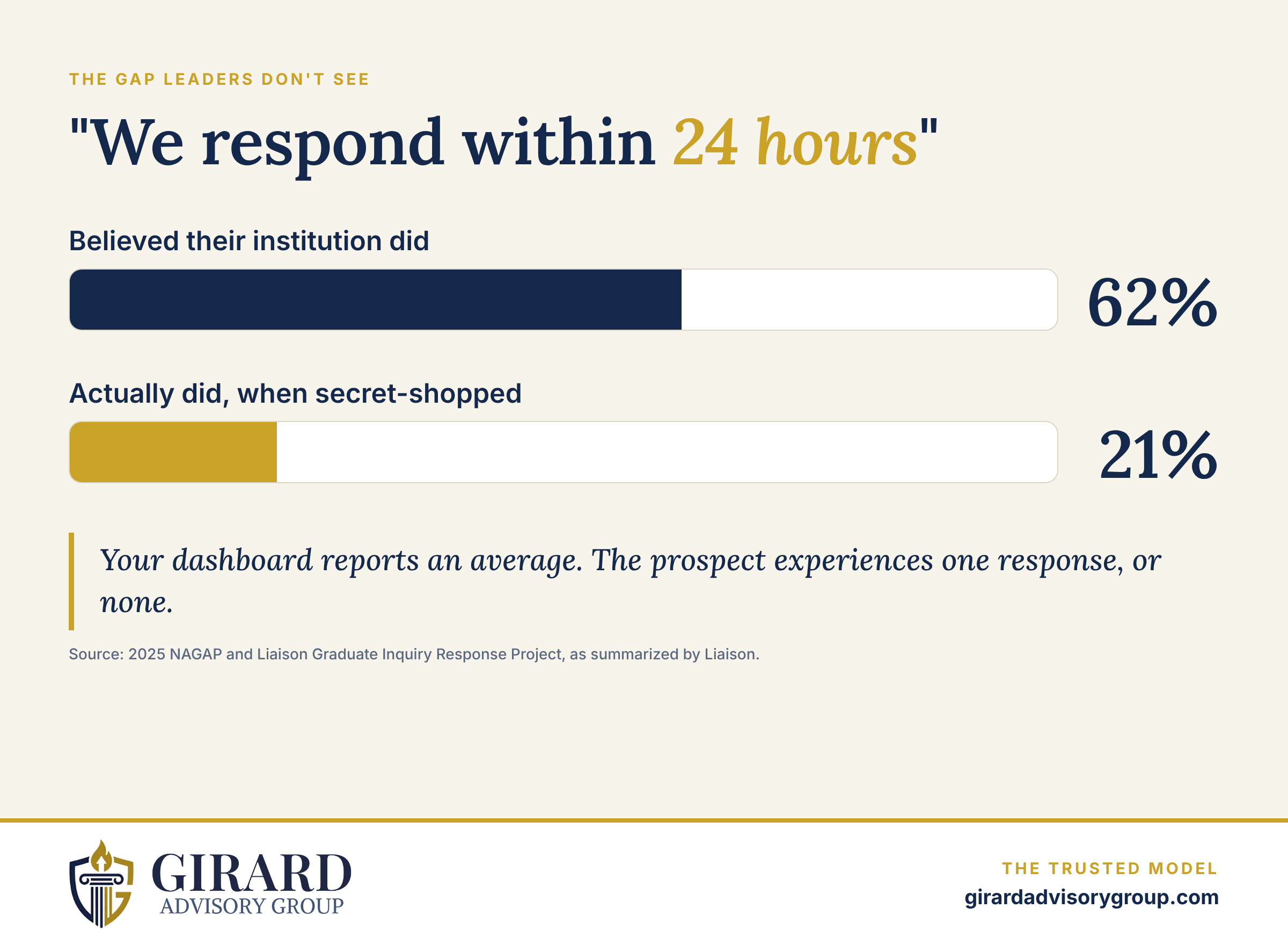
That gap between what leaders believe and what a prospect experiences is the whole problem. Your dashboard reports an average. The prospect experiences one response, or none.
Two numbers to own
- Speed to lead: minutes from inquiry to the first personal attempt, by phone or text. An auto-reply does not count. Measure it for nights and weekends separately, because that is when working adults inquire.
- Contact rate: the share of inquiries you hold a real two-way conversation with. A fast first attempt followed by silence is not delivery.
Report both weekly, by rep and by campus, next to the review KPI from Part 2. They belong on the same scorecard because they measure the same thing: whether the school does what it says.
Does admissions know what the prospect already heard?
A prospect arrives at the first conversation carrying a version of your school that someone else assembled. Most admissions teams have never seen it.
Ask your reps three questions this week:
- What does ChatGPT or Google’s AI Overview say when someone asks whether our school is worth it?
- What is our current Google rating, and what did the last three reviews say?
- What total program cost does our website show today?
If they cannot answer, they are walking into every conversation blind. The prospect knows something the rep does not, and the prospect notices.
It gets worse when the answers conflict. The AI summary quotes one tuition figure, the website shows another, and the rep says a third. Part 5 of this series called for one set of numbers. The first conversation is where a prospect finds out whether you have one.
The fix is a briefing, not a script
- Share the quarterly AI audit with admissions. The audit from Part 4 should not live in marketing. Reps should read exactly what the assistants say, including the parts that are wrong.
- Put new reviews in the weekly admissions meeting. If a review complains about financial aid delays, the next prospect has read it. The rep should be ready to address it honestly.
- Give reps the same fact sheet the website uses. Cost, program length, schedule, outcomes, start dates. One source, updated on one date.
- Prepare honest answers to the hard questions. Accreditation, credit transfer, total cost, and job placement come up because prospects saw them online. A rep who answers them directly sounds like the reviews. A rep who dodges sounds like the warning.
Answer the question they came with
A prospect who has done this much research does not inquire to hear the pitch. They inquire because one question is still open.
In RNL and Halda’s 2024 College Planning Study of 2,242 students, 96% expected a school to answer their specific questions. Another 84% expected the school to appear to know them and their situation when it made contact.
Most first calls do the opposite. The rep opens with qualifying questions, moves to the program overview, and pushes for the appointment. The prospect’s question about cost or schedule gets answered with “we’ll cover that when you come in.”
To someone who just read about for-profit schools hiding the price, that sentence confirms the worst thing they heard.
A first conversation that delivers has four parts:
- Start with their question. “What made you reach out today?” Then answer it, fully, before anything else.
- Say what they already know. “You’ve probably seen our reviews and our pricing online.” It tells the prospect you have nothing to hide.
- Give the same numbers the website gives. If the rep does not know, the answer is “let me get you the exact figure today,” followed by the exact figure, today.
- Offer the next step as a service. The tour is where they meet instructors and see the labs. It is not the price of getting a straight answer.
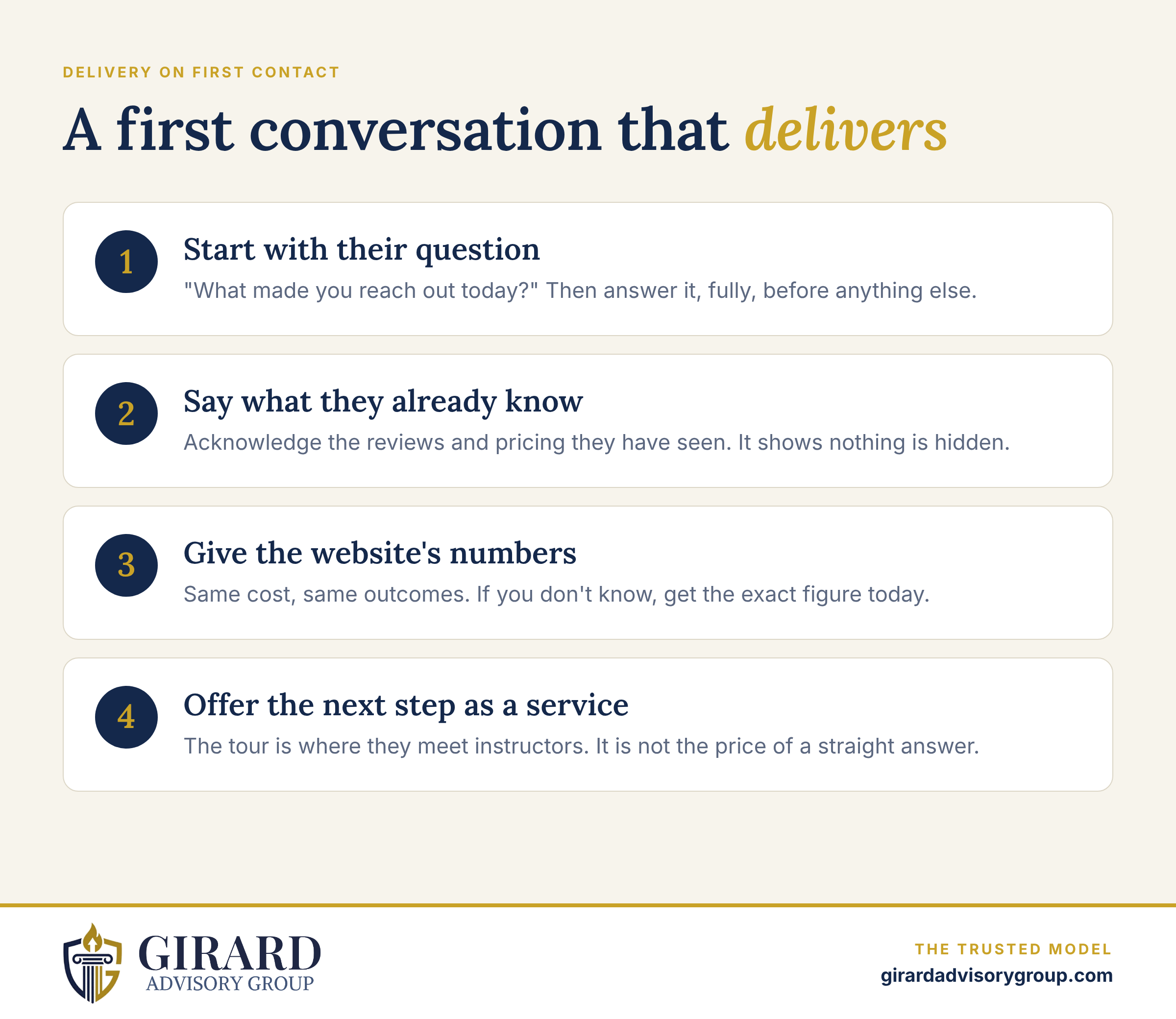
None of this slows enrollment. The appointment a prospect books after getting a straight answer is the one that shows up.
Delivery does not end with the first call
The first contact sets a standard that every later step is measured against. A prospect who got a call back in five minutes will notice when the financial aid office takes four days.
Walk the path the way a new student does and check four handoffs. The inquiry-to-tour handoff promises real instructors, real labs, and real students; it breaks when the tour is a conference room and a brochure. The tour-to-financial-aid handoff promises clear cost with no surprises; it breaks when new fees appear on the enrollment agreement. The enrollment-to-first-day handoff promises people who know their name; it breaks when weeks of silence pass between signing and starting. The first-day-to-first-month handoff promises the culture the reviews described; it breaks when nobody notices a missed class.
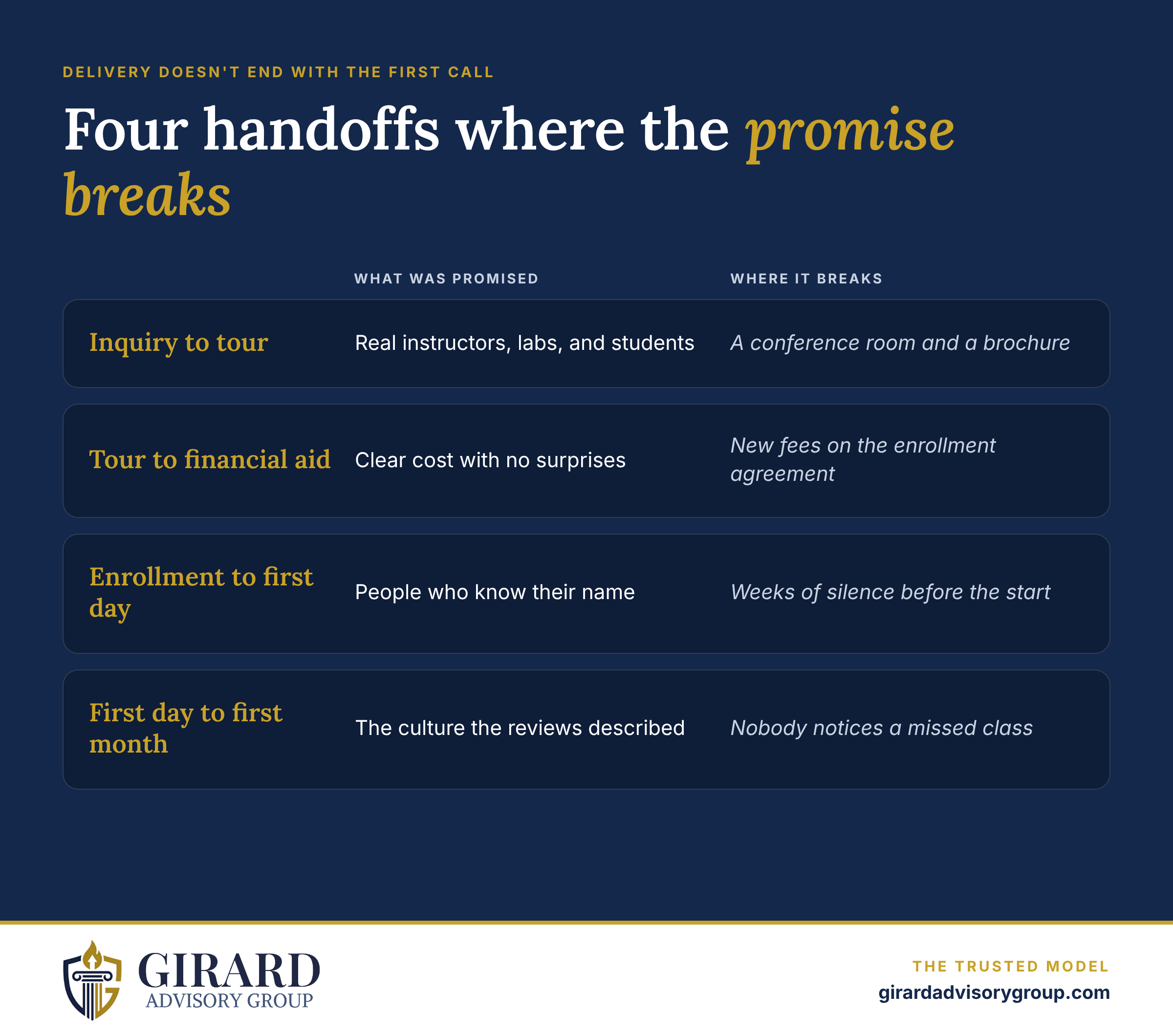
The last handoff is where TRUSTED hands off to the CARING+ model. Trust earned before the inquiry has to be kept by the people a student meets after it. The student who feels misled in week two writes the review the next prospect reads, and the cycle starts again at R.
From the field: one appointment a day
When I took over one campus, it had just closed its October enrollment cycle with nine enrollments. Lead flow was abysmal. A team of three admissions reps was running maybe one appointment a day between them.
Nobody on that team thought of themselves as breaking a promise. But a prospect who inquired and waited, or never heard back, had learned something about the school before ever meeting us.
I did not start with staff changes. I started with accountability, in the first two weeks:
- A daily standup with campus administrators. We called the plays for the day and reviewed yesterday’s numbers.
- Speed to lead and contact rate, tracked by rep. Every inquiry had a named owner and a clock.
- A review of the admissions process itself. We looked at what a prospect actually experienced from form to first conversation, and changed what was not working.
- Weekly metrics with one owner per outcome. No shared responsibility, because shared responsibility means nobody’s.
Staff changes came later, when it was clear who would grow under the new standard and who would not. Over time I brought in experienced admissions professionals who treated a fast, honest first conversation as the job.
By the following October, annual enrollments had gone from 175 to 305. Marketing improved over that year too, and I will not pretend response discipline did it alone. But the leads we already had were the first thing we fixed, and they cost nothing extra to answer.
Score yourself: Delivery on first contact
Give your school one point for each statement that is true today. This is checklist 7 of 7.
- We measure speed to lead in minutes, including nights and weekends, and review it weekly by rep.
- We have submitted a test inquiry to our own school in the last 90 days and timed the response.
- Our admissions team has read what AI assistants and our most recent reviews say about us.
- A rep can state total program cost on the first call, and it matches the website.
- Someone owns the handoffs from inquiry to tour to enrollment to first day, and checks them.
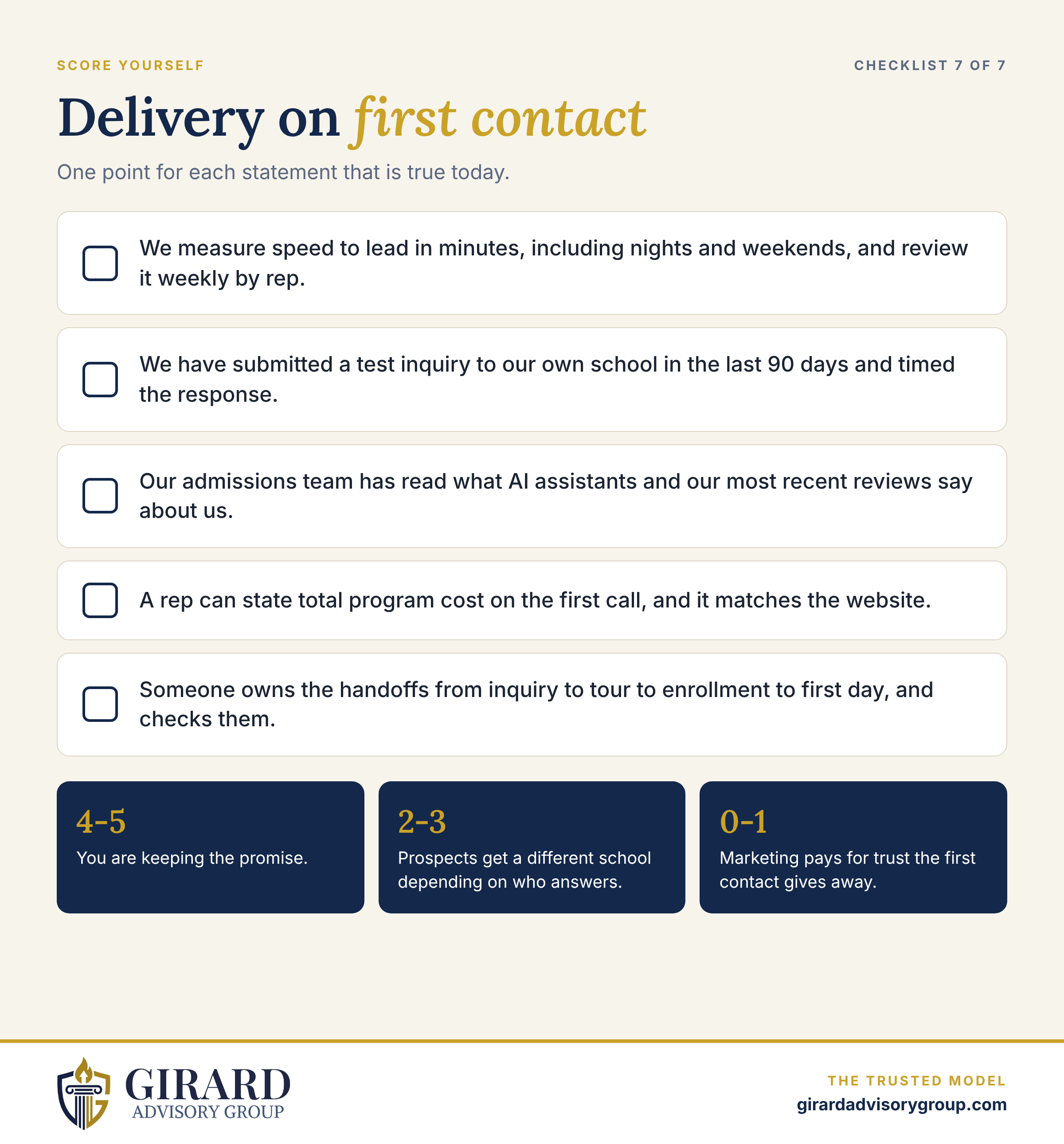
4 or 5: you are keeping the promise. 2 or 3: prospects are getting a different school depending on who answers. 0 or 1: your marketing is paying for trust that the first contact gives away.
The series wrap: seven elements, one verdict
A prospective student does not experience seven separate things. They experience one school and reach one verdict. The model is sequential. A weak early element means the prospect never reaches a later one, and a strong last element cannot repair a verdict formed on the first six. But the reverse is also true, and it is the point of this post. Six strong elements can be undone in one slow, evasive first contact.
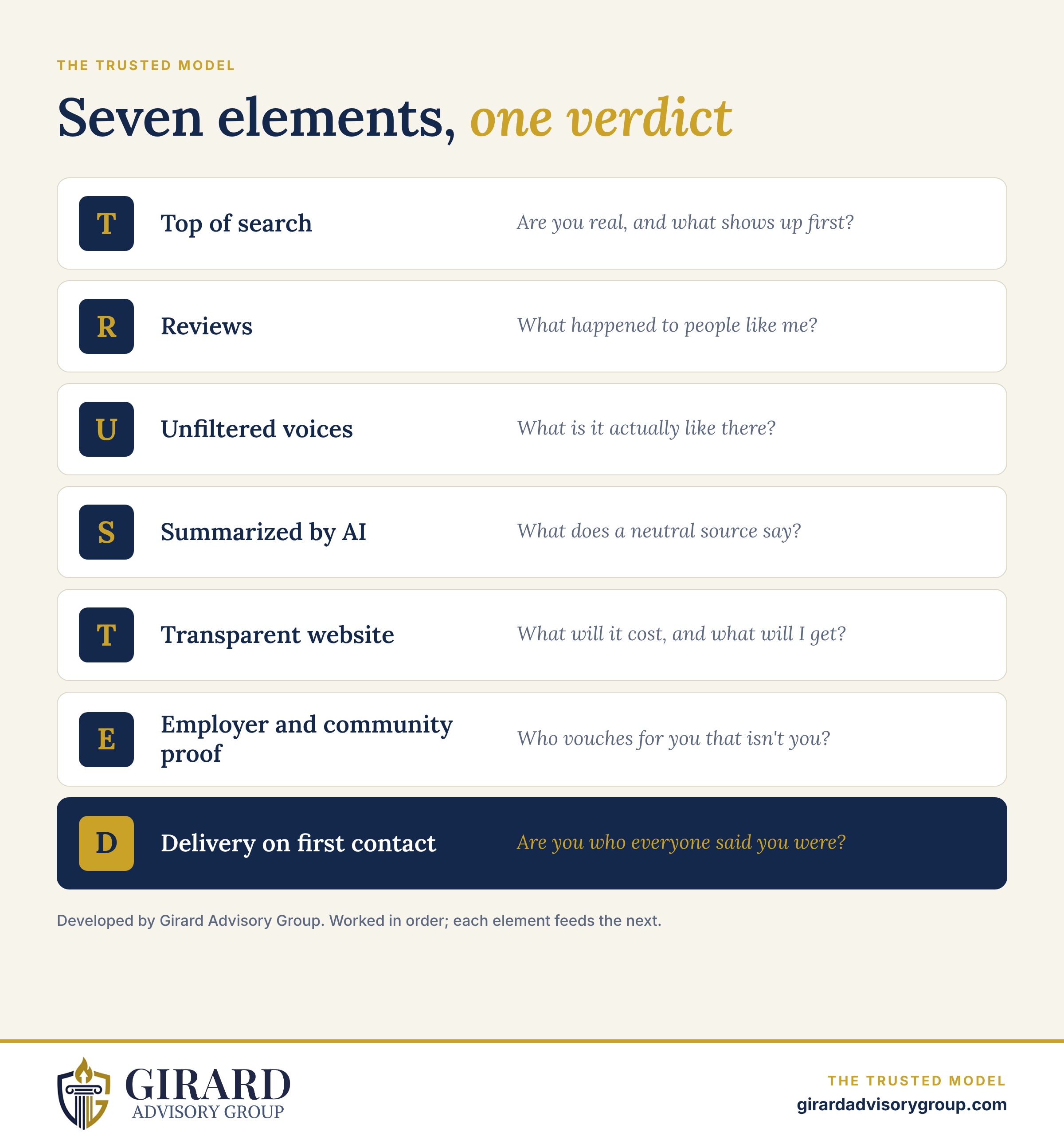
The seven elements are: T — Top of search (Are you real, and what shows up first?); R — Reviews (What happened to people like me?); U — Unfiltered voices (What is it actually like there?); S — Summarized by AI (What does a neutral source say?); T — Transparent website (What will it cost, and what will I get?); E — Employer and community proof (Who vouches for you that isn’t you?); D — Delivery on first contact (Are you who everyone said you were?).
It is also a loop. Today’s enrolled student is next term’s reviewer, next year’s graduate voice, and eventually the employee whose manager vouches for your program. Delivery feeds every element before it.
That is why no single department can own TRUSTED. Marketing owns pieces of it. So do admissions, career services, academics, and compliance. Someone at the campus level has to own the whole picture. Read the full framework at The TRUSTED Framework.
Start with the TRUSTED audit
If you scored yourself across all seven posts, you have a rough audit already. If you would like an outside view, Girard Advisory Group offers a free TRUSTED audit. I review your school the way a prospect does, from the first search to the first response, and send you a summary of what I found on each element.
Request a free TRUSTED audit at girardadvisorygroup.com/contact or email jpg@girardadvisorygroup.com.
Frequently asked questions
- What does “delivery on first contact” mean in the TRUSTED model?
- It is the seventh element: whether a prospect’s first real exchange with your school matches what they learned from search, reviews, video, AI, your website, and employers. Speed, honesty, and consistency are the three tests.
- What is a good speed-to-lead target for a career college?
- A personal attempt within five minutes during staffed hours, and a clear standard for nights and weekends. The Lead Response Management study found contact odds fall sharply between 5 and 30 minutes. Start by measuring where you are, because most schools are surprised.
- Does an automated reply count as a response?
- Not as delivery. It confirms the form worked. In the RNL and Halda study, 96% of students expected answers to their specific questions, and an auto-reply answers none of them.
- How fast do students actually expect to hear back?
- In the same study, 22% expected a response within three hours and another 46% within 24 hours. Half said a slow response would somewhat decrease their interest, and 7% said it would decrease it significantly.
- Should admissions reps really discuss cost on the first call?
- Yes, using the same published figures the website shows. Withholding cost until the campus visit tells a prospect you have something to hide, and inconsistent figures create compliance risk as well as trust risk.
- How is this different from The Contactability Problem?
- That post explains why inquiries go cold before you reach them. This one covers what has to be true once you do reach them, so the conversation matches the school they were promised.
- We are a small campus. How do we cover nights and weekends?
- Decide the standard first, then staff to it. Options include a rotating on-call rep who texts back within minutes, or a first-thing-next-morning rule with a named owner. Whatever you choose, tell prospects on the form when they will hear from a person, and keep that promise.
Sources
- Elkington, D. and Oldroyd, J. (2007). The InsideSales.com/MIT Lead Response Management Study.
- UPCEA (December 2025). Enrollment Process Review: Secret Shopper Analysis. 1,000 inquiries to 182 institutions.
- Liaison (2025). From First Click to Connection: 5 Proven Ways to Build Trust at the Graduate Inquiry Stage, summarizing the 2025 NAGAP and Liaison Graduate Inquiry Response Project.
- RNL and Halda (2024). 2024 College Planning Study, as presented in Understanding and Engaging the Post-Pandemic Prospective Student. 2,242 students surveyed.
- Girard, J. P. (2026). The Contactability Problem: Why So Many Inquiries Go Cold Before You Ever Speak to Them. Girard Advisory Group Insights.
Explore Topics
Written by
John P. Girard
John P. Girard is the founder of Girard Advisory Group and a thirty-year veteran of career and proprietary higher education, with hands-on leadership across enrollment growth, campus operations, accreditation and compliance, curriculum development, brand and marketing, and P&L management. Over three decades he has held roles spanning Campus Director, Campus President, Regional Campus Director, and National Director of Marketing & Digital Media Brand Management, leading multi-campus organizations through growth, accreditation, and operational turnarounds. That range — from the admissions floor to the boardroom — is what shapes his advisory approach: strategy that has to hold up in daily campus operations, not just on a slide. John holds a Master's degree in Teacher Education from the University at Albany, SUNY, and has served on the Board of the Ohio-Michigan Association of Career Colleges and Schools.