If No One Owns Your Reviews, the Internet Does

John P. Girard
Founder, Girard Advisory Group
Hope is not a review strategy. The schools that win on reviews treat them like any other number that matters — with a weekly target, a named owner, a defined moment to ask, and a clock on every response.
Ask most campus leaders how they manage reviews, and you will hear some version of the same answer: “We ask happy students to leave one.” Then a few weeks pass, nobody asks, a frustrated student posts a one-star review at midnight, and it sits at the top of the school’s Google profile for a month with no reply.
That is not a strategy. It is hope.
The schools that win on reviews treat them like any other number that matters: enrollment, retention, placement. There is a weekly target, a named owner, a defined moment to ask, a standard for whose voices you want, and a clock on every response. Run that way, reviews stop being luck and become an operating system.
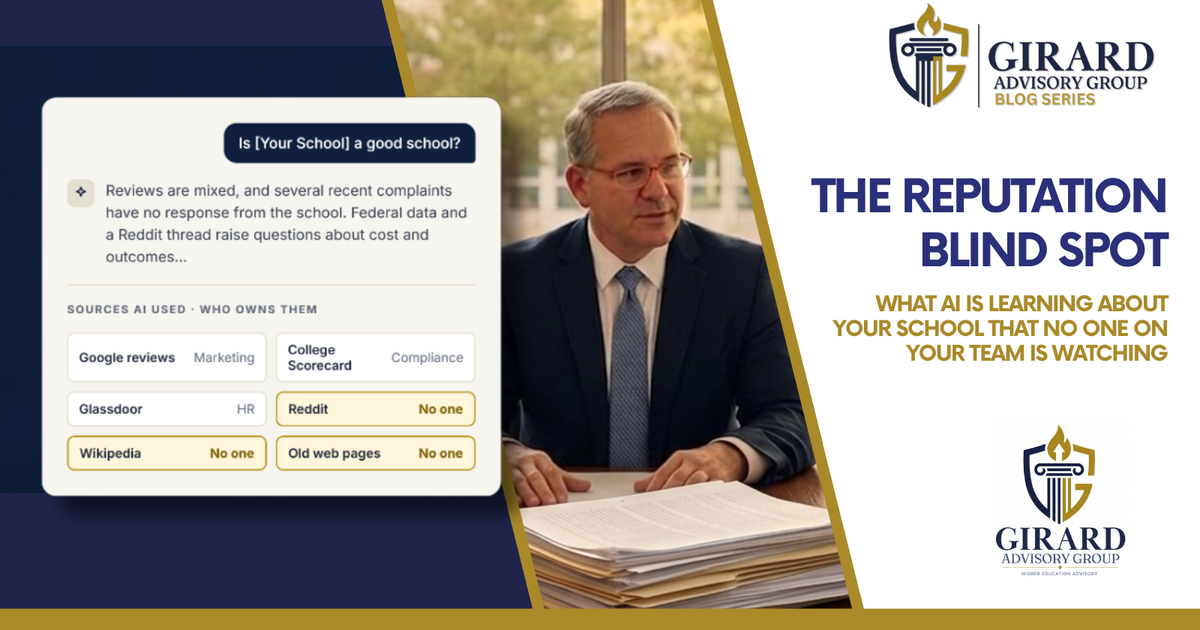
This is the second element of the TRUSTED model: Reviews. In the series opener, The Reputation Blind Spot, I argued that silence lets AI write your message for you. This post is the how-to.
Two audiences read your reviews now
Reviews used to have one audience: the prospect. Now they have two, and the second one is reading every word.
Prospects read them, and they are getting pickier. BrightLocal’s 2026 survey of more than 1,000 U.S. consumers found that:
- 41% always read reviews before choosing a local business, up from 29% a year earlier
- 68% will only use a business rated four stars or higher, and 31% now require 4.5 or better
- 74% only care about reviews from the last three months
- 47% won’t use a business with fewer than 20 reviews
AI tools read them, and summarize them for everyone else. When a prospect asks ChatGPT or Google what students say about your school, the answer is built largely from review platforms and other sources you don’t own. BrightLocal found that 82% of consumers read AI-generated review summaries, and nearly a quarter would rely on the summary alone.
That changes the math. A single unanswered complaint used to be one voice among many. Now it can become a line in the AI’s summary of your school, repeated to every prospect who asks.
Responses count too. 89% of consumers expect businesses to respond to reviews, and half are put off by generic, templated replies. Your response is not just customer service. It is part of the public record, and it is the only part of the conversation you write.
The review operating system: five parts
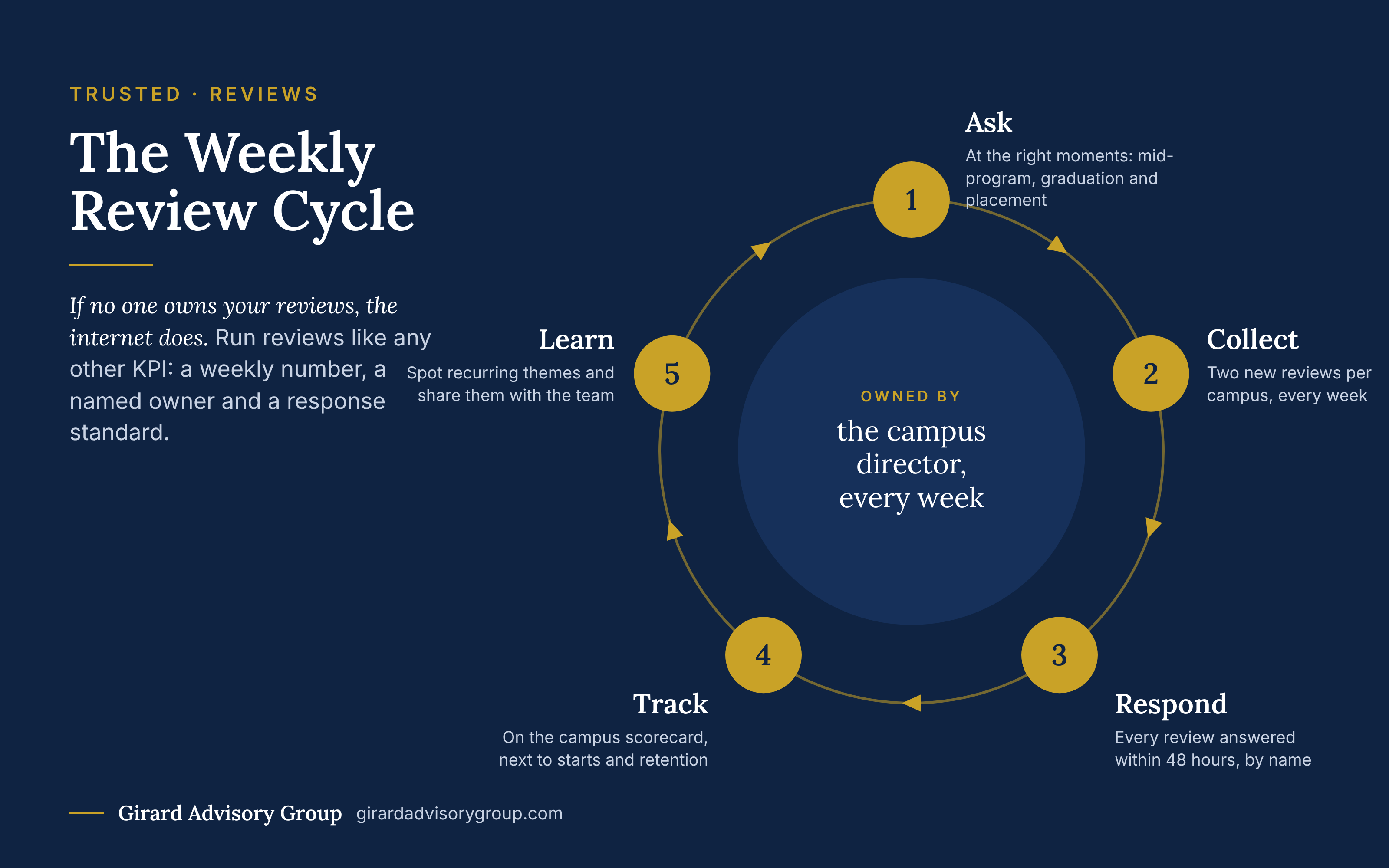
| Part | The question it answers | What good looks like |
|---|---|---|
| 1. Target | How many, how often? | A small weekly number per campus, tracked on the scorecard |
| 2. Owner | Who is accountable? | The campus director, not the marketing team |
| 3. Timing | When do we ask? | At defined high points in the student journey |
| 4. Voices | Whose reviews do we want? | A mix of current students and outcome voices |
| 5. Response | How fast, and by whom? | Every review answered within 48 hours, by a real person |
1. Set a weekly target. Pick a number small enough to hit every week and put it on the same scorecard as starts, attendance, and placement. Two new reviews per campus per week is a good starting point. A small, steady number beats a big push once a year, because recency matters as much as the rating.
2. Make the campus director the owner. Marketing can build the links, templates, and tracking. But the people who see students every day are on campus, and the campus director is the one who can make asking for reviews part of the culture. When reviews are on the director’s scorecard, they get discussed in the weekly meeting. When they’re on marketing’s, they get discussed in a report nobody reads.
3. Ask at the right moments. The best time to ask is right after something good happens, while the student still feels it:
- Passing a certification or licensure exam
- Finishing a lab milestone, project, or practical
- Starting or completing an externship
- Graduation, and the first job offer after it
Make it easy: a short link or QR code, sent by someone the student knows, with a sentence explaining why it matters to future students.
4. Ask for the right voices. Not every review carries the same weight. Aim each week for two kinds:
- An active student, ideally partway through the program. They have enough experience to speak credibly about instruction and support, and they’re still engaged enough to want to share it. In a two-semester program, the second semester is the sweet spot.
- A graduate, employer, or partner. These speak to outcomes, the thing prospects and AI tools care about most, and they come from people with no reason to flatter the school.
5. Respond to every review within 48 hours. Positive or negative, every review gets a reply from a named person, not a generic “Thanks for your feedback!” The response shows prospects that someone is listening, and it puts the school’s voice into the record AI tools read. Track response time the same way you track the weekly target.
Three reviews, three responses
Most teams know how to say thank you. Fewer know what to do with a complaint, and almost nobody has a plan for an unfair one. Here is a model for each.
One rule applies to all three: never discuss a student’s records in public. Student privacy rules such as FERPA limit what a school can share, and a public reply is the wrong place for details about grades, attendance, or financial aid anyway. Acknowledge, take it offline, and name a real person.
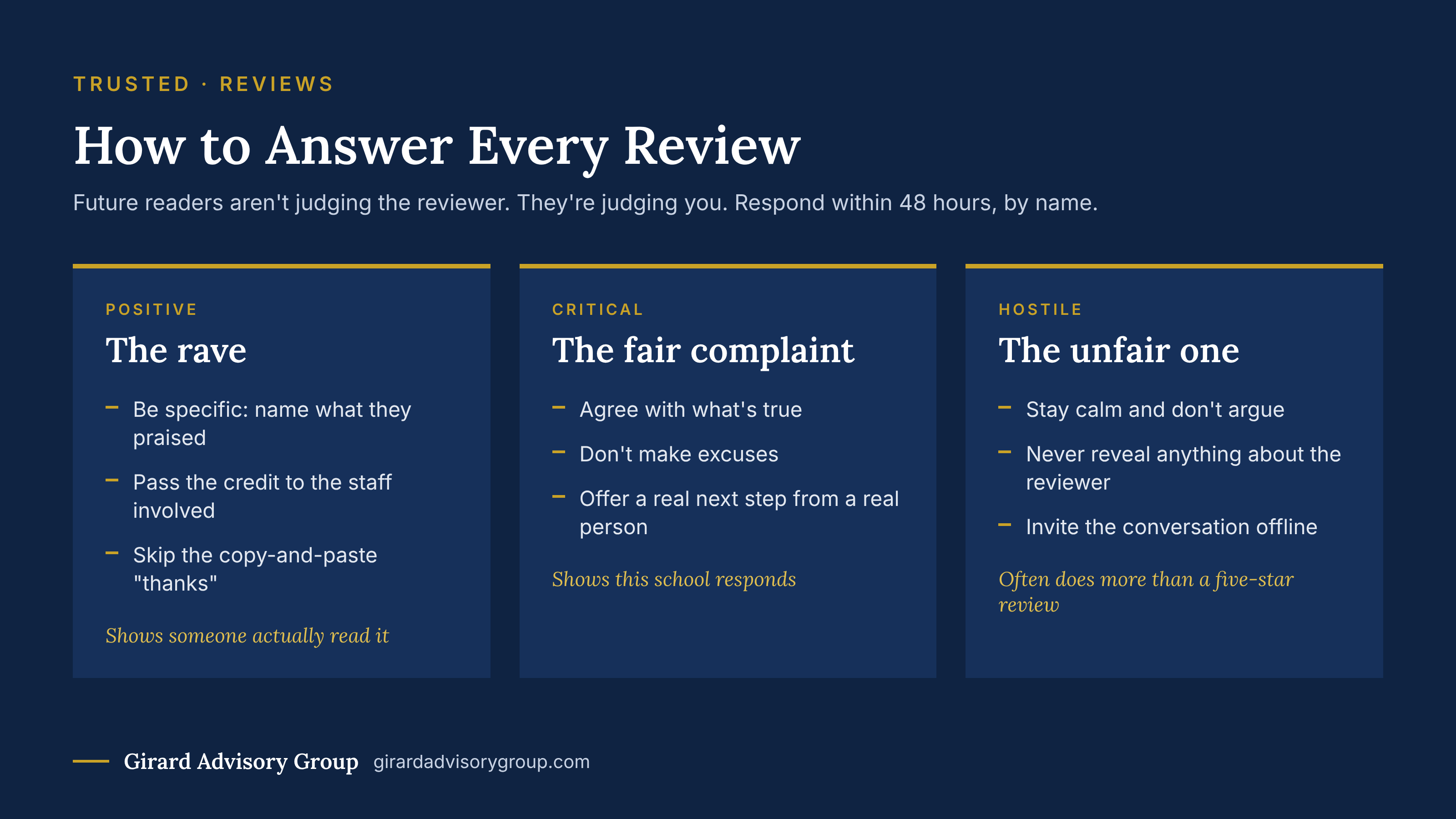
The rave
“Best decision I ever made. My instructors actually cared and I passed my certification on the first try!”
Response: “Congratulations on passing your certification on the first try. That’s a big accomplishment, and it reflects the work you put in. Thank you for mentioning your instructors; I’ll make sure they see this. We can’t wait to hear where your career takes you. — [Name], Campus Director”
Why it works: It’s specific, it names what the student said, and it passes the credit to staff. A copy-and-paste “Thanks for the kind words!” tells readers nobody actually read it.
The fair complaint
“Good instructors, but financial aid took forever to answer my emails and I was stressed for weeks.”
Response: “Thank you for being honest about this. Waiting weeks for answers about financial aid is stressful, and you shouldn’t have had to. I’ve shared your feedback with our financial aid team, and I’d like to talk with you directly. Please call me at [phone] or email [email]. I’m also glad to hear your instructors have been a strong support. — [Name], Campus Director”
Why it works: It agrees with what’s true, doesn’t make excuses, and offers a real next step from a real person. Prospects reading it learn something important: when things go wrong, this school responds.
The unfair one
“Total scam. They just want your money. Don’t go here.”
Response: “We’re sorry to hear you feel this way, and we take concerns like this seriously. We’d welcome the chance to understand what happened and see how we can help. Please contact me directly at [phone] or [email]. — [Name], Campus Director”
Why it works: It stays calm, doesn’t argue, and doesn’t reveal anything about the reviewer. Future readers aren’t judging the reviewer; they’re judging you. A measured response to an angry review often does more for your reputation than the five-star review above it.
If a review violates the platform’s policies — for example it is spam, contains hate speech, or is clearly about a different school — flag it for removal. Otherwise, respond and move on. The best answer to an unfair review is a steady stream of fair ones.
From the field: when reviews went on the scorecard
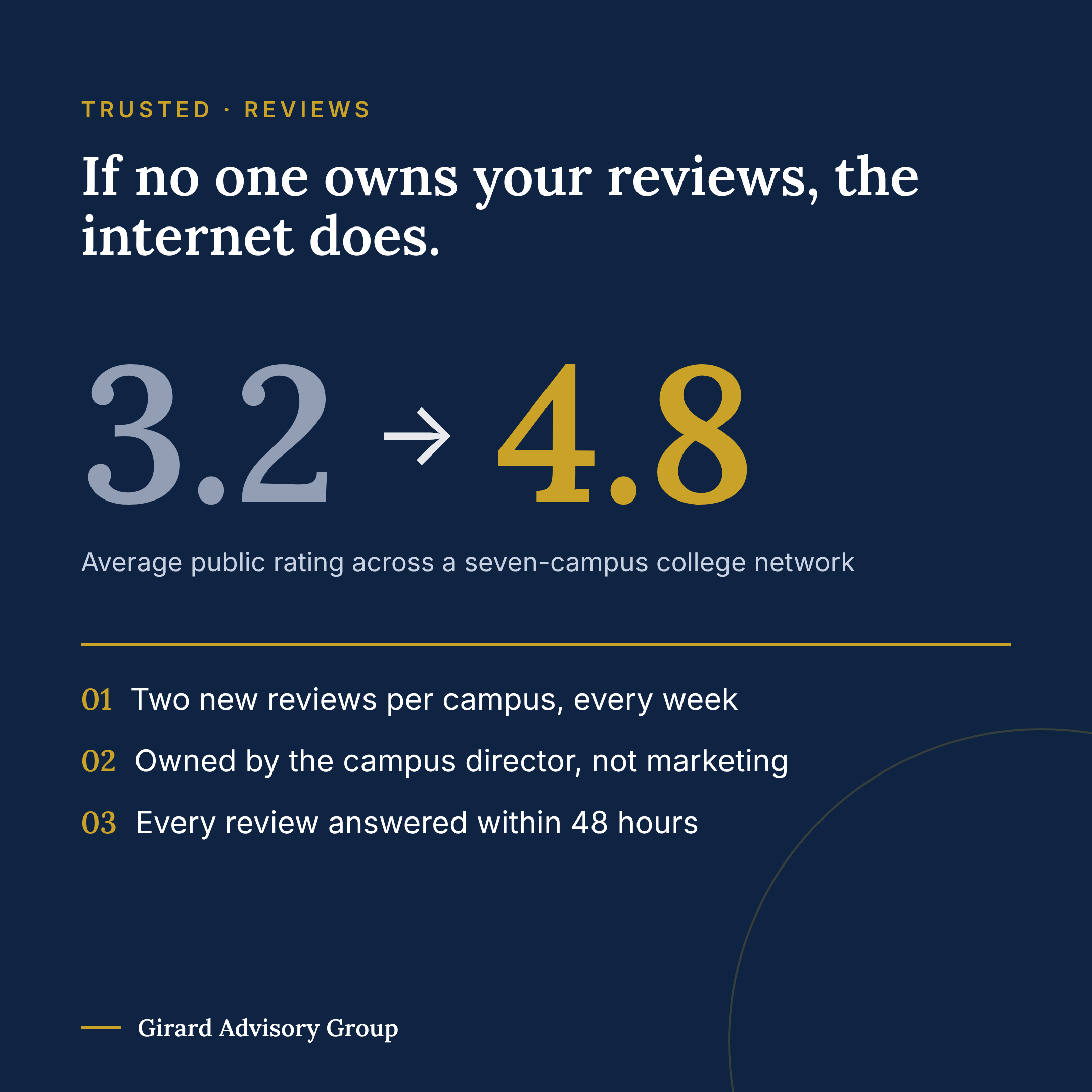
At a seven-campus network where I led marketing, reviews used to be something we hoped for. Then we made them a weekly KPI: two new reviews per campus, every week, sitting on the same scorecard as starts and retention. Campus directors, not the marketing team, were accountable for hitting it. Every review, positive or negative, had to receive a response within 48 hours of being posted.
We were deliberate about whose voices we asked for. Each week, one review from an active student, ideally in the second semester of a two-semester program, and one from a graduate, employer, or partner.
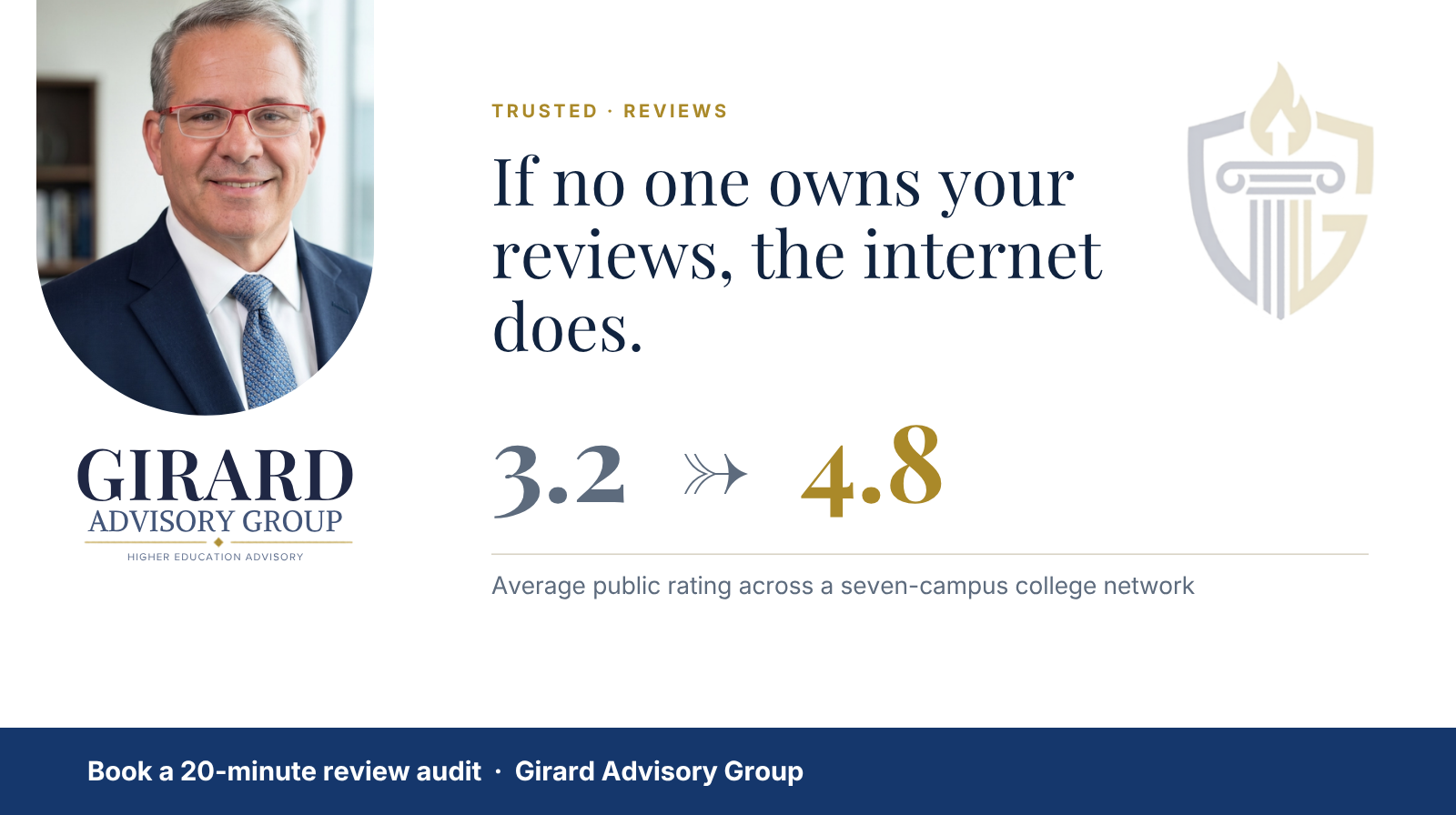
Over time, our average rating climbed from 3.2 to 4.8, with campuses now rated between 4.6 and 4.9 on Niche and Google. Just as important, the recurring themes in those reviews — such as hands-on training and instructor support — became the story told about the schools, on review sites and in the AI answers built from them. That is what ownership does: it turns a hope into a habit.
Score yourself: Reviews
Give your school one point for each item that is true today. This is the second of seven checklists in the TRUSTED series.
- Each campus has a weekly review target, tracked on the same scorecard as starts and retention
- A named leader at each campus, usually the campus director, owns that target
- You ask for reviews at defined moments, such as exams, externships, and graduation
- Your recent reviews include graduates, employers, or partners, not just current students
- Every review from the past 90 days has a personal response, posted within 48 hours
A score of 3 or below usually means your reviews reflect whoever felt strongly enough to post, not the school you actually run.
Turn the hope into a habit
None of this is complicated. A target, an owner, the right moments, the right voices, and a response clock. What makes it work is treating it with the same discipline you bring to attendance or placement: reviewed every week, owned by a person, never left to chance.
Do that, and your reviews start to reflect the school you actually run. And because AI tools build their summaries from those reviews, the story they tell starts to change too.
Next in the series: Unfiltered voices, and why real student and instructor content beats polished stock imagery. You can follow all seven elements on the TRUSTED framework page.
Want to know how your reviews look from the outside? Girard Advisory Group offers a free TRUSTED audit: an outside-in review of what prospects find before they ever inquire, with specific, prioritized fixes. Reach out at jpg@girardadvisorygroup.com to request yours.
Frequently asked questions
How many reviews should a career college aim for each week?
Start with a small, steady number you can hit every week, such as two per campus. Consistency matters more than volume, because prospects and AI tools both weigh how recent your reviews are.
Should we respond to positive reviews too?
Yes. A specific, personal thank-you shows prospects that real people read every review, and it adds your school’s voice to the public record.
How should a school respond to a negative review?
Acknowledge the concern, avoid arguing or making excuses, never share details from the student’s records, and offer a named person and a direct way to follow up offline.
Can we offer incentives for reviews?
Be careful. Most review platforms, including Google, prohibit offering incentives in exchange for reviews, and the FTC has rules against fake or incentivized reviews. Ask genuinely, make it easy, and leave the content up to the student.
Can we remove negative reviews?
Only when a review violates the platform’s policies, such as spam or reviews about the wrong business. Otherwise, the best response is a calm public reply and a steady flow of new reviews.
Who should own reviews at a school?
The campus director should own the target and the culture of asking. Marketing can support with links, templates, tracking, and reporting. The complete seven-surface model is documented on the TRUSTED Pre-Inquiry Framework page.
Sources
- BrightLocal, Local Consumer Review Survey 2026 (Feb 2026; 1,002 U.S. adults)
Explore Topics
Written by
John P. Girard
John P. Girard is the founder of Girard Advisory Group and a thirty-year veteran of career and proprietary higher education, with hands-on leadership across enrollment growth, campus operations, accreditation and compliance, curriculum development, brand and marketing, and P&L management. Over three decades he has held roles spanning Campus Director, Campus President, Regional Campus Director, and National Director of Marketing & Digital Media Brand Management, leading multi-campus organizations through growth, accreditation, and operational turnarounds. That range — from the admissions floor to the boardroom — is what shapes his advisory approach: strategy that has to hold up in daily campus operations, not just on a slide. John holds a Master's degree in Teacher Education from the University at Albany, SUNY, and has served on the Board of the Ohio-Michigan Association of Career Colleges and Schools.