Trust is not a marketing claim. It is the result of what prospective students see, what they hear, how they are guided, and what they experience once they arrive.
1
Coherence is credibility
Career and vocational education institutions are often evaluated before a conversation ever begins. A prospective student sees a website, a social post, a program page, an employer comment, or a campus review and makes a quick judgment: does this institution appear clear, capable, and worth trusting? That judgment is shaped by brand management, but not in the narrow sense of logos or campaigns. Brand is the architecture of the promise an institution makes across every touchpoint. When the message, experience, and evidence do not align, prospective students feel the gap. Consistency is not cosmetic; it is a signal that the institution can deliver what it says it will deliver.
Brand creates the expectation. Reputation records whether the institution met it. Reviews, comments, referrals, employer feedback, and public conversations are not a separate marketing channel; they are the visible residue of operational choices. This matters especially in career education, where sector stigma can make a single unresolved concern feel larger than it would elsewhere. The answer is not to manage perception after the fact. It is to build a disciplined response system, listen for recurring friction, and give campus leaders ownership of the student experience that produces the reputation. Trust is won long before a review is written — and it is protected by what happens after one appears.
The path to a campus is changing again. Increasingly, prospective students ask an AI assistant where to train, which program fits, what outcomes to expect, or whether a school is credible. That assistant is now part of the first impression. It draws on the information an institution has made available, the clarity of its public presence, and the signals that support its authority. This does not make the human enrollment conversation less important. It makes the work before that conversation more important. Institutions need to be findable, accurate, and genuinely useful when a prospective student begins asking questions — because the first advisor may no longer be a person on the admissions team.
The inside of the institution must support the outside
AI can also improve the work inside the building. It can reduce administrative friction, surface patterns, support preparation, and give staff more time for the judgment and care that students need. But it cannot substitute for the relationships that make a campus credible. The wrong use of AI automates the very moments where a student needs to be heard, coached, or reassured. The right use removes low-value work so people can do more of the human work. That distinction brings the argument back to operations: technology should reinforce the institution’s values, not quietly replace them.
The first four ideas diagnose the same underlying problem: trust cannot be manufactured at the edge of an institution. It has to be built at the center. A coherent brand, a durable reputation, a credible AI presence, and useful operational technology all depend on the daily experience students and employees have with the campus. That is why culture is not the final soft topic in the sequence. It is the operating asset that makes every other promise real. The CARING+ Model of Campus Engagement offers a practical way to lead that work — turning care, accountability, and student-centered execution into habits that can be seen, felt, and sustained.
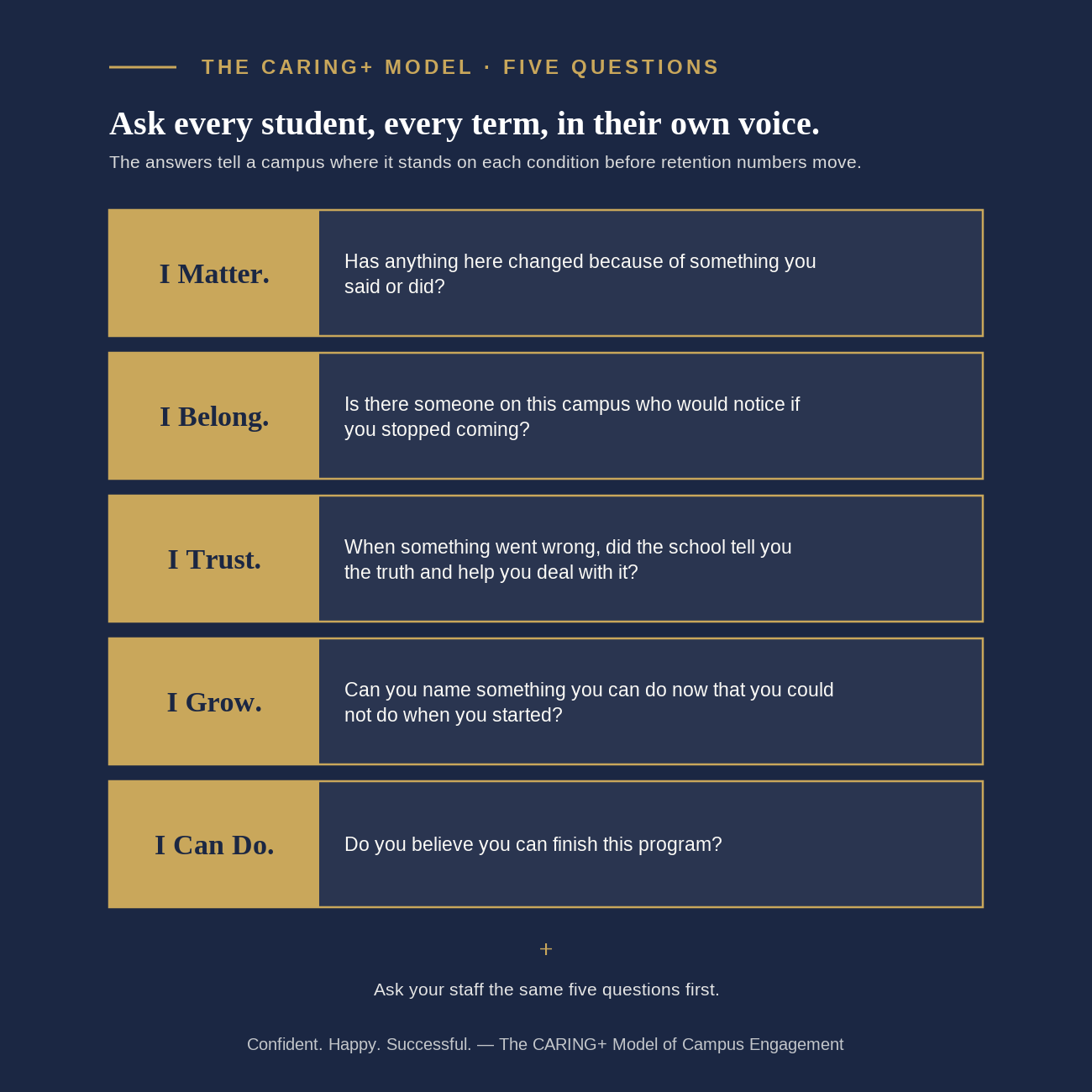
The model is built on five conditions a campus either creates or fails to create: I Matter — every student's presence is acknowledged and valued
I Belong — students experience genuine connection to the campus community
I Trust — students trust the institution to be honest, consistent, and fair
I Grow — students see real progress toward competence and credential
I Can Do — students believe they are capable of completing and succeeding.
A culture model does not become real because it is announced. It becomes real when leaders let people experience the change, enlist trusted peer coaches, protect time for dialogue, embed the work in real processes, and hold the standard long after the launch. This is the leadership discipline that turns CARING+ from a framework into a campus reality.
The TRUSTED model: earning the inquiry before it arrives
Trust is not built at the point of inquiry. It is built upstream, across seven surfaces a prospective student encounters before they ever contact you: the Google results page, the reviews, the social and video presence, what an AI assistant says, the website itself, employer and community validation, and the tone of first contact. Together these spell TRUSTED — a sequential framework for pre-inquiry trust that a campus team can audit, assign, and improve. Weakness on an early surface means the student may never reach a later one. The schools that work all seven in order are the ones whose inquiries answer the phone.
Asked every term, these five questions tell a campus where it stands on every condition in the CARING+ model. Where the answers are no, that is where the work starts.
This is not a list of separate initiatives. It is one leadership agenda: build an institution whose promise is coherent, whose experience earns trust, and whose systems give people more capacity to deliver both. Three named frameworks run through it, each addressing a different layer of the same problem. TRUSTED is how a school earns trust before a student ever raises their hand. CARING+ is how it keeps that trust after enrollment — turning care, accountability, and student-centered execution into habits that can be seen, felt, and sustained. And the CARING+ Model is also the standard by which Girard Advisory Group holds itself accountable in every engagement, translated from the student's experience to the leader's. The practical question is where the gap is widest in your institution: perception, experience, operations, culture, or the leadership follow-through that makes any of it durable.