Your Reviews Are Talking to AI. Is Anyone Answering?

John P. Girard
Founder, Girard Advisory Group
Over three outside-in reviews of very different colleges, the finding was the same: nobody was answering their reviews. That silence used to cost a few prospects. In 2026, it costs more — because AI is reading too, and summarizing what it finds.
Over the past few days I ran outside-in marketing reviews on three very different colleges: a single-campus career college, a multi-state career college, and a national online university. Different sizes, different students, different budgets. Same finding at all three: nobody was answering their reviews.
Not the glowing ones. Not the angry ones. Not the one posted two weeks ago by a student who says they were billed for classes they never took.
That silence used to cost you a few prospects who scrolled far enough to notice. In 2026 it costs more, because the prospect is no longer the only one reading. AI is reading too, and it is summarizing what it finds.
What three schools had in common
Each review used only what a prospective student can see: search results, review sites, the website, AI assistants, and a real inquiry form. Here is the pattern.
| What we checked | What we found |
|---|---|
| Owner responses to reviews | None found on any platform, at any of the three schools |
| Ratings across platforms | Wide swings: a respectable score on one site, a score in the twos on another with more than a hundred reviews |
| Recent negative reviews | Left unanswered for weeks, including a billing complaint that called for a private follow-up |
| Google Business Profiles | Wrong phone numbers on some campus listings; one profile still shows the school’s old name on its building sign |
| Brand name | One school shares its name with a neighborhood and other businesses, so its listings compete with strangers in search |
| First response to an inquiry | Ranged from a text within two minutes to no contact at all after ten minutes |
None of these schools lacks good people or good programs. Each had real strengths: generous credit transfer, strong value pricing, conversion tools that work. What they lacked was an owner and a rhythm for reputation. When everyone assumes someone else is watching, no one is.
Why silence costs more now
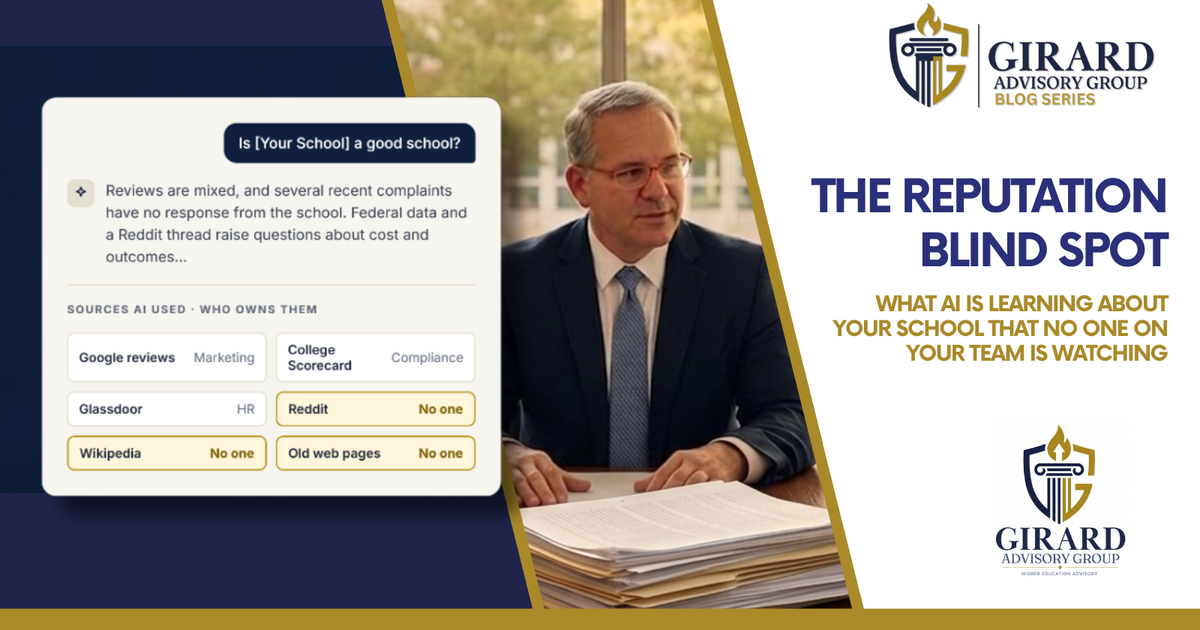
Your reviews are no longer just read by people. They are summarized by AI and handed to prospects as an answer.
At the online university, a Google search for its Yelp reviews returned an AI Overview before any link. It summarized the reviews as mixed and pointed to debates about nursing accreditation, state licensing and clinical placements. The school’s lowest-rated platform was now writing its first impression, and no one from the school had said a word in any of those threads.
The numbers explain why this matters:
- 55% of U.S. adults aged 30 to 49 use ChatGPT, the core age range for adult learners (Pew Research Center, February 2026).
- 46% of prospective students use AI in their college search, and 18% have dropped a school because of something AI told them (EAB, via Inside Higher Ed, February 2026).
- 68% of Google searches now end without a click (SparkToro, June 2026).
If most searches end on the results page, the results page is your website. And the review sites feeding it are part of your brand whether you manage them or not. I wrote more about this in “AI Looks Beyond Your Website.”
Reputation through the TRUSTED lens
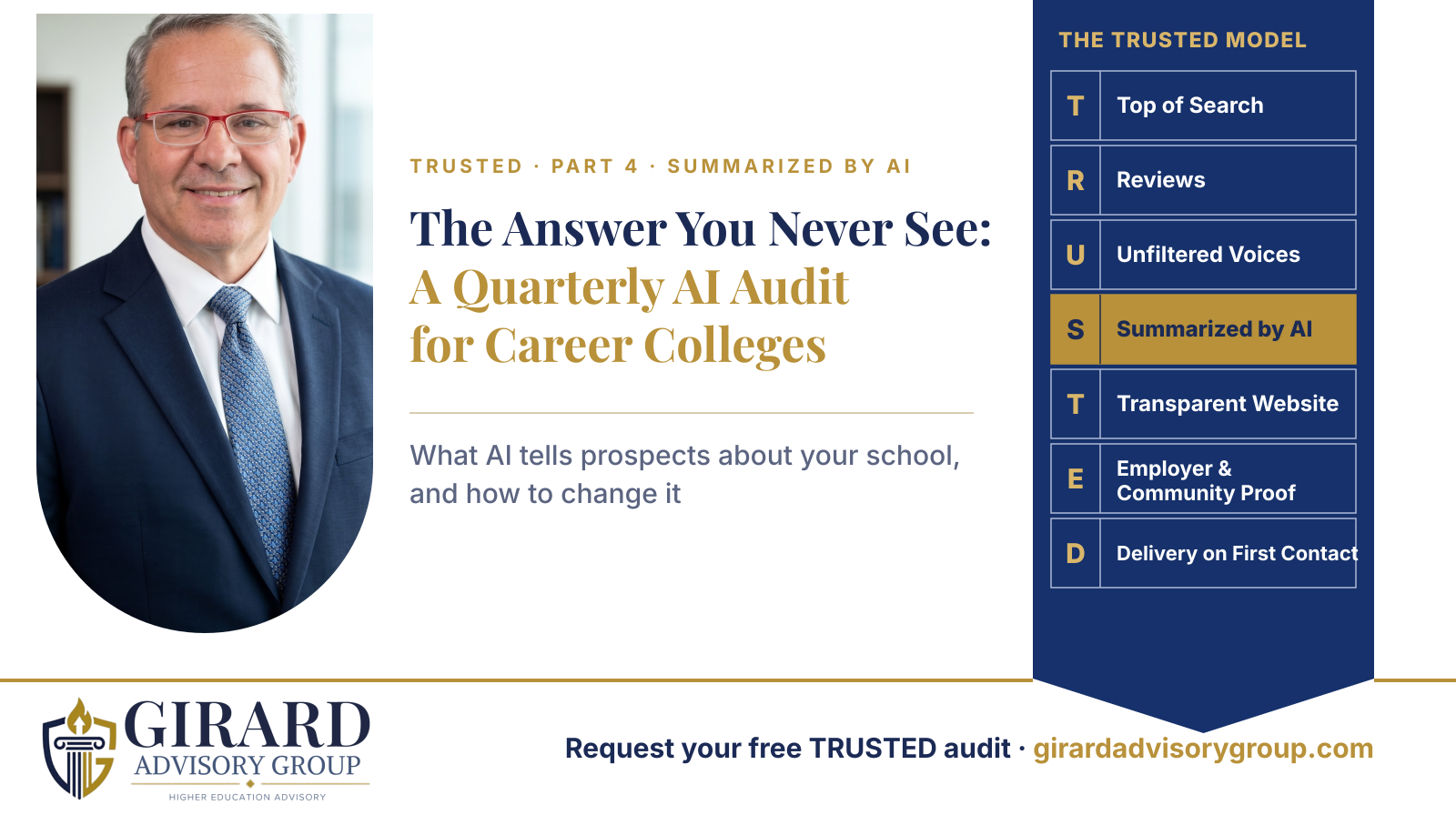
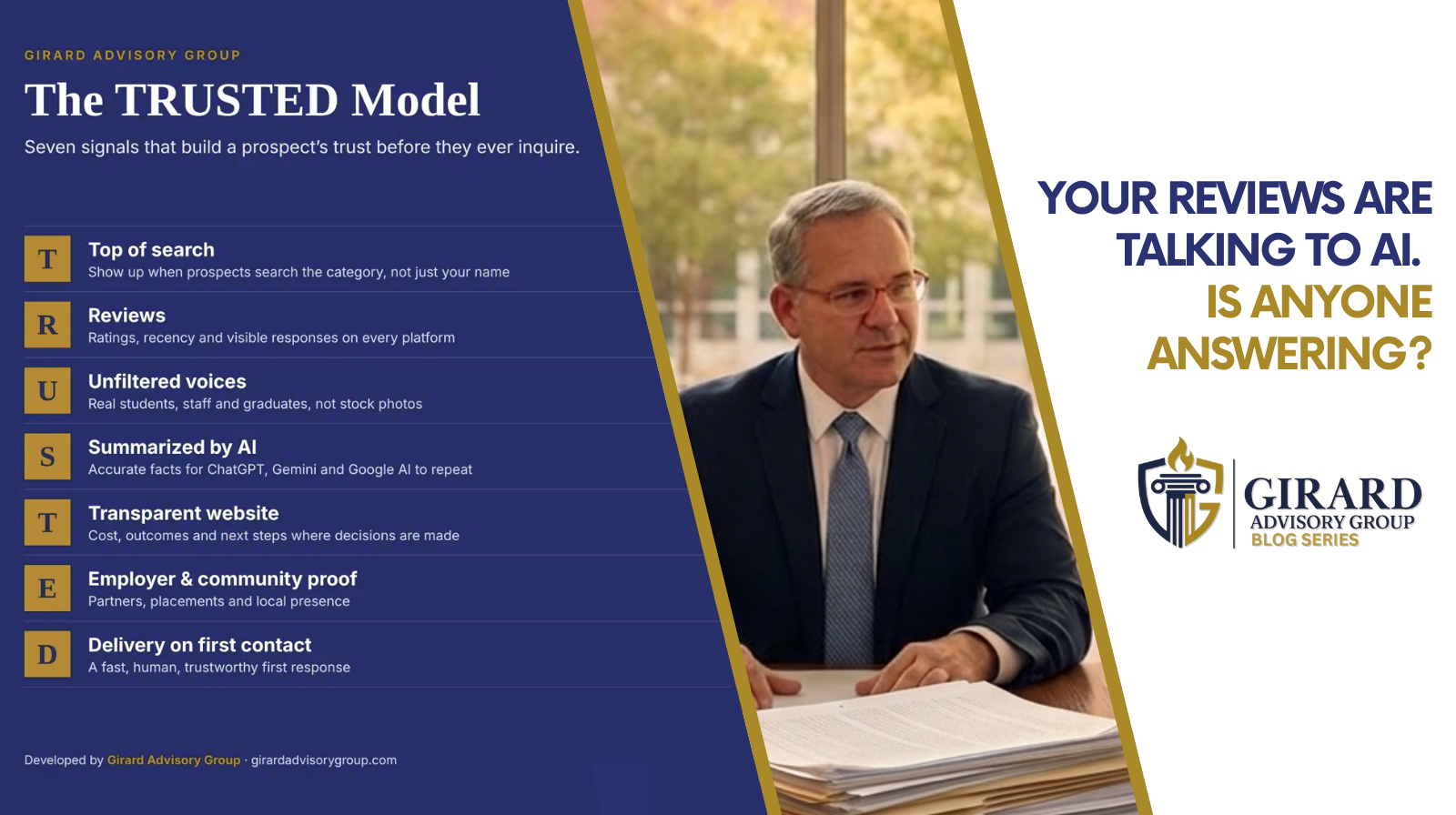
TRUSTED is a model developed by Girard Advisory Group to map the seven signals that build a prospect’s trust before they ever inquire. Reputation is not one signal. It runs through all seven, and this week’s reviews showed how the gaps compound.
| TRUSTED signal | What prospects see when no one owns it |
|---|---|
| Top of search | Aggregators, competitors, or an unrelated business with the same name |
| Reviews | Complaints standing alone, with no sign the school read them |
| Unfiltered voices | Forum threads and Q&A debates with no current student or staff voice |
| Summarized by AI | An AI answer built from your weakest platform and outdated facts |
| Transparent website | Prices and outcomes missing where decisions are made, so prospects go looking elsewhere |
| Employer & community proof | Strong partnerships that never show up beside the reviews |
| Delivery on first contact | A slow or suspicious-looking reply that confirms the doubts a review planted |
The last row is where reputation becomes real. One school texted back within two minutes, but its automated welcome email landed with a Gmail warning that it might be suspicious. Another had made no contact five minutes after the form was submitted. A prospect who just read an unanswered complaint is testing whether it is true, and your first response is the evidence.
A weekly reputation process any school can run
This does not take new software or a new hire. It takes a named owner and 60 minutes a week. At a seven-campus network I led marketing for, a routine like this lifted our average public ratings from below average to near the top of the scale.
- Name one owner. One person is accountable for every listing, every platform, every week. Campus directors respond; the owner makes sure it happens.
- Claim and correct every profile. Google, Yelp, Niche, Trustpilot, Indeed, Glassdoor and the BBB. Fix phone numbers, hours, photos and the school name. Old names and wrong numbers tell AI and prospects that no one is home.
- Respond within 72 hours. Every review, positive or negative. Thank the good ones personally, mentioning the program, not with a template.
- Take hard ones offline fast. For billing, records or safety complaints, reply publicly with empathy and a direct contact, then resolve it privately. Hard news gets the truth, the reason and the next step.
- Ask at the right moments. Request reviews at milestones students feel good about: passing a practical, finishing a term, graduating, getting hired.
- Answer the open questions. Where Q&A sections and forums debate your accreditation or licensing, post a clear, factual answer and link to the source page on your site.
- Test your own front door monthly. Submit an inquiry as a prospect. Time the first text, call and email, and check whether your email lands in the inbox or the spam folder.
- Ask AI what it thinks of you. Run the same five prospect questions through ChatGPT, Gemini and Google each month, and track what changes.
Who is answering for your school?
Every school in this week’s reviews had a better story than the one prospects were seeing. The fix was not a bigger budget. It was someone owning the conversation.
So ask your team three questions this week:
- Who owns our reviews, and when did we last respond to one?
- What does Google’s AI say about us right now?
- How long did our last inquiry wait for a human reply?
If you are not sure of the answers, Girard Advisory Group offers a free outside-in TRUSTED snapshot. We look at your school the way a prospect and an AI assistant do, and show you where trust is leaking before an inquiry ever reaches your admissions team. Contact us at girardadvisorygroup.com. The complete seven-surface model is documented on the TRUSTED Pre-Inquiry Framework page.
Sources
- Pew Research Center, ChatGPT use among U.S. adults, February 2026
- EAB survey of prospective students on AI in college search, reported by Inside Higher Ed, February 2026
- SparkToro zero-click search study, reported by Search Engine Land, June 2026
- Girard Advisory Group outside-in reviews of three colleges, October 2026 (schools not named)
Explore Topics
Written by
John P. Girard
John P. Girard is the founder of Girard Advisory Group and a thirty-year veteran of career and proprietary higher education, with hands-on leadership across enrollment growth, campus operations, accreditation and compliance, curriculum development, brand and marketing, and P&L management. Over three decades he has held roles spanning Campus Director, Campus President, Regional Campus Director, and National Director of Marketing & Digital Media Brand Management, leading multi-campus organizations through growth, accreditation, and operational turnarounds. That range — from the admissions floor to the boardroom — is what shapes his advisory approach: strategy that has to hold up in daily campus operations, not just on a slide. John holds a Master's degree in Teacher Education from the University at Albany, SUNY, and has served on the Board of the Ohio-Michigan Association of Career Colleges and Schools.