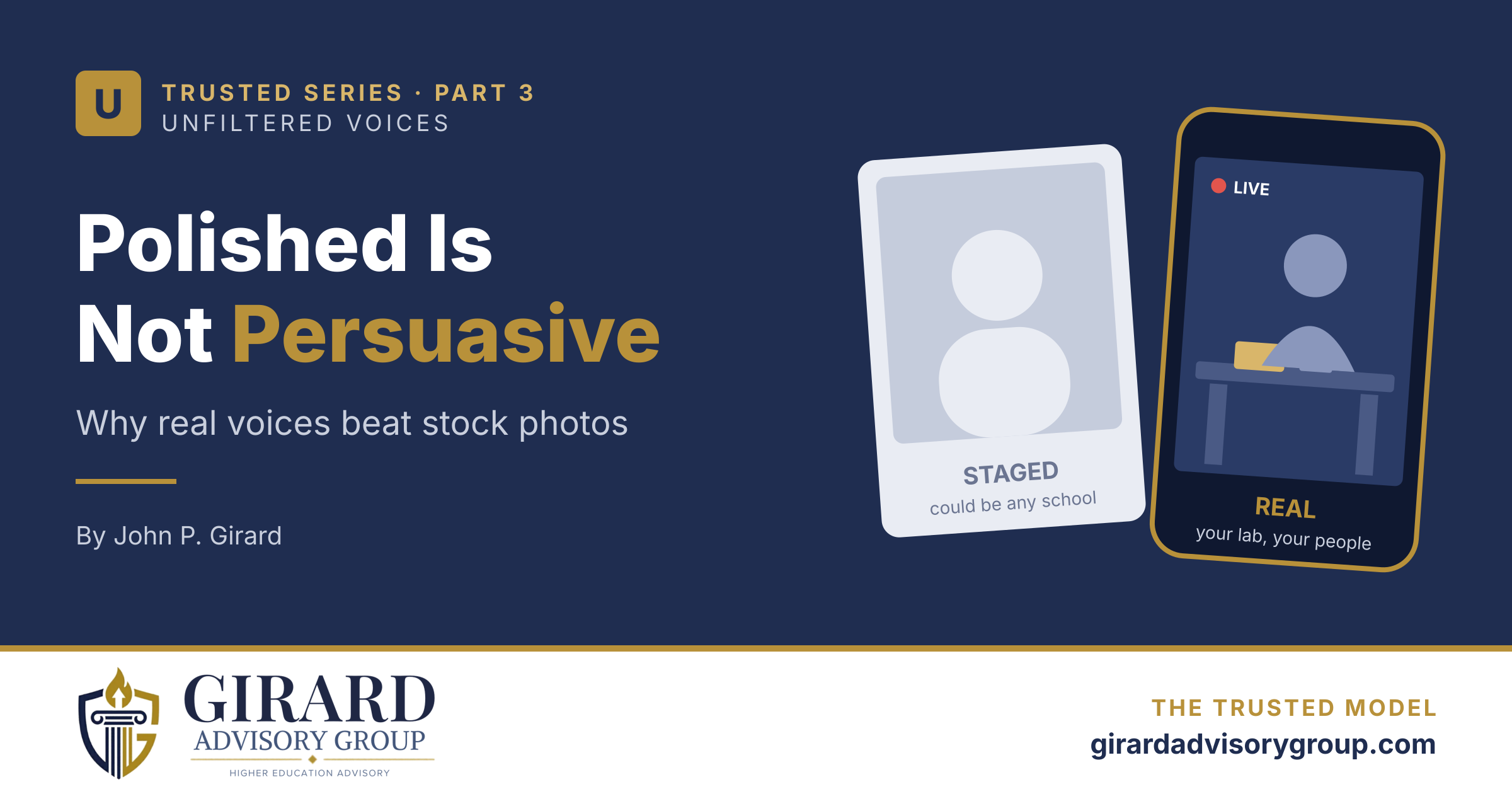
Polished Is Not Persuasive: Why Real Voices Beat Stock Photos

John P. Girard
Founder, Girard Advisory Group
Today’s prospects read too-perfect lighting and equipment arranged rather than used as a signal: they wouldn’t show me the actual place. In our sector, that is the worst message we can send.
I will start with a confession. For a stretch of my career, I chose polished over real. Clean stock photos of smiling students in spotless labs. Later, AI-generated images that looked even cleaner. The pages looked professional. They also looked like every other school’s pages, and the prospects we were trying to reach could tell in about a second.
Today’s prospective students have grown up inside a visual feed. They read too-perfect lighting, equipment arranged rather than used, and a room with no wear on it as a signal: they wouldn’t show me the actual place. In our sector, that is the worst message we can send, because our whole promise is that the training, the equipment, and the instructors are real, and you can drive over and see them.
Polished is not persuasive. Real is.
This is the third element of the TRUSTED model: Unfiltered voices. It means real students, instructors, graduates, and employers, on camera and in their own words, saying what the school is actually like. In Part 2, I covered reviews—the written verdicts of people who came before. This post is about the faces and voices behind them.
Prospects want to see the place, not be told about it
Video now does part of the job search engines used to do alone. A September 2026 survey of 1,518 U.S. adults researching or recently enrolled in a degree program, run by Grand Canyon Education, found that:
- TikTok and YouTube introduce students to new schools almost as often as search engines do (26% vs. 22%)
- 49% have added or removed a school from consideration because of something they saw on TikTok, YouTube, or Instagram
- Campus tours (41%) and day-in-the-life videos (39%) were the most useful formats, far ahead of polished admissions advice (17%)
- A recent graduate (29%) was the most trusted voice on the real student experience, ahead of an official student ambassador (15%)
- 46% trust content less when they learn the school paid or supported the creator
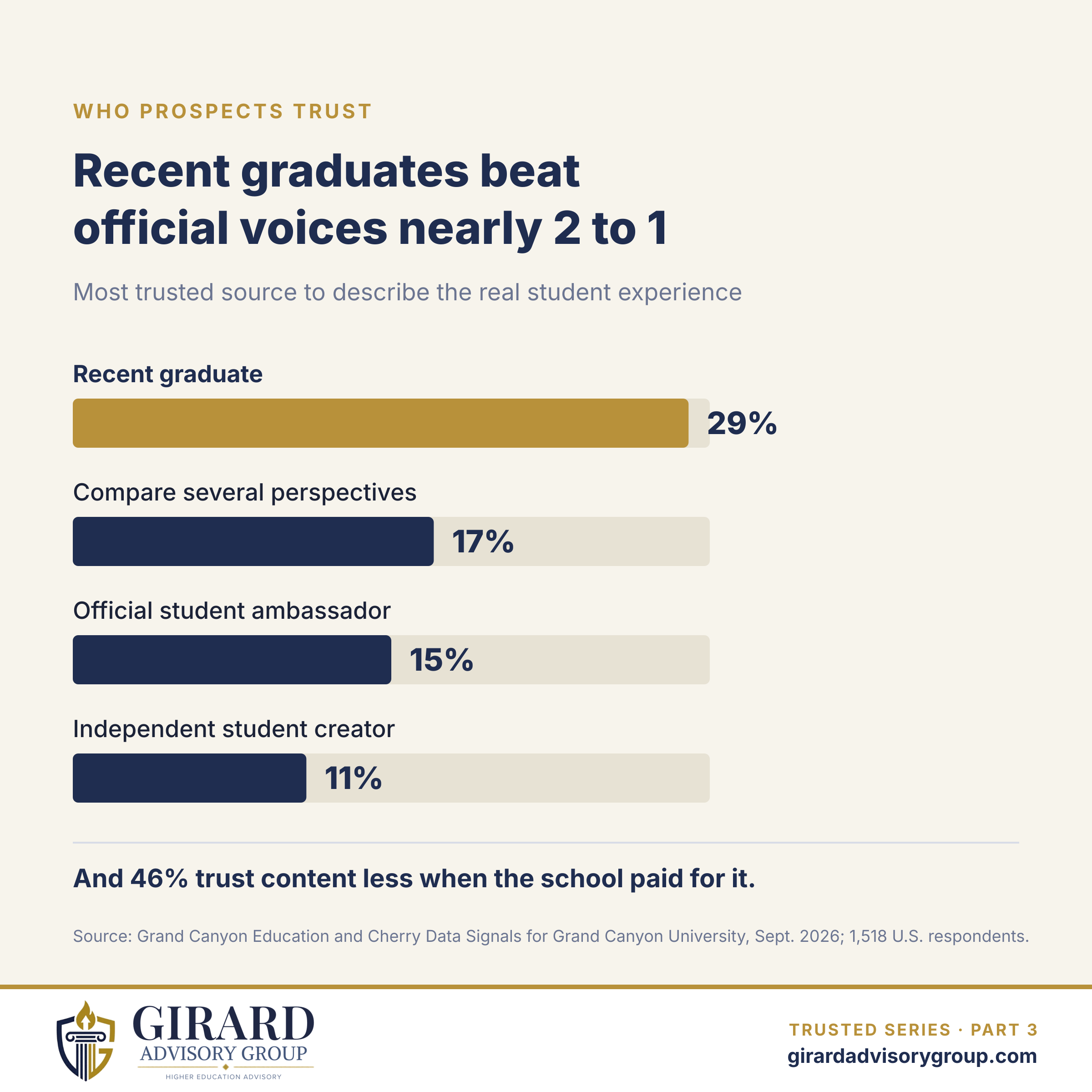
Read those last two together. Prospects are not just asking what the school looks like. They are asking who is talking, and whether that person has any reason to oversell.
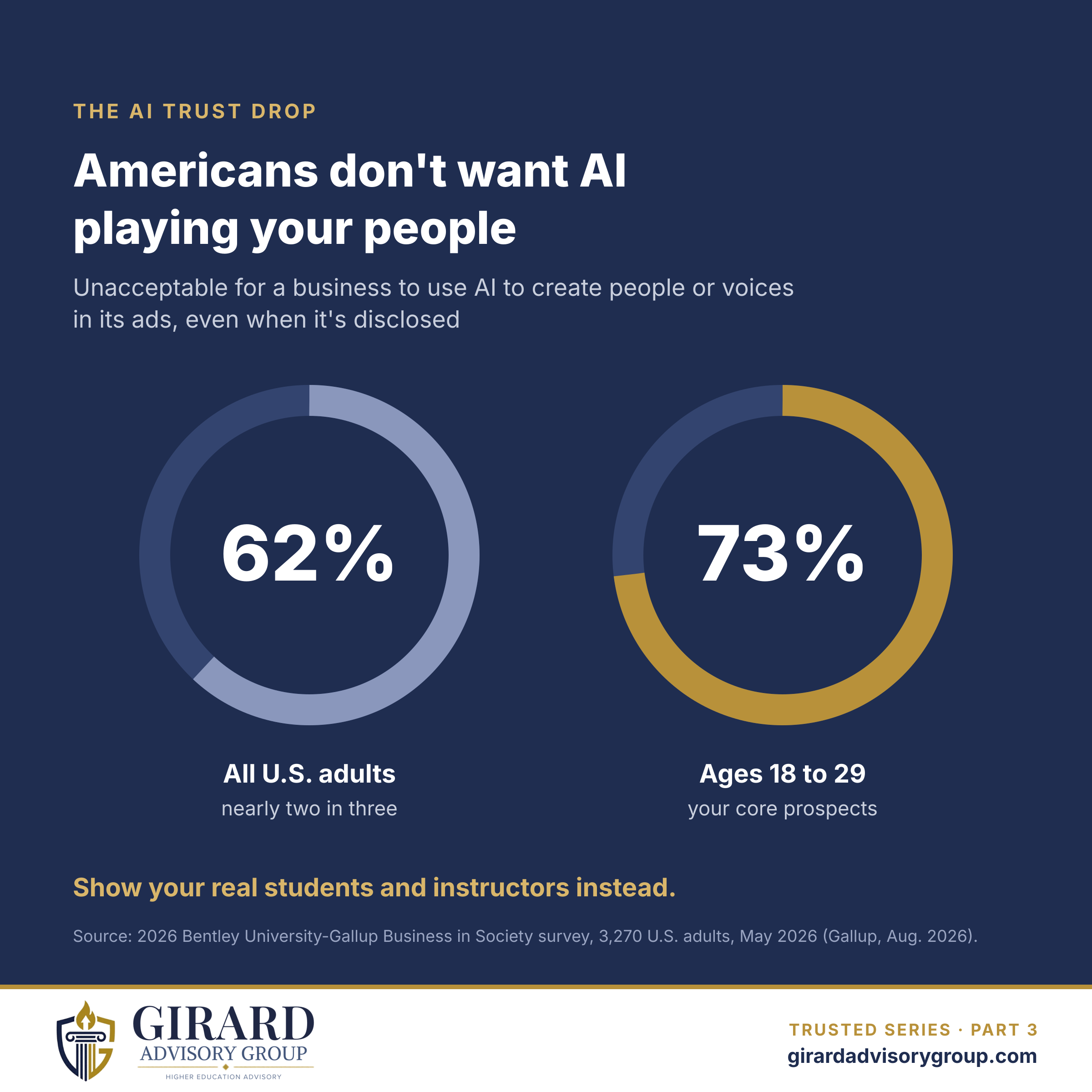
Polished and synthetic imagery now works against you. The 2026 Bentley University-Gallup Business in Society survey, a nationally representative study of 3,270 U.S. adults, found that 79% had recently seen ads that looked AI-made, and nearly half (49%) view businesses’ use of AI in ads negatively. Nearly two in three (62%) say it is unacceptable for a business to use AI to create people or voices in its ads, even when it discloses it. Among 18- to 29-year-olds—the core of most career colleges’ prospect pool—that rises to 73%.
Real people move them to act. In a national study of 2,000 Gen Z Americans by Walr for Talker Research, customer reviews (72%) ranked well above brand advertising and brand social media (57% each) as credible sources. “Seeing real people talk about it” was the second-biggest reason they would engage with a brand (35%), behind only clear, useful information.
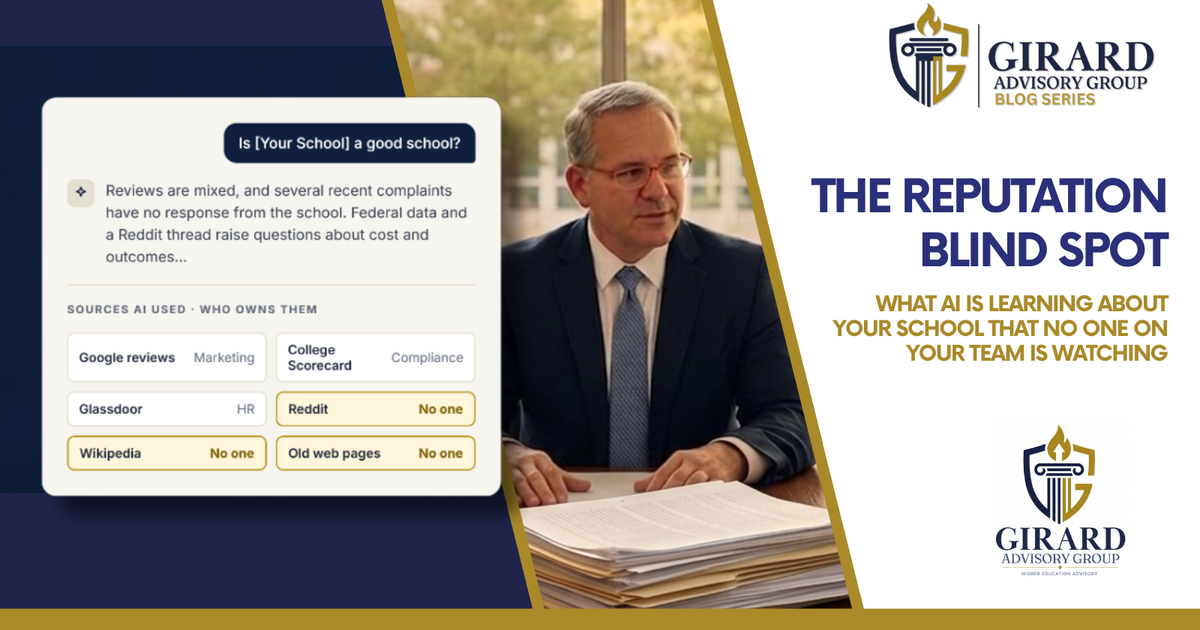
AI tools are listening, too. When a prospect asks an assistant what a school is really like, the answer draws on video titles, transcripts, captions, and the community posts around them—not only your website. A library of real student and instructor video, with honest titles and accurate captions, gives those tools something true to quote. An empty channel leaves them to quote someone else. (Part 4 of this series, Summarized by AI, goes deeper on that.)
What good looks like: eight formats that earn trust
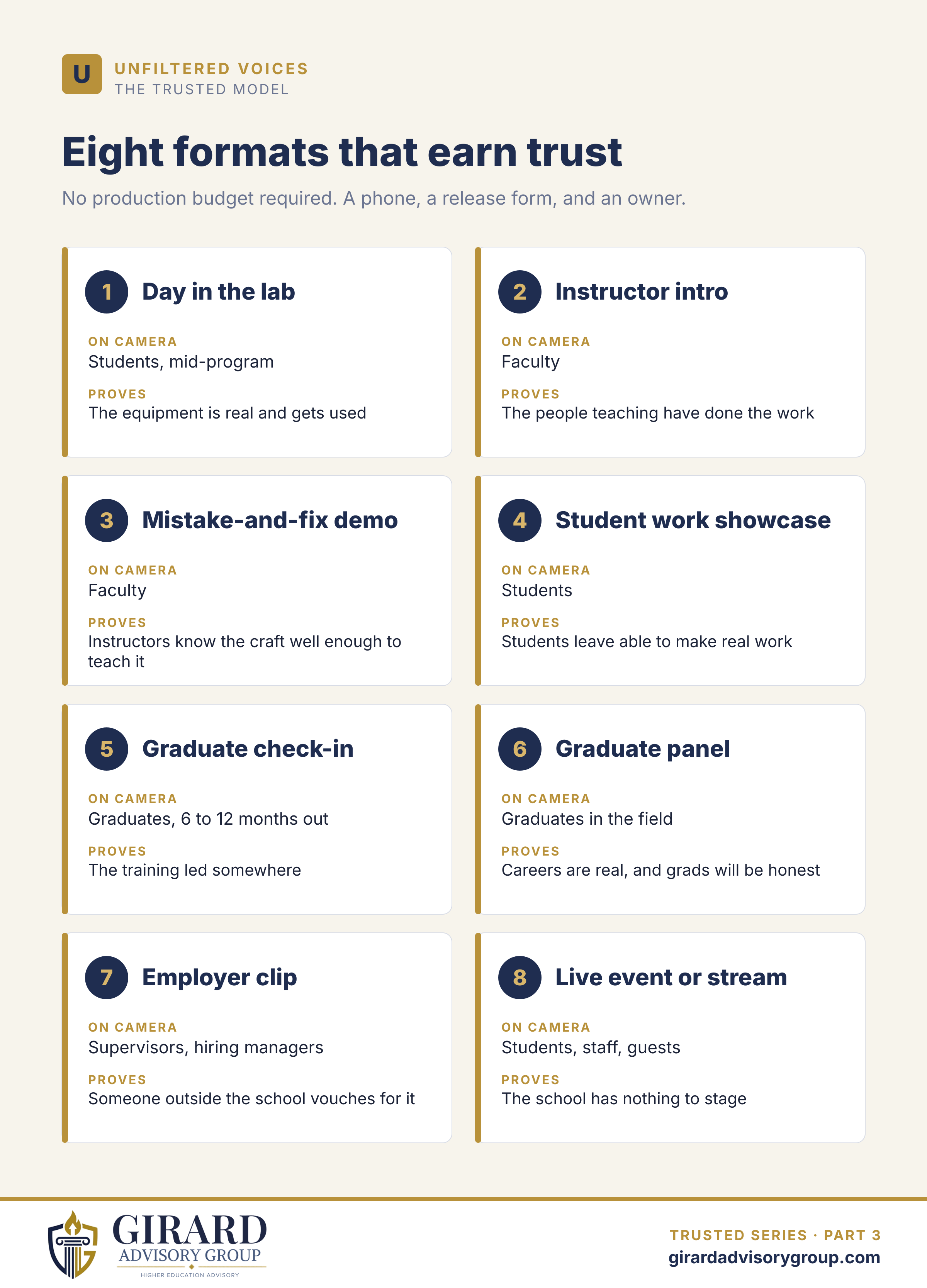
None of these needs a production budget. They need a phone, a release form, and someone who owns the calendar.
| Format | Who’s on camera | What it proves |
|---|---|---|
| Day in the lab, shop, or studio | Students, mid-program | The equipment is real and students actually use it |
| Instructor intro | Faculty | The people teaching have done the work |
| Mistake-and-fix demo | Faculty | Instructors know the craft well enough to teach it |
| Student work showcase | Students | Students leave able to make real work |
| Graduate check-in | Graduates, 6 to 12 months out | The training led somewhere |
| Graduate panel | Graduates working in the field | Careers are real, and graduates will be honest about them |
| Employer or externship-site clip | Supervisors and hiring managers | Someone outside the school vouches for it |
| Live event or livestream | Students, staff, guests | The school has nothing to stage |
1. Shoot the real place. Actual students, in your actual labs, using your actual equipment, on a normal day. A slightly cluttered bench and a student who is concentrating instead of posing do more persuasive work than any produced spot. Keep clips short and vertical for social, and post the longer cut to YouTube.
2. Put instructors on camera. For a career college, faculty with industry experience are one of the strongest proof points you have. A 60-second intro, where an instructor says where they worked and what they will hold students to, answers a question every prospect is asking: will the people teaching me know the field?
3. Follow your graduates. A short check-in from a graduate on the job, ideally filmed at the workplace with the employer’s permission, is the most believable content you can publish. It is also the voice prospects said they trust most.
4. Show the mistake, then the fix. Have an instructor demonstrate a common beginner error and how a professional corrects it. It teaches something useful in under a minute, and it proves expertise better than any résumé. It also tells prospects something reassuring: mistakes are expected here, and someone will show you how to fix them.
5. Showcase student work. Post finished projects, portfolios, and capstone presentations, with the student explaining what they made, what went wrong along the way, and what they would do differently. Real work, rough edges included, answers the question prospects care about most: will I be able to do this?
6. Put graduates on a panel. Record or livestream a conversation with three or four graduates working in the field. Let them talk about the job, the pay range in general terms, what the program prepared them for, and what it didn’t. Prospects trust recent graduates more than any official voice, and a panel lets them hear several at once. Then cut the strongest moments into short clips.
7. Get consent, then coach without scripting. Use a signed media release for every student, graduate, and guest, and confirm it with your compliance lead and your school’s FERPA directory-information policy. Then give people a prompt, not a script: “Tell me what you did in lab today” beats a memorized line every time. Retake for audio and light, never for polish.
8. Be upfront about student creators. If you pay or reward students to post, disclose it clearly, as FTC endorsement rules require. Then let them speak in their own words. Nearly half of prospects discount sponsored content, so the disclosure is a reason to keep the content honest, not a reason to skip it.
Where to post so it gets found. Put each clip where prospects and AI tools look: YouTube (with descriptive titles, a written description, and edited captions), TikTok and Instagram for discovery, your Google Business Profile, and embedded on the matching program page. A video that lives only on a staff member’s phone does nothing.
The voices you don’t control
Some of the most-watched content about your school was not made by your school. A student films a rant in the parking lot. A graduate posts a “was it worth it?” video. A Reddit thread asks whether you are legit. You cannot delete any of it, and you should not try.
The same Grand Canyon Education survey found that 52% of prospects have used or would use Reddit in their research, mostly to find honest student experiences and unexpected costs. But only 17% said negative comments would make them drop a school right away. Most said they would dig deeper or ask the school directly. That is an opening, if someone is paying attention.
- Find it. Once a month, search TikTok, YouTube, Instagram, and Reddit for your school’s name, your campus city, and your top program. Note what comes up and who posted it.
- Fix the real issue first. If a student video is about a real problem, the answer is operational before it is public. Route it to the campus director the same way you would route a fair complaint in a review.
- Respond like a person, or not at all. Where a reply makes sense, it comes from a named staff member, it is short, and it offers a direct way to talk. Never argue, and never discuss a student’s records in public. Sometimes the best response is no comment at all, plus more real content of your own.
- Make the honest version easy to find. The strongest answer to one unflattering video is twenty true ones. Prospects compare sources. Give them more real voices to compare.
From the field: let the instructors say it
At a seven-campus network where I led marketing, our social feeds used to sound like every other school’s: program features, start dates, and images that could have come from anywhere. The strongest proof we had—instructors who still work in the industry—barely showed up.
So we rebuilt the content around them. Each campus featured its own working-pro instructors, by name, with their real industry backgrounds. Then we built a series around “the note”: the one piece of feedback an instructor gives every student, written in that instructor’s own voice. It was the kind of line a working pro says in the room, not something a marketing team would write.
We did the same for students with “Day One”: scene-by-scene posts showing what a new student actually does before lunch on the first day, built around a real student’s name and photo instead of a stock smile.
What made it work was specificity a prospect could check. A named instructor, a real career, a line of feedback in their own words, a real student in the real room. That answers the question every prospect is quietly asking—will the people teaching me know the field?—better than any produced spot can. It also broke my own habit of reaching for clean stock and AI-generated images, which looked fine in review meetings and did little in the feed.
Score yourself: Unfiltered voices
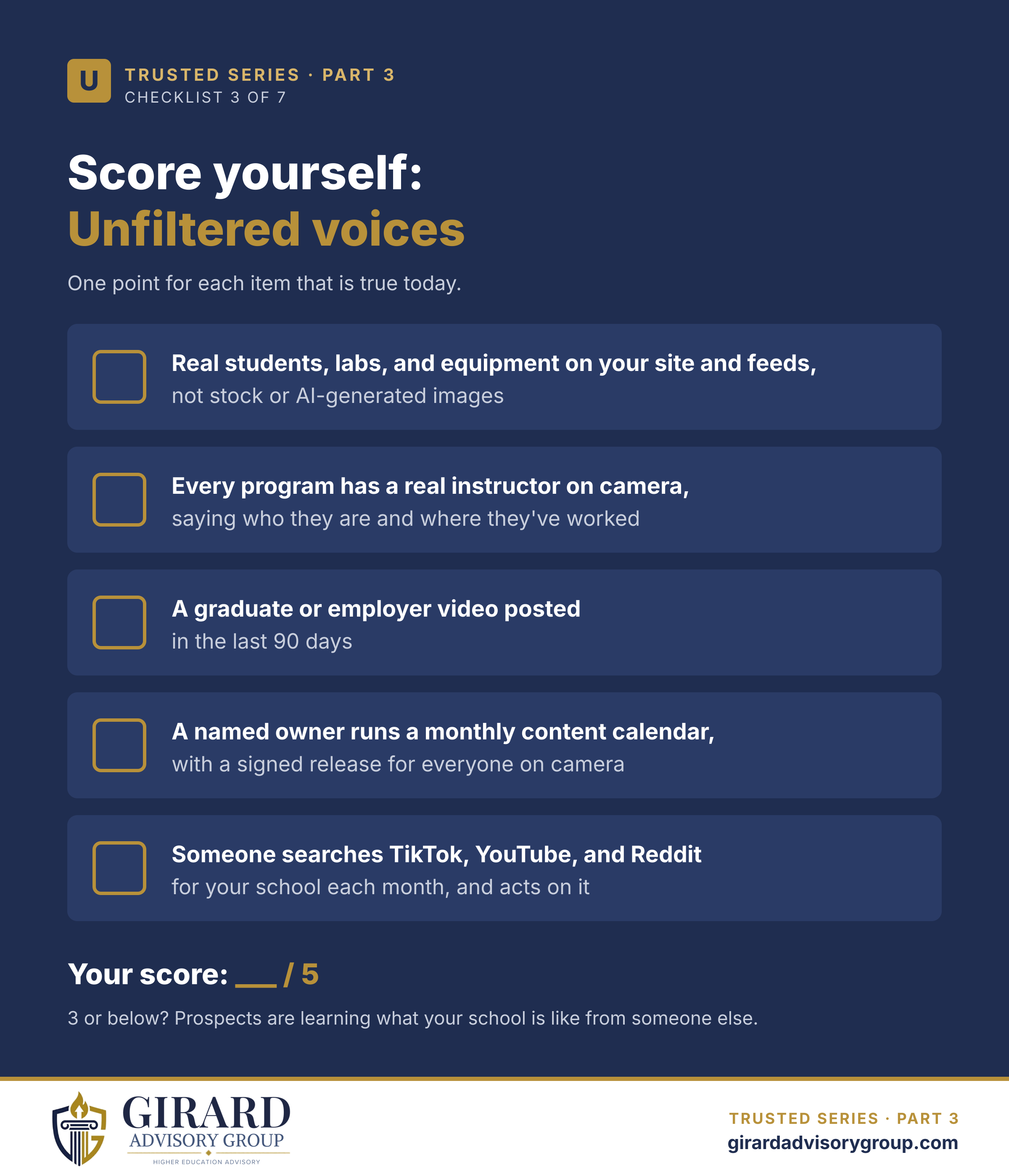
Give your school one point for each item that is true today. This is the third of seven checklists in the TRUSTED series.
- ☐ Your website and social feeds show your actual students, labs, and equipment, not stock or AI-generated images
- ☐ Each program has at least one real instructor on camera, saying who they are and where they have worked
- ☐ You have posted a graduate or employer video in the last 90 days
- ☐ A named person owns a monthly content calendar, and every person on camera has a signed release
- ☐ Someone searches TikTok, YouTube, and Reddit for your school’s name each month, and acts on what they find
Your score: ___ / 5. A score of 3 or below usually means prospects are learning what your school is like from someone other than you.
Show them the real place
The instinct to polish is understandable. Nobody wants the clutter, the bad lighting, or the student who stumbles over a sentence. But prospects are not grading production value. They are asking whether this place is real and whether the people in it will tell them the truth.
So give them the real place: your students, your instructors, your graduates, and the employers who hire them, in their own words. Do it every week, not once a year. That is how a school earns trust from people it hasn’t met yet, and how it gives AI tools something true to repeat.
Next in the series: Summarized by AI, and how to run a quarterly audit of what AI assistants are telling prospects about your school. You can follow all seven elements on the TRUSTED framework page.
Want to know what prospects see before they ever inquire? Girard Advisory Group offers a free TRUSTED audit: an outside-in review of what prospects find before they ever inquire, with specific, prioritized fixes. Reach out at jpg@girardadvisorygroup.com to request yours.
Frequently asked questions
Do we need professional video to compete? No. Prospects told researchers they want campus tours and day-in-the-life clips far more than polished admissions content. A phone, decent audio, and real people are enough. Save production budget for a few cornerstone pieces, if any.
Is it wrong to use stock or AI-generated images at all? Not always. They can work for backgrounds or abstract graphics. But for anything that claims to show your students, your labs, or your outcomes, use the real thing. That is where synthetic images cost you the most trust.
Can we pay students to create content? Yes, as long as the relationship is clearly disclosed, as FTC endorsement rules require, and the student speaks in their own words. Expect some prospects to discount sponsored posts, so balance them with unpaid graduate and employer voices.
What releases do we need? A signed media release for every person on camera, and a check against your FERPA directory-information policy for students. Confirm the form with your compliance lead before you start filming.
What should we do about a negative video a student posted? Don’t try to get it removed unless it breaks the platform’s rules. Fix the underlying issue, offer a named contact if a reply makes sense, and keep publishing honest content so prospects have more to compare.
Who should own unfiltered content at a school? Marketing can own the calendar, standards, and posting. But campus directors and program leads need to make faculty, students, and graduates available—the same way they own the weekly review target. The complete seven-surface model is documented on the TRUSTED Pre-Inquiry Framework page.
Sources
- Grand Canyon Education and Cherry Data Signals for Grand Canyon University, How AI, Social Media and Reddit Are Reshaping the Way Students Choose a College (Sep 2026; 1,518 U.S. respondents)
- Gallup, Americans Aren’t Sold on Businesses Using AI in Advertising (Aug 2026; 2026 Bentley University-Gallup Business in Society survey, 3,270 U.S. adults)
- Talker Research, Customer Reviews More Credible Than Influencers for Gen Z (Mar 2026; 2,000 Gen Z Americans)
Explore Topics
Written by
John P. Girard
John P. Girard is the founder of Girard Advisory Group and a thirty-year veteran of career and proprietary higher education, with hands-on leadership across enrollment growth, campus operations, accreditation and compliance, curriculum development, brand and marketing, and P&L management. Over three decades he has held roles spanning Campus Director, Campus President, Regional Campus Director, and National Director of Marketing & Digital Media Brand Management, leading multi-campus organizations through growth, accreditation, and operational turnarounds. That range — from the admissions floor to the boardroom — is what shapes his advisory approach: strategy that has to hold up in daily campus operations, not just on a slide. John holds a Master's degree in Teacher Education from the University at Albany, SUNY, and has served on the Board of the Ohio-Michigan Association of Career Colleges and Schools.